Service details from AccessAble's own 2026 article and Disability Horizons' explainer. Coverage and re-verification figures are AccessAble's published claims.
What AccessAble is, and why it is different from reviews
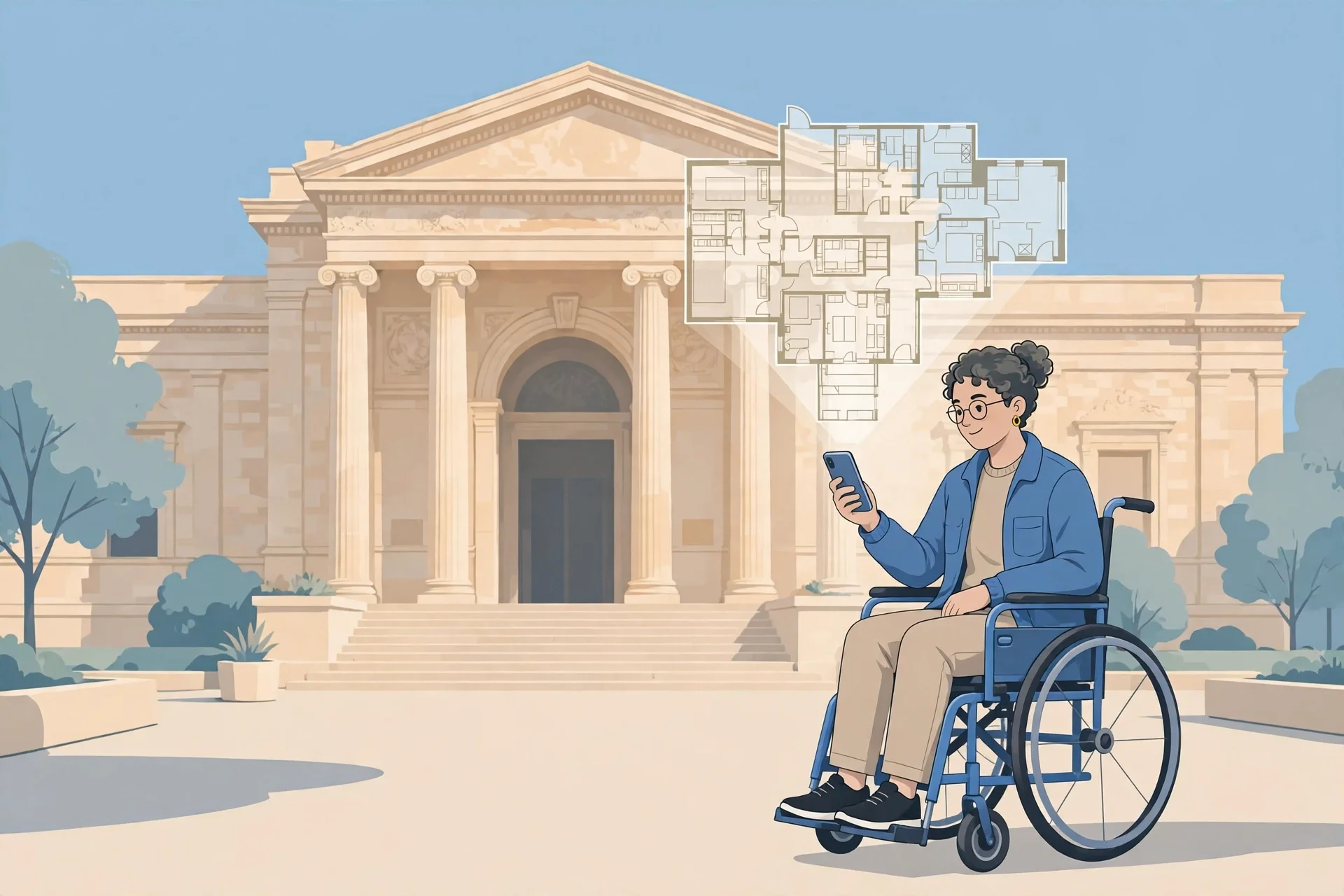
AccessAble is a UK service that sends trained surveyors to visit venues in person and record accessibility in detail – door widths, step counts, hearing loops, accessible toilets, parking bays, background music levels – hundreds of data points per venue, checked before publication on the website and app, which are free for everyone to use. The organisation works with hospitals, universities, local authorities, hotel groups and tourist attractions across the UK; its surveyors work every week from Belfast to Suffolk, Bristol to Glasgow, collecting the information disabled people and carers say matters. The crucial distinction is that these are factual guides, not reviews or ratings. A guide does not tell you a venue is 'good' or 'wheelchair friendly'; it tells you the accessible entrance has a 12 cm threshold, the lift measures 110 × 140 cm, and the accessible toilet is 40 metres from the main hall – and you decide whether that works for you. That objectivity is the point: what is accessible for one person is not accessible for another, so the guide supplies the raw facts and leaves the judgement to the reader. AccessAble says its surveyors collect hundreds of pieces of information per visit and take hundreds of photographs every day, because accessibility information is not a nice-to-have but essential. And the maintenance behind the guides is serious: every year the organisation contacts more than 70,000 venues to check whether their access has changed, and where it has, surveyors go back and re-check before the guide is updated. No guide stays perfect forever, but a system that re-verifies at that scale is meaningfully different from a venue's own access statement written once and never updated – which is what most of us are otherwise relying on. The scale behind the guides is worth appreciating, because it explains why they are trustworthy in a way venue-written access statements are not. AccessAble's surveyors are trained specifically in access auditing, they visit in person rather than relying on venue self-reporting, and the data is checked before publication – a chain of custody for facts that a 'we have disabled access' line on a venue website simply does not have. The organisation has been doing this since 2000 and reports over 125,000 venues surveyed, which makes it the largest structured dataset of UK venue accessibility in existence. When you read a guide, you are reading the output of that pipeline, not one person's afternoon with a tape measure.
How to read a Detailed Access Guide in visit order
Open a guide and work through it in the order you will experience the visit, which is how it is structured. Start with getting there: parking (how many accessible bays, how far from the entrance, the surface and any gradients), drop-off points, and the route from the car park or station to the entrance – the part of the trip that venue websites most often skip. Then the entrance itself: which entrance is step-free, door widths, whether doors are automatic, powered or manual, and any intercom or buzzer you need to use to get in. Inside, the guide walks the route you will actually take: reception or ticket desk height, corridors, lifts (dimensions and which floors they serve), seating, and the location and layout of accessible toilets, including turning space, grab rails and emergency cords. Look for the measurements that matter to your specific chair and body: door and lift widths against your chair's width, thresholds against your ground clearance, counter heights against your reach, and distances if pushing range is a factor. The photographs are part of the data, not decoration – use them to sanity-check descriptions, especially of entrances and toilets, where a single image often reveals what text cannot convey about the real-world tightness of a space. Many guides also include easy-read versions and quick summaries if you want the essentials without the full detail, and each venue's accessibility symbols give you the at-a-glance picture before you dive in. The habit to build is reading the guide before you commit to the trip, not after you arrive: the entire value of the service is moving the accessibility questions from the day of the visit – when the answers are hardest to act on – to the planning stage, when they cost nothing. Pay particular attention to the sections of a guide that venues themselves tend to gloss over: the accessible toilet detail (is it actually accessible, or a standard cubicle with a grab rail?), the distance from parking to entrance (fifty metres uphill is a different proposition from fifty metres flat), and the availability of seating along the route for people who can walk short distances but not long ones. These are the details that decide whether a visit works, and they are exactly the details a venue's own marketing copy omits. If the guide flags something as a tight fit for your chair, believe the measurement over your optimism – the guide was written with a tape measure, your optimism was not.
Using symbols, filters and a free account to plan faster
AccessAble's 33 accessibility symbols are the fastest way to filter for your needs without opening every guide. They cover categories including step-free access, accessible toilets, hearing loops, facilities for assistance dogs, quiet or safe spaces, and companion or carer discounts, and they were designed in consultation with disabled people to flag the information that most affects whether a visit works. On the website or app, you can filter search results by the symbols that matter to you – for example, showing only venues with step-free access and an accessible toilet within a given area – instead of reading dozens of guides to find the three that fit. Creating a free account lets you save your accessibility preferences so searches are pre-filtered automatically, and save individual guides to return to later, which is useful when planning a multi-stop day out or comparing shortlisted venues. The guides also extend beyond the obvious day-out categories: AccessAble covers hotels, B&Bs, glamping sites and self-catering accommodation with detail on accessible rooms, dining options and on-site parking – the accommodation search being one of the trickiest parts of any trip – and has guides for major UK airports including Bristol, Gatwick, Manchester and Belfast, plus a partnership with a major travel brand on guides for hotels abroad, handy when the trip involves a flight and a foreign hotel in the same itinerary. If you travel with companions, the companion-discount symbol and the assistance-dog facilities symbol answer two questions that venue websites routinely bury three clicks deep. The practical workflow: filter by your symbols, shortlist two or three venues, read the full guides for the shortlist in visit order, and save the winner to your account – twenty minutes that replace an afternoon of phone calls. The app deserves a specific mention for day-of-visit use: with your preferences saved, you can pull up the guide for the venue you are standing outside, check the entrance you need, and navigate straight to it – which beats standing in the rain reading a venue's homepage. Download the guides for your planned stops before you leave, in case signal is poor at the venue. And if you find something has changed – the lift is out, the entrance is different – report it; the re-verification system depends partly on user feedback flagging what needs a re-survey, and your report improves the guide for the next person.
The limits: what a guide cannot do for you
A guide is a snapshot, and snapshots age – this is the honest caveat that belongs in any guide to guides. AccessAble's annual re-verification programme is strong, but a lift can break the morning of your visit, a venue can rearrange its furniture, temporary works can close the step-free entrance, and a guide updated eleven months ago cannot know. For high-stakes visits – a hospital appointment, a wedding, a first day at a new job, a long-planned holiday – use the guide to know exactly what to ask, then confirm the two or three critical facts with the venue directly; the guide makes that phone call five minutes instead of fifty, because you are verifying specifics rather than starting from zero. Second, guides describe the venue, not your journey between venues: the accessible restaurant is only useful if the pavement route to it works for you, so pair venue guides with your own route knowledge or a mapping tool. Third, a guide cannot capture staff attitudes or the quality of assistance on the day, which is where reviews and disabled-community word of mouth still earn their place – use the factual guide for the physical facts and community sources for the human ones, and you will rarely be surprised by either. Finally, remember the guides are UK-focused; travelling abroad, look for the equivalent national services where they exist, or fall back on contacting venues with a specific, measurement-based question list – door width, step count, lift dimensions, toilet layout, parking distance – modelled on what an AccessAble guide would tell you. Used this way, the guides do exactly what they promise: they take the chance out of going out, replacing hours of phone calls with twenty minutes of reading, and leaving you free to enjoy the part of the trip that was supposed to be the point. One more use case that is underappreciated: use the guides proactively when choosing between options, not just to validate a choice you have already made. Comparing three hotels on their actual accessible-room layouts, or three restaurants on their real entrance situations, routinely reverses the initial favourite – and the comparison takes minutes with the symbols and measurements in front of you. The guides are at their most powerful as a decision tool rather than a confirmation tool. Build the habit of checking before you shortlist, and the number of accessibility surprises in your life drops sharply.