Skip to content
HomeNewsair travel
News / AIR TRAVEL

Dubai Airport Trials Self-Driving Wheelchairs for Faster Gate Transfers

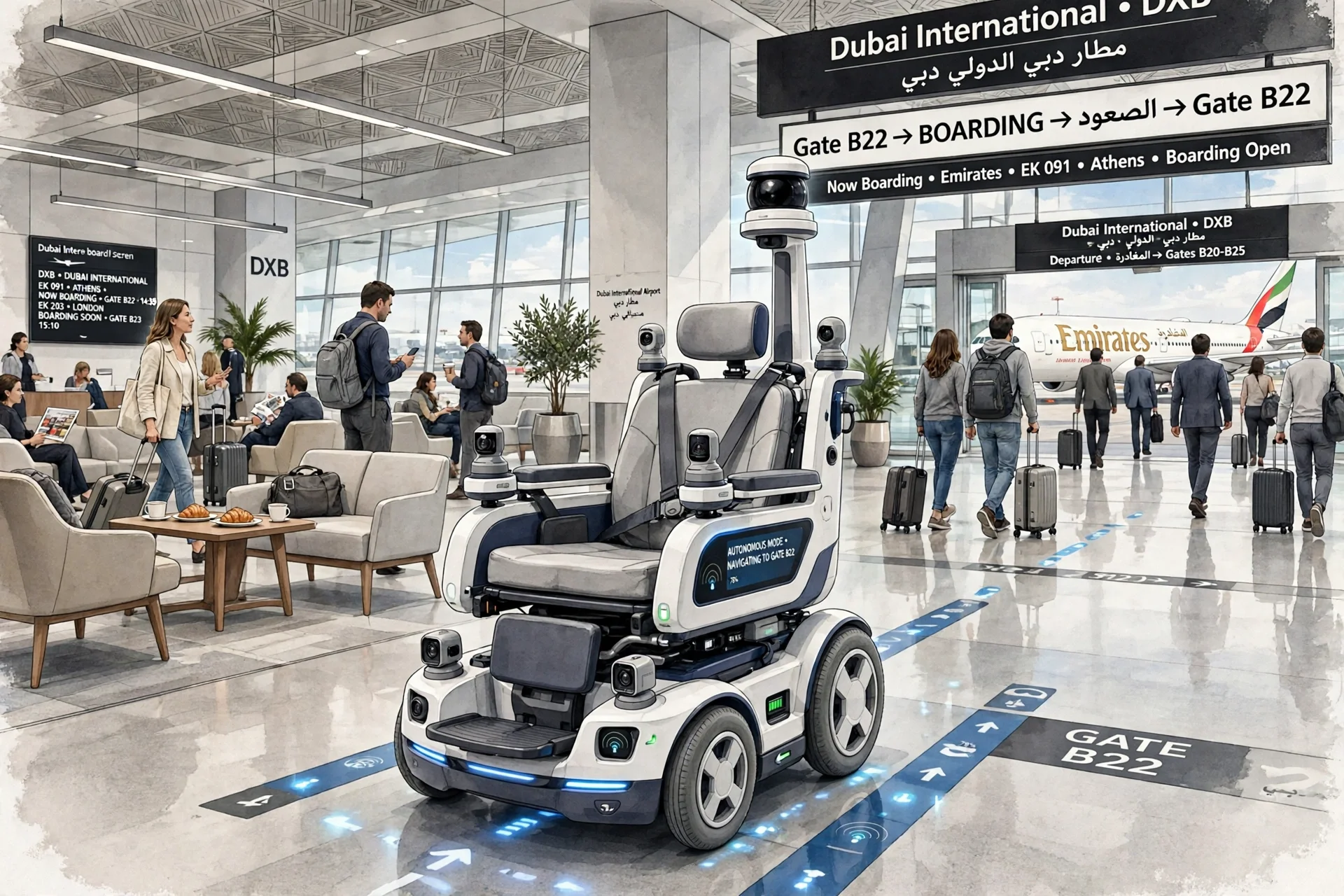
Airport services company dnata has begun trialling a self-driving wheelchair at Dubai International's Terminal 1 D concourse: the chair uses four LiDAR cameras to carry passengers from the lounge to the boarding gate, with manual override available at any moment. dnata describes it as a potential future service with no confirmed launch date, and says the trial could expand to Terminal 3. The announcement came with new hardware — three ambulifts, 24 custom-built accessible shuttle buses and stackable power wheelchairs — and new figures on the scale of dnata's accessibility operation.

Dubai Airport Trials Self-Driving Wheelchairs for Faster Gate Transfers

Illustration of an autonomous self-driving wheelchair with LiDAR sensors moving through a bright airport terminal toward the boarding gate.

Trial and fleet upgrades announced at AccessAbilities Expo 2026, 19 October 2026. dnata describes the self-driving wheelchair as a potential future service with no confirmed launch date.

How the trial works

The autonomous wheelchair is being tested in the D concourse of Terminal 1. Four LiDAR cameras map the surroundings as the chair travels from the lounge to the boarding gate, and staff can take manual control or stop the chair at any time. dnata is careful about expectations: it calls the project a potential future service rather than a launch, gives no date for wider use, and says only that an expansion to Terminal 3 is under consideration. For passengers, the key point is that the trial does not change how assistance is booked today — it is an experiment running alongside the existing staffed service, not a replacement for it.

New equipment joining the fleet

The trial was announced together with a hardware refresh. dnata has added three new ambulifts — the lifting vehicles that raise passengers with reduced mobility to aircraft door level — and 24 custom-built accessible shuttle buses designed to carry passengers together with their personal mobility aids. Three stackable power wheelchairs have also been introduced, a practical addition for peak periods when standard airport wheelchairs run short. Taken together, the message is that dnata is investing in both experimental technology and the unglamorous equipment that determines day-to-day reliability.

The scale of the operation

dnata put numbers on its accessibility work for the first time in detail: it assists around two million passengers with accessibility needs at Dubai International each year, and more than 3,500 of its employees have completed hidden-disability training. The former “Special Handling” department has been formally renamed “Accessible Travel”, and hearing loop systems are now installed at ten service points across Terminals 1, 2 and 3. Those figures matter more than any single gadget: at an airport of DXB's size, the consistency of staffed assistance decides most journeys.

What it means for your next trip through DXB

If you are flying through Dubai soon, nothing about this announcement changes your planning. Book wheelchair assistance through your airline as usual — most airlines ask for at least 48 hours' notice — and confirm exactly where you will be met after landing. The autonomous chair is worth watching because the lounge-to-gate transfer is one of the weakest links in airport assistance worldwide, but until dnata sets a launch date, staffed assistance remains the service that counts.
Sources & further reading

Dubai airport tries self-driving wheelchair for quicker trip from check-in to plane – The Nationaldnata enhances accessibility services with fleet and technology upgrades – Air Cargo Update

Our editorial approach

CONTINUE EXPLORING

A little more useful reading.

Emirates Unveils New Accessible Travel Concepts at AccessAbilities Expo 2026NEWS

Emirates Unveils New Accessible Travel Concepts at AccessAbilities Expo 2026

At AccessAbilities Expo 2026 in Dubai (19–21 October), Emirates presented three accessibility concepts still in development: a cabin familiarisation experience for blind and low-vision passengers, an accessible lounge suite with a powered lift-and-swivel seat, and a height-adaptive biometric boarding gate. The airline also confirmed upgraded self-service kiosks at Dubai Terminal 3 and said its autism travel rehearsal programme has now run 80 sessions across six continents, benefiting more than 400 families.

Read the story
ICAO Unveils New Global Accessibility Strategy for Air TravelNEWS

ICAO Unveils New Global Accessibility Strategy for Air Travel

The UN aviation agency ICAO has unveiled a new global accessibility strategy for air travel, announced at a joint ICAO/ACI/IATA symposium in Montreal on 14–15 October 2026. Backed by a 2025 ICAO Assembly resolution and due for Council approval in January 2027, it is the first worldwide framework aimed at making the whole air journey accessible — including for travellers with non-visible disabilities.

Read the story
Airport Lounge Access for Wheelchair Users: A Practical GuideGUIDES

Airport Lounge Access for Wheelchair Users: A Practical Guide

Wheelchair users can generally use airport lounges, but getting in depends on the lounge's own entry rules, while moving around inside depends on that lounge's layout. At airports like London Heathrow, the official passenger-assistance team can escort you to the lounge when you book help at least 48 hours ahead. This guide explains which lounges welcome wheelchairs, how to arrange the escort, and what to check before you book.

Read the guide