Applies to US and foreign airlines operating flights to or from the United States under the Air Carrier Access Act, 14 CFR Part 382. Rule details from trade reporting citing the eCFR; passenger-rights guidance from the US DOT.
What took effect on October 2, 2026
Under 14 CFR 382.65, new single-aisle aircraft with an FAA-certified maximum seating capacity of at least 125 seats, delivered on or after October 2, 2026 and equipped with lavatories, must now carry an onboard wheelchair built to enhanced accessibility standards. The rule is part of a broader overhaul of accessibility requirements for wheelchair users under the US Air Carrier Access Act, and it applies to both US and foreign airlines operating flights to or from the United States. The October date is a compliance milestone, not a suggestion: aircraft delivered from that day onward must have the upgraded equipment on board. To help carriers work out whether the requirements apply to their fleets, the onboard-wheelchair maker Airchair has launched a free online compliance assessment that takes airlines about two to three minutes to complete. The company developed the tool after finding that some airlines flying narrowbody aircraft with more than 125 seats into the US were still unaware of the changes.
What the new onboard wheelchairs must do
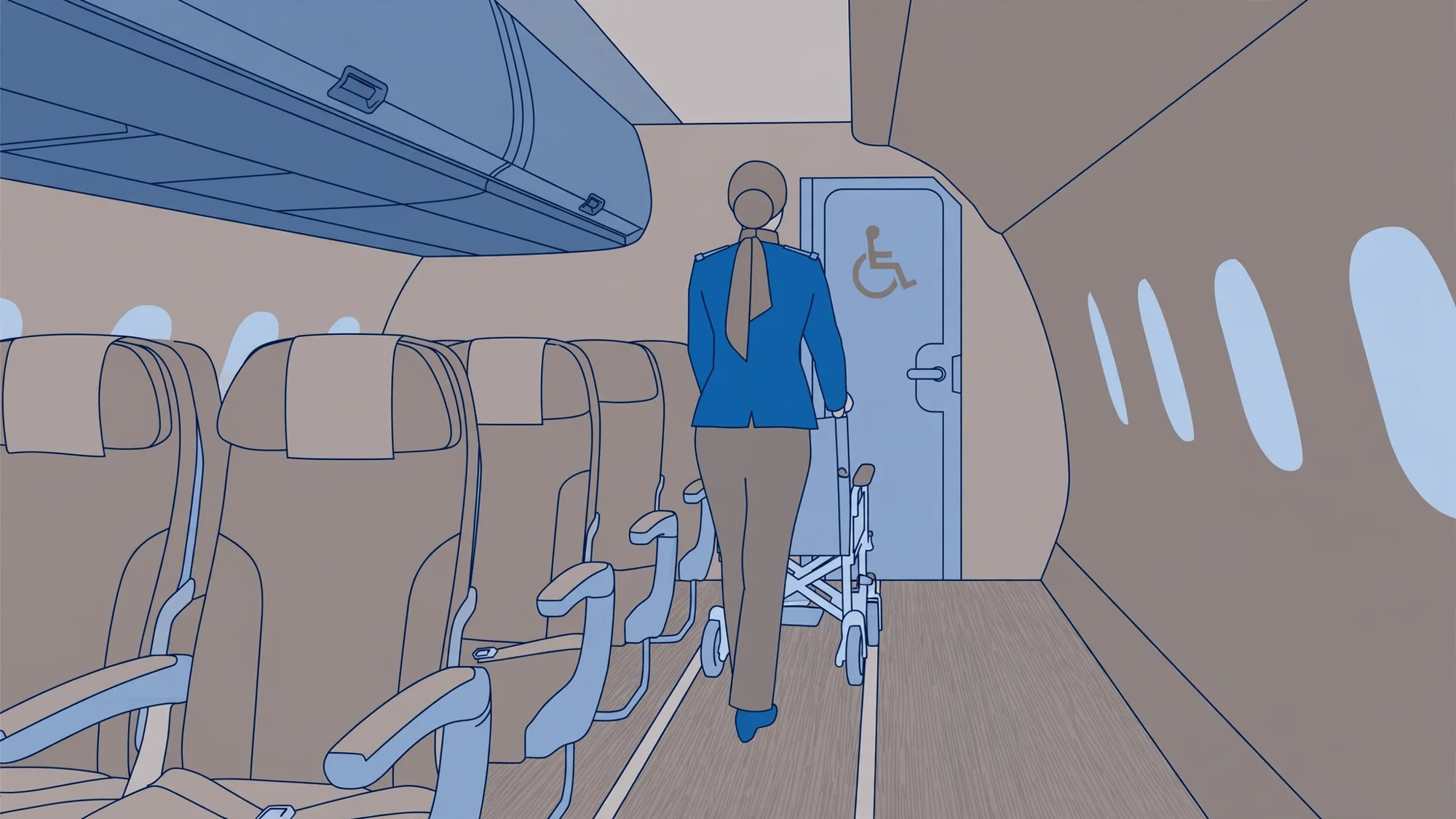
The upgraded standards target the moments wheelchair users find hardest in the cabin: transfers and reaching the lavatory. The chair must be manoeuvrable forward and backwards through the aisle by an attendant, its seat height must make transfers between the wheelchair and the passenger seat easier, and its wheels must lock securely during transfers. It must also have a padded seat and backrest, appropriate restraints, and repositionable arm and foot supports. Crucially, the chair must be capable of manoeuvring into an accessible aircraft lavatory so that a passenger can transfer to the toilet and the lavatory door can close. That last requirement addresses one of the most dignity-sensitive parts of air travel for passengers with reduced mobility. The US DOT already requires airlines to help passengers with disabilities move to and from aircraft lavatories on request, including with an onboard wheelchair where applicable; the new standards improve the equipment used to deliver that assistance.
The phase-in timeline to 2031
The October 2026 date is only the first step. Under a related DOT rule, after October 2, 2026, whenever an airline replaces an onboard wheelchair on an aircraft with a maximum seating capacity of 125 or more, the replacement must meet the new standards. After the same date, newly acquired onboard wheelchairs for aircraft with more than 60 passenger seats must also comply, where compliant equipment is available. By October 2, 2031, every onboard wheelchair provided for passenger use on aircraft with more than 60 seats must meet the enhanced standards. In practice, this means the fleet will turn over gradually: new aircraft and replacement chairs first, full coverage within five years. Passengers should not expect every aircraft to carry the upgraded chair immediately.
What this means for your next flight
For travellers, the change is behind the scenes rather than something to book or request. If you need assistance moving within the cabin or reaching the lavatory, ask the crew; airlines remain required to provide that help on request. The practical effect over time should be safer transfers, a chair that actually fits through the aisle, and a realistic chance of using the lavatory with the door closed. If you believe an airline has failed to provide required disability assistance, you can ask to speak to the airline's Complaints Resolution Official (CRO), who must be made available to you at no cost. When planning, remember the rule covers flights to and from the United States; on purely domestic routes in other countries, different national rules apply, so check with your airline before you fly.