Scope: FAAN's 8 Oct 2026 announcement and same-week Nigerian press reporting on MMIA accessibility works; equipment availability can vary by terminal and date.
In brief
- FAAN took delivery of two ambulifts for Lagos MMIA on 8 October 2026, with NACHO Aviation Services overseeing deployment; a ground-handling company added a third unit.
- The vehicles lift passengers who cannot use stairs directly to aircraft door height, replacing stair climbs and manual carries.
- Travellers should request PRM assistance from their airline well before flying through Lagos and allow extra time, especially in the December peak.
Two Ambulifts Delivered to MMIA on 8 October
On Thursday 8 October 2026, the Federal Airports Authority of Nigeria (FAAN) announced on its official X handle that it had taken delivery of two ambulifts for Murtala Muhammed International Airport (MMIA) in Lagos, Nigeria's busiest international airport. The announcement marked a visible step in the airport's effort to make boarding and disembarking easier for passengers with reduced mobility.
The delivery was formalised in a handover ceremony. Keys to the two vehicles were presented to NACHO Aviation Services by FAAN's Director of Airport Operations, Capt. Abdullahi Mahmood. NACHO Aviation Services, an established ground-handling and aviation services provider in Nigeria, will oversee the deployment and operation of the ambulifts at the airport.
FAAN's messaging around the delivery was deliberate. The authority said the ambulifts would help passengers with reduced mobility board and disembark aircraft with greater safety, dignity and efficiency. That choice of words matters: boarding assistance is one of the moments in a journey where a wheelchair user's experience depends most heavily on the equipment and people around them, and it is where dignity is easiest to lose. FAAN framed the new vehicles as part of a broader programme of passenger-facilitation improvements at the airport rather than a one-off purchase.
Reporting in the same week added context that puts the delivery in a wider picture. According to Realnews Magazine, FAAN's Managing Director, Mrs Olubunmi Kuku, said the authority had acquired two AmbuLifts and that a ground-handling company had provided one more, which means three of the vehicles are now available for operations at the airport. Kuku also pointed to terminal upgrades already under way at MMIA, including ramps, accessible elevators, dedicated wheelchair routes, and flight information displays with both audio and visual output.
She also offered practical advice tied to the calendar: with the December peak travel period approaching, travellers were advised to arrive three to four hours before departure. The combination of new boarding equipment, ongoing terminal accessibility work and an early-arrival advisory suggests FAAN is preparing MMIA for the year's heaviest travel weeks with accessibility explicitly on the checklist.
For passengers, the takeaway from the announcement is straightforward. Lagos's main international airport has increased its capacity to board travellers who cannot use aircraft stairs, the equipment has been formally handed to the operator responsible for running it, and the airport authority is publicly tying the move to passenger facilitation rather than treating it as an internal fleet matter.
What an Ambulift Does, and Who It Helps
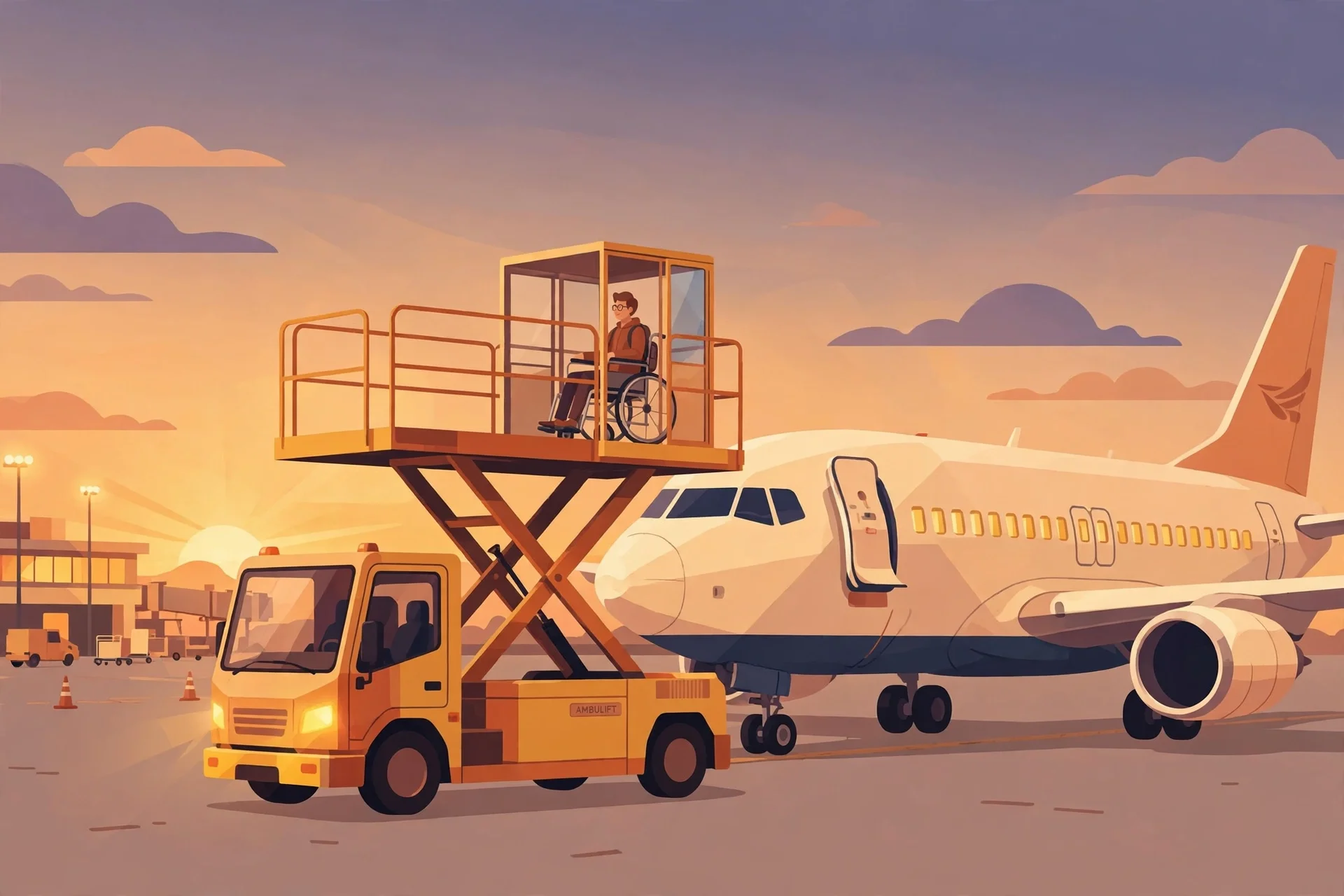
An ambulift is a specialist high-lift vehicle built for one job: getting passengers who cannot climb aircraft stairs on and off the plane. It carries an enclosed cabin on a hydraulic lifting platform. The vehicle drives up alongside the aircraft door, the cabin rises to door height, and the passenger boards directly at the same level as everyone else, without stairs, steep ramps or being carried.
The people who benefit most are wheelchair users, but the industry term FAAN used, passengers with reduced mobility (PRM), covers a wider group: older travellers, passengers recovering from injury or surgery, and anyone for whom a standard aircraft stairway is unsafe. For all of them, the ambulift replaces two things nobody should have to rely on: climbing stairs they cannot safely manage, and being manually lifted or carried by staff, a practice that is uncomfortable for the passenger and a safety risk for everyone involved.
Ambulifts are most valuable where aircraft park away from the terminal, at remote stands with no airbridge. Instead of a long carry up the stairs, the passenger waits in a weather-sheltered cabin that rises smoothly to the aircraft door. The enclosed cabin matters more than it sounds: boarding can take several minutes, and doing it shielded from sun, rain and the noise of the ramp is part of the dignity FAAN referenced in its announcement.
The vehicles are standard equipment at airports around the world, so their arrival at MMIA brings Lagos into line with common international practice rather than introducing an exotic new technology. What is new is local capacity: with three units now reported to be available, the airport can cover more flights and more terminals without the equipment becoming a bottleneck at peak times.
The ambulift delivery sits alongside the wider terminal upgrades described by FAAN's Managing Director: ramps, accessible elevators, dedicated wheelchair routes through the terminals, and flight information displays that combine audio and visual output so that deaf and blind travellers can follow departure information independently. Taken together, these measures address the whole journey through the airport, not just the boarding step. A smooth lift to the aircraft door helps less if the passenger cannot reach the gate comfortably, and the terminal works described suggest that part of the journey is being addressed too.
One point of terminology is worth noting for travellers reading airline communications. You may see these vehicles called ambulifts, ambu-lifts or high-lift boarding vehicles; they are the same category of equipment. And PRM, passengers with reduced mobility, is the standard aviation term for travellers who need boarding assistance, covering wheelchair users and others with mobility needs.
For the passenger, the practical difference shows up in the sequence of a typical assisted journey. After check-in, a PRM passenger is usually taken to the gate in an airport wheelchair, then transferred to an aisle chair for the final leg. Where an ambulift is available, that aisle chair rolls into the lift cabin, rises to the aircraft door, and the passenger transfers directly into their seat, with no stair climb in between; on arrival the process runs in reverse. Each transfer point is a moment where things can go wrong, so removing the stair segment entirely simplifies the whole chain. The December timing of the delivery is also significant: Nigeria's end-of-year travel peak brings heavy passenger loads, and having three units available means the airport can keep assistance moving when flight schedules are at their most compressed.
What to Do Before You Fly Through Lagos
New equipment only helps if it is booked for your flight, so the practical step for travellers is unchanged: arrange assistance in advance. Special assistance at airports is organised through the airline, which coordinates with the airport and its handling agents, so the request should start with the carrier, not the airport.
Contact your airline as early as possible, ideally at the time of booking, and describe your needs clearly: that you are a wheelchair user or otherwise unable to use aircraft stairs, and that you will need ambulift boarding and an aisle chair to reach your seat. Airlines and airports plan staffing and equipment around these requests, and early notice makes it far more likely the right equipment is assigned to your flight.
It is worth confirming the arrangement again in the days before travel, and asking specifically about equipment availability for your terminal. MMIA handles both international and domestic traffic, and equipment can differ between terminals, so a short confirmation call or message to the airline avoids surprises on the day.
Allow extra time at the airport. FAAN's Managing Director advised travellers to arrive three to four hours before departure during the December peak period, and passengers needing assistance should treat that as a minimum rather than a target: assistance teams work through a queue of flights, and arriving early keeps you near the front of it. Outside peak periods, the airline's own guidance on when to arrive still applies, with a margin added for the assistance process.
At the airport, head to the airline's check-in or the special-assistance desk and confirm that your PRM request is on the booking. Keep the airline's confirmation of your assistance request, such as a booking reference note or email, where you can show it quickly. If the assistance you were promised is not provided, ask to speak to the airline's duty representative at the airport and keep a written record of what happened, including flight number, date and the names of staff you spoke to, in case you need to follow up afterwards.
The bottom line for Lagos-bound travellers: the airport now has more boarding equipment than before, but it is the advance request to the airline that puts that equipment on your flight.