Applies to manual wheelchairs; camber angles and adjustment methods vary by chair design (folding vs rigid) and manufacturer. Educational overview only — not a fitting prescription. Sources verified from manufacturer and clinical pages on 2026-10-17.
What Camber Is
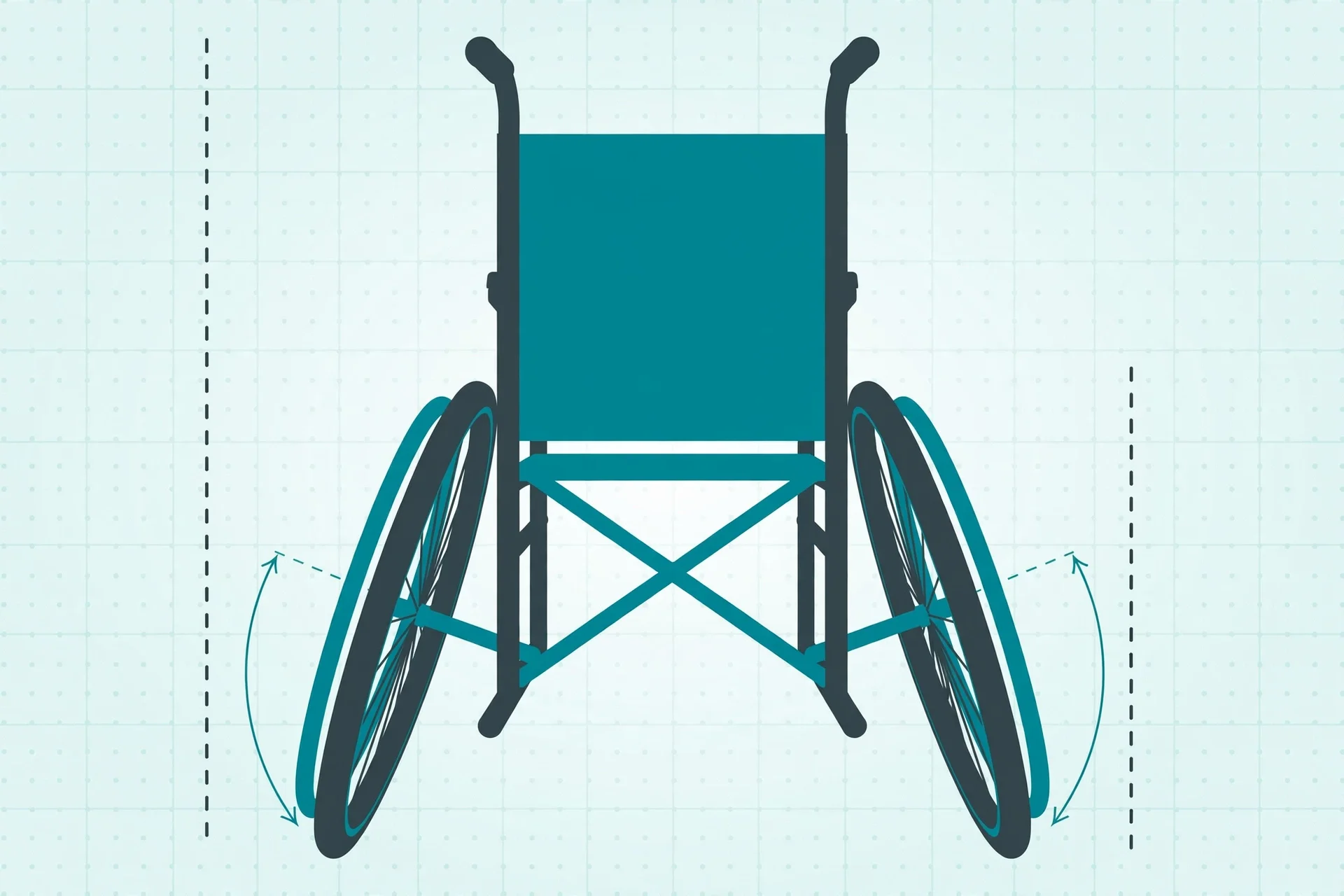
Camber is the angle of a wheelchair's rear wheels measured against the ground. When the tops of the wheels tilt inward toward the chair while the bottoms flare outward, the wheels have camber; when the wheels stand perfectly vertical, camber is zero. The angle is measured in degrees, and a higher number means more tilt. On manual wheelchairs, common camber settings range from 0 to 8 degrees, with most everyday chairs set between 0 and 3 degrees. Sports chairs go much further — 15 degrees or more is not unusual.
How camber is applied depends on the chair. Motion Composites explains that on customizable folding wheelchairs it is usually set through the axle plate or axle receiver, while on rigid wheelchairs it is built into the plugs that insert into the camber tube. Basic standard wheelchairs may not offer camber at all, which is worth knowing when you choose a mobility base. And once selected, camber is not a casual tweak: most changes require tools and possibly new parts.
What Cambered Wheels Do for You
There are real reasons wheelchairs have carried camber since athletes first introduced it to improve handling. Here is what the angled setup buys you:
- More sideways stability. Angling the wheels moves the contact patches farther apart, widening the chair's footprint at the ground. That wider base adds lateral stability, which helps on side slopes and during the quick side-to-side movements of active use. The Academy of Neurologic Physical Therapy's fitting guide notes that camber gives the wheelchair more upright stability and improves turning maneuverability. - Protected hands in tight spaces. With camber, the bottom of the wheel is the widest point of the chair, so if you brush a doorframe, the lower wheel meets the obstacle — not the top of the wheel where your hands are pushing. The ANPT fitting guide calls out exactly this benefit: camber protects the hands as they propel the wheelchair through narrow doorways. - Better propulsion mechanics. Bringing the tops of the wheels closer to your body moves the hand rims nearer to you, which can reduce how far your shoulders must reach outward and lower shoulder strain during pushing. Motion Composites describes a more natural push stroke — pushing down and out — when the hand rim sits in this position. - Quicker, livelier handling. Camber makes turning quicker and can sharpen acceleration, one reason sports chairs carry so much of it. - A smoother ride. Angling the wheels redirects some of the forces traveling up through the frame from the environment, making the ride feel less bumpy.
What Camber Costs
Every setup choice has a price, and camber is no exception. Here is what you give up for the angled wheels:
- Extra overall width. The trade-off for that stability is size: roughly 1 inch (2.54 cm) of added width for every 2 degrees of camber. The ANPT guide warns that too much camber makes the chair difficult to maneuver through tight spaces — narrow doorways and bathroom stalls are the classic problem spots. - Interference with other parts. Excessive camber can make the wheels rub against armrests, side guards, or the user. - Uneven tire wear and reduced traction. Angled wheels do not meet the ground the way vertical ones do, which can wear tires unevenly and reduce grip. - Not available on every chair. Basic standard chairs may not offer camber at all, and adjusting it later usually means tools and replacement parts.
One last note: camber is one of several setup choices, and it interacts with axle position, seat height, and backrest angle. Treat this article as education, not a prescription — an occupational therapist or assistive technology professional can help weigh the trade-offs for your body and your daily environments.