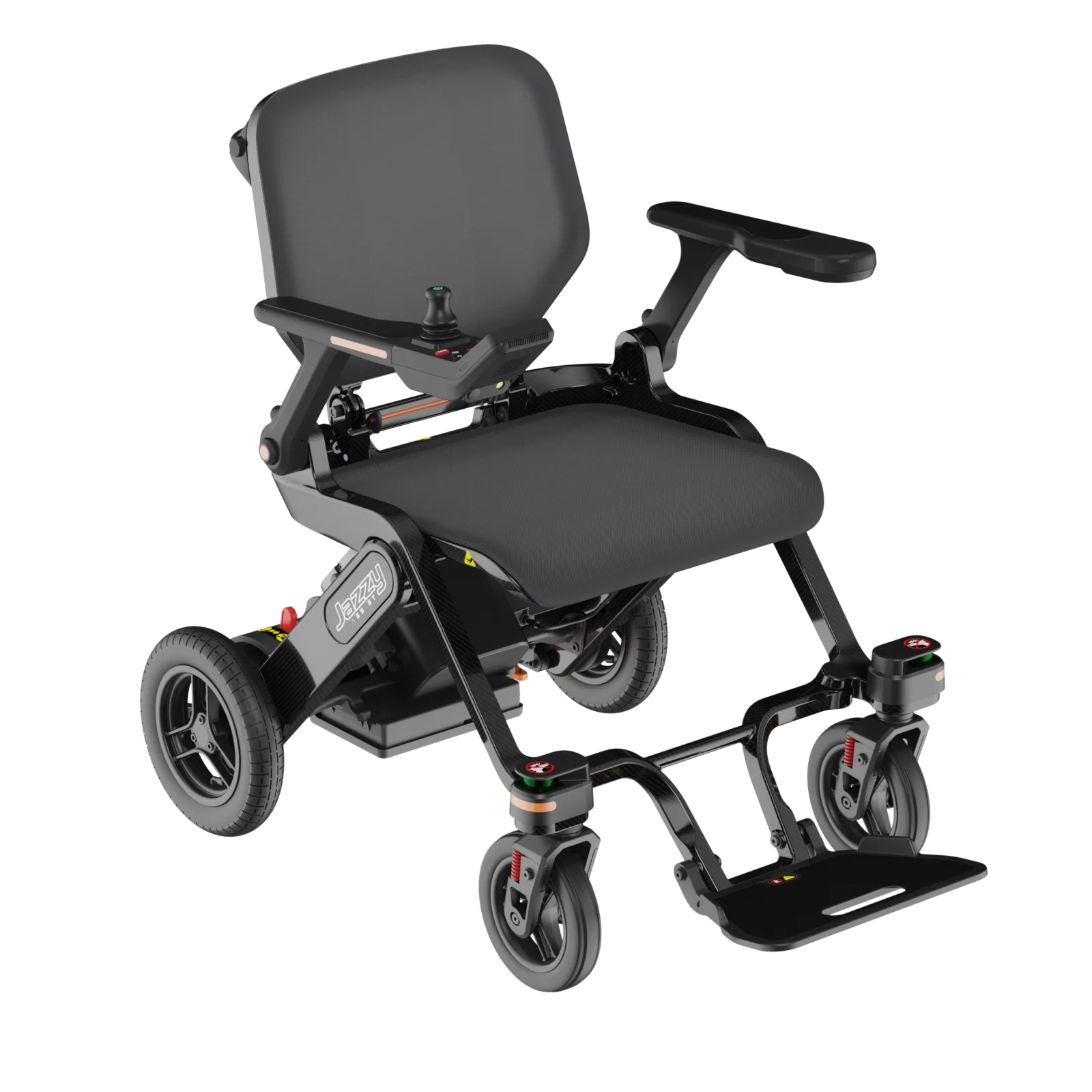
Specifications are from the manufacturers' and reviewer's pages linked below and apply to the SmartDrive MX2+ model described there; other models and regions may differ.
Three ways to add power to a manual wheelchair
A power assist device sits between a manual wheelchair and a full powerchair. It keeps your existing chair — its seating, its compact size, its ability to fit into a car boot — and adds motorised help for the parts of the day that cost the most energy: slopes, long corridors, thick carpet, headwinds, and the long push home when you are already tired. For many people the appeal is energy conservation as much as distance: arriving with something left in the tank for the rest of the day. There are three broad families of device, and they feel quite different in use. Rear-mounted units, such as the Permobil SmartDrive MX2+, attach a powered drive wheel behind the rear axle. You start the motor with a control, and it pushes the chair forward while you steer with your hands on the handrims, much as you would normally. They add relatively little bulk to the chair and are popular with people who want to keep a lightweight, foldable setup. Hub-based systems take a different approach: the standard drive wheels are replaced with motorised wheels that amplify every push you make. The feel is natural — you still push, but each push carries you further — at the cost of heavier wheels that you must lift for transport and that change how the chair folds. Front-mounted traction devices, sometimes called power add-ons, clamp onto the front of the frame, lift the small front castors off the ground, and pull the chair along. They excel on rough or outdoor terrain and give a confident ride over grass, gravel and uneven pavements, but they make the chair longer and are usually detached for car transport. Choosing between them comes down to honest questions about your own situation: how much upper-body strength and stamina do you have on a bad day, not just a good one; how much weight can you or your carer lift in and out of a car repeatedly; what surfaces do you travel on most days; and does the chair need to stay foldable for your lifestyle? Whatever type interests you, arrange a proper trial with a trained dealer before you commit. Several manufacturers, Permobil included, require certified dealer fitting and user training before a device goes home with you, and there is no substitute for feeling how a unit behaves on a slope, a kerb cut and a narrow doorway.
A closer look: the SmartDrive MX2+
The SmartDrive MX2+, made by Permobil, is one of the best-known rear-mounted units. A compact drive unit mounts on a bracket behind the rear axle of your manual wheelchair, and a small powered wheel — Permobil's air-free OmniWheel, which cannot puncture — drives you forward once activated. Permobil states that the device can reduce the number of pushes needed by up to 80 percent. Treat that as the manufacturer's own figure: it reflects their testing, and your real-world result will vary with terrain, total weight and how you use the device. Three control options have been offered over the product's life, and the differences matter. SwitchControl is a wired push-button control supplied as standard with every unit. It works in two modes — latched, where one press starts the motor and another stops it, and momentary, where the motor runs only while you hold the button — and it includes a mono jack socket so you can connect an external ability switch of your choice, which is important for users with limited hand function. PushTracker is the smartwatch control: paired with a compatible Apple Watch or Wear OS device, it lets you start the motor with a double tap on the handrim, hold a cruising speed with a single tap, and stop with a double tap followed by braking on the handrims. The third option, the SpeedControl Dial, is subject to an important safety notice. Permobil has voluntarily recalled the dial and instructs owners to stop using it immediately, cut its cord, destroy the dial, and contact the company for a free SwitchControl replacement. If you are buying second-hand, check which control the unit comes with and make sure no recalled dial is in the box. On specifications, the MX2+ is designed for users weighing between 30 and 331 pounds (14 to 150 kilograms), with the combined weight of user and chair not exceeding 351 pounds (159 kilograms). It fits 22, 24, 25 and 26 inch drive wheels. Top speed defaults to 4 miles per hour (6 kilometres per hour) and can be adjusted up to 5.5 miles per hour; the maximum rated slope is 10 degrees. Permobil rates the range at up to 12.3 miles, a figure measured with a 331-pound load — read it as an upper limit achieved in test conditions rather than a promise of everyday range, since hills, extra weight and stop-start use all bring it down. The drive unit itself weighs 13.2 pounds, or 14.4 pounds (6.5 kilograms) with the mounting hardware, and the magnetic charger refills the battery in around three hours. The device carries a two-year warranty. Independent long-term reviews add context that spec sheets cannot. A detailed review by Living Unlimited, drawing on extended real-world use, notes that attaching and removing the unit is not trivial for everyone: in a small six-person Swedish study the review cites, only one participant could manage it independently. That is a striking figure, but it comes from a tiny sample — treat it as a caution to trial the mounting yourself rather than as a verdict on the product. The same review describes a learning curve of roughly three months before the device feels second nature, and advises switching the unit off in situations where powered movement could surprise you: on downhill stretches, at kerbs and when moving on or off pavements, in tight indoor spaces, and during transfers in and out of the chair.
Before you buy: a practical checklist
Work through these checks with your dealer or therapist before money changes hands. 1. Get an individual assessment. A wheelchair service, dealer or occupational therapist can confirm whether a power assist device suits your strength, trunk control and the chair you already own — and whether a different type of device would serve you better. Bring your chair to the appointment, not just its measurements. 2. Confirm compatibility in detail. Check your drive-wheel size, frame type and the combined weight of you and your chair against the manufacturer's stated limits. For the MX2+, that means 22 to 26 inch wheels and 351 pounds all-in for user plus chair. 3. Trial it on your real routes. A showroom glide tells you little. Test mounting and removing the unit yourself, try your steepest regular slope, a kerb cut, a narrow doorway, and loading everything into the boot of your car. 4. Plan for transport weight. Rear-mounted units keep the chair compact, but the drive unit still has to be lifted in and out of vehicles and on and off the chair — be sure you or your carer can manage that day after day, not just once in a shop. 5. Learn the stopping drill. Know exactly how to stop the device quickly, and know when to switch it off altogether: downhill stretches, kerbs, confined spaces and transfers are the situations reviewers consistently flag. 6. Check which control you are getting. If you are considering a used SmartDrive, verify it comes with SwitchControl or the watch control, and confirm the recalled SpeedControl Dial is not included. 7. Ask about warranty and servicing. Find out who repairs the device near you, how long parts typically take, what the two-year warranty actually covers, and what a battery replacement costs when the time comes. 8. Budget for training time. Several manufacturers require certified setup and user training, and even after that, reviewers suggest allowing around three months to feel fully confident. 9. Keep expectations realistic. A power assist device reduces effort; it does not turn a manual chair into a powerchair, and manufacturer range and push-reduction figures are measured in test conditions. The right question is not how the numbers look on paper, but how the device feels on your hill, in your rain, at the end of your day. A device you trust is one you will actually use; a device that surprises you will end up sitting in a cupboard.