Guidance reflects manufacturer documentation for lead-acid/AGM wheelchair batteries; check your own chair's manual, as lithium-based models may differ.
Why Cold Weather Is Hard on Batteries
Low temperatures slow the chemical reactions inside a battery, so it holds less usable charge and takes longer to refill. The result is a noticeable drop in range on freezing days — the same trip that feels easy in summer can push the battery harder in winter. Permobil's official charging guidance recommends charging and storing at around 20°C, normal indoor temperature, because cold charging is slower and less efficient. AGM (absorbed glass mat) batteries are marketed as maintenance-free, but that only means they need no watering: they still need frequent, full charging to stay healthy. Repeatedly running the battery flat and recharging it in a cold garage is exactly the habit manufacturers warn against.
What the Manuals Actually Say
Permobil's official battery charging guide recommends charging for at least 8 hours every night, and notes that a fully depleted battery needs around 12 hours to refill completely. It also advises against using timer plugs that cut the charge short, since an interrupted charge never reaches full capacity. WHILL's Model C2 user manual gives precise temperature bands: storage from -15°C to 40°C, with the battery and charger stored between 0°C and 40°C and charging carried out within the specified temperature range. For chairs sitting unused, WHILL recommends fully charging first and recharging at least once a month; if the chair will sit unused for more than four months, remove the battery and check it every three months. Both manufacturers agree on storage conditions: indoors or under cover, protected from rain and damp.
A Practical Winter Routine
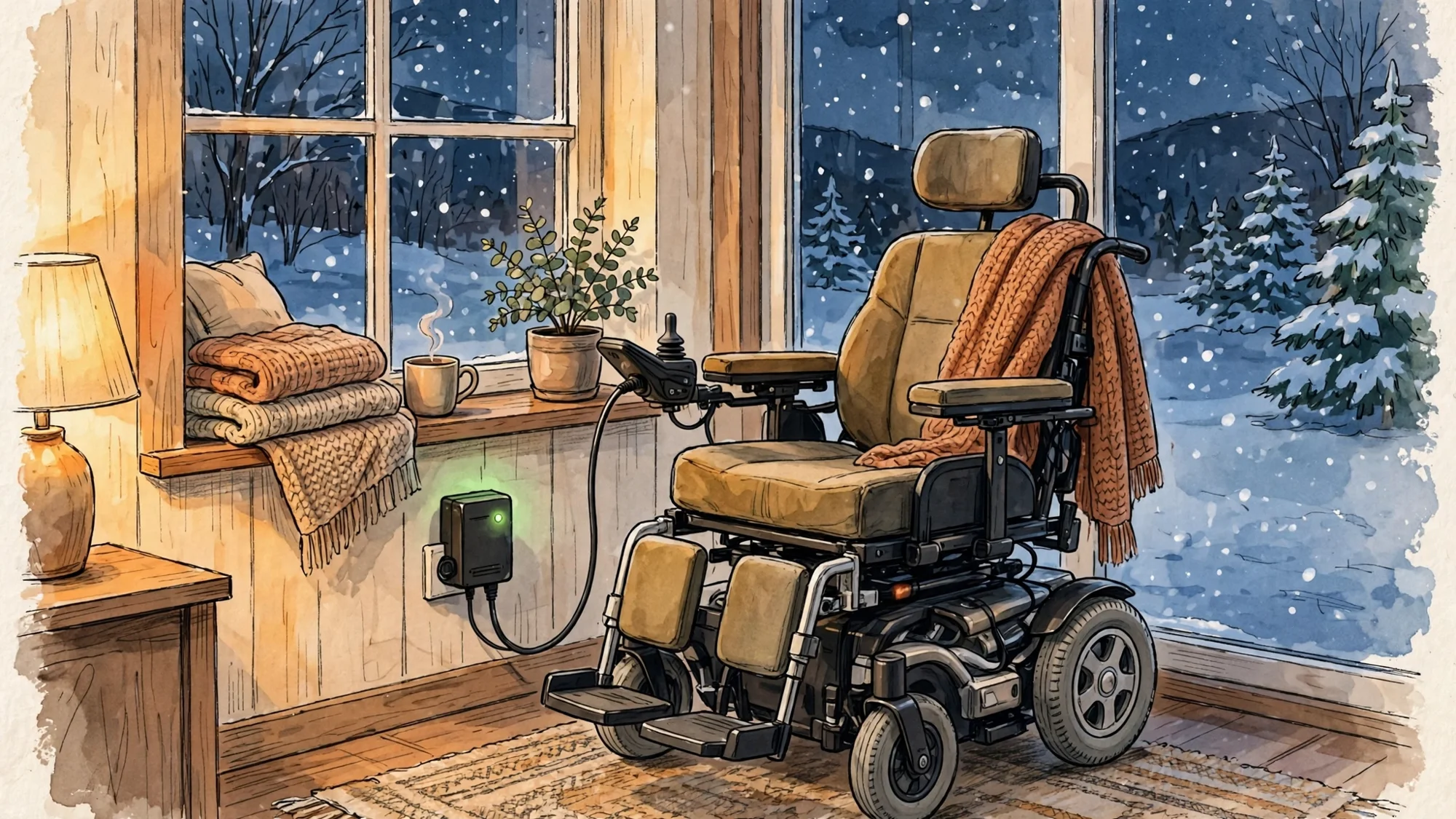
Translate the manuals into a daily routine. Start the day with a full charge — plug in every evening and leave it overnight, without a timer plug interrupting. On cold days, plan shorter trips and keep a margin of range in reserve rather than cutting it fine. Take the charger with you on longer outings so you can top up at your destination. Avoid leaving the chair in a freezing car boot overnight; bring it indoors or into a heated space whenever you can. After coming in from rain or slush, wipe the chair down and let it dry — dampness and cold are a bad combination for electrical contacts.
Storing the Chair for Weeks at a Time
If you will not use the chair for several weeks — a hospital stay, a holiday, or simply a deep-winter break — charge the battery fully first, then recharge at least once a month while it sits. WHILL's manual goes further for very long storage: beyond four months, take the battery out and check its charge every three months. Store the chair indoors or under cover, away from rain and damp, and keep the battery and charger within 0–40°C. A battery left flat in a cold shed for months is the most common reason chairs struggle to hold a charge when spring comes.