
Capacity and test figures from manufacturer pages (BraunAbility Europe, Autochair via dealer listing), checked 8 Oct 2026. Loading guidance from Driving Mobility, the UK charity network of mobility centres.
Boot hoists: push-button loading
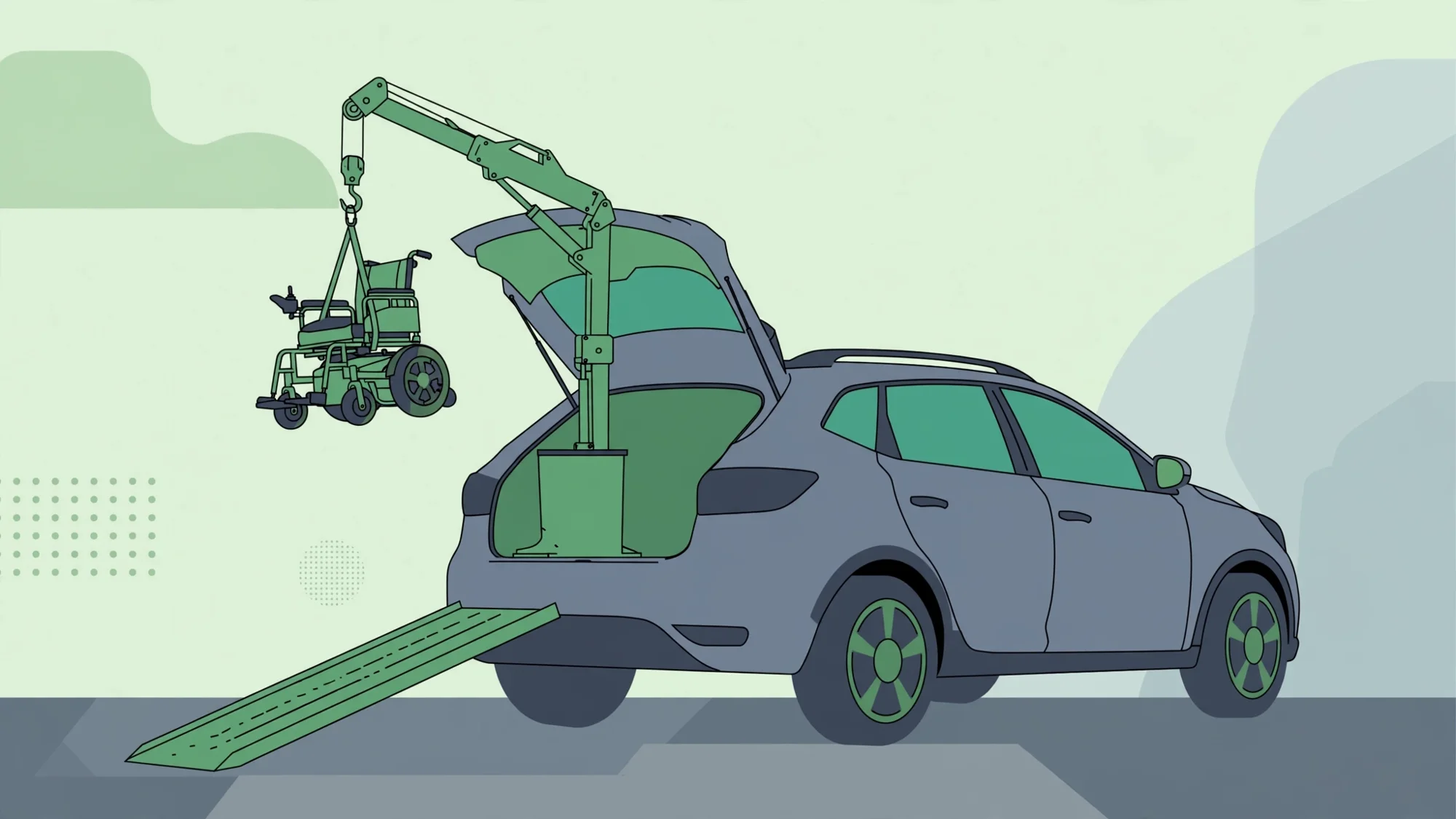
A boot hoist is a small crane mounted in the luggage compartment that lifts the chair in at the touch of a button. BraunAbility's Carolift 100, for example, lifts 80 or 100 kg depending on configuration, has passed crash tests as well as climate and EMC testing, and its detachable top section weighs around 10 kg, so most of the hoist can be removed to free the boot. Autochair's Smart Lifter range lifts up to 200 kg in heavier configurations and loads in about 60 seconds, with two-way and four-way movement options to suit different boot shapes. Installation usually needs only limited permanent modification to the vehicle, which helps resale value, and many hoists can be transferred to a next vehicle if it fits. Hoists suit people who can guide the chair onto the lifting straps but cannot lift its full weight. Check the hoist's rated capacity against your chair's total weight including the battery.
Ramps and platform lifts
A ramp is the simplest option and needs no electrics, but someone must push the chair up it, and steep or wet ramps can be hard work and slippery. Telescopic or folding ramps help with storage. A powered platform lift does the lifting for you: the chair is wheeled onto a platform that raises it into the vehicle. Platform lifts need more boot space and cost more than simple ramps, but they remove the physical effort entirely. Whichever you choose, measure twice: the UK charity Driving Mobility advises checking vehicle and equipment dimensions for compatibility before buying, and consulting a local mobility centre or adaptation specialist if you plan to change your vehicle.
When a WAV makes more sense
A wheelchair-accessible vehicle, with a lowered floor and a ramp or lift, lets you travel seated in your own chair and avoids loading it into a boot altogether. For heavy powerchairs above typical hoist capacities, or where the user travels alone and needs to drive from the chair, a WAV is often the practical answer. The trade-off is cost and the fact that you are committing to a converted vehicle rather than adapting the car you already own. Our separate guide to wheelchair-accessible vehicles covers conversion types in more detail.
Choosing: five questions to ask first
Start with the numbers: what does your chair weigh with the battery fitted, and what is the hoist's rated capacity? Next, look at your boot: its opening height, floor length and whether the hoist's mounting post will still leave room for anything else. Third, who loads the chair, and can they operate straps and a hand control? Fourth, does the hoist supplier offer a home demonstration so you can see it work with your actual chair and car before committing? And fifth, if you are on the Motability Scheme, check which adaptations are covered and what you would pay. Answering those five questions first saves the most common disappointment: a hoist that fits the car but not the chair, or the chair but not the routine.