Storage guidance verified 2026-10-12: WHILL Model C2 user manual storage section (temperature, humidity, indoor, monthly recharge) and a retailer folding/storage guide (fold sequence, dryness, cover). Guidance paraphrased, not copied. Scope: general home storage and folding practice; figures quoted are manufacturer-stated limits, not promises about battery life or safety outcomes; layout advice is general guidance, not an accessibility-code determination. Battery charging routine details live in the companion article power-wheelchair-battery-charging-best-practices-guide; battery recycling/disposal is covered by wheelchair-battery-recycling-disposal-guide (2026-10-08).
Shrink the footprint: fold it or break it down
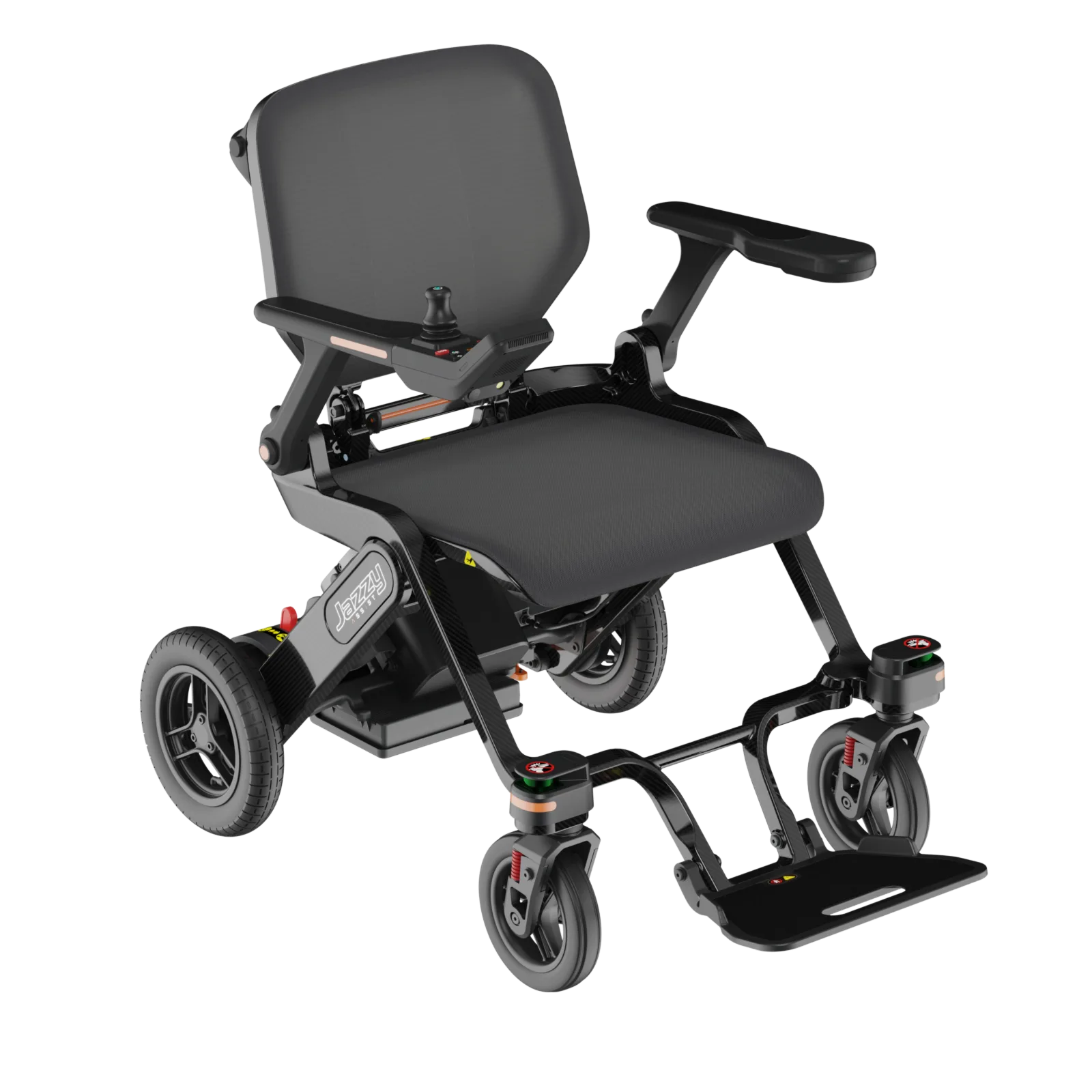
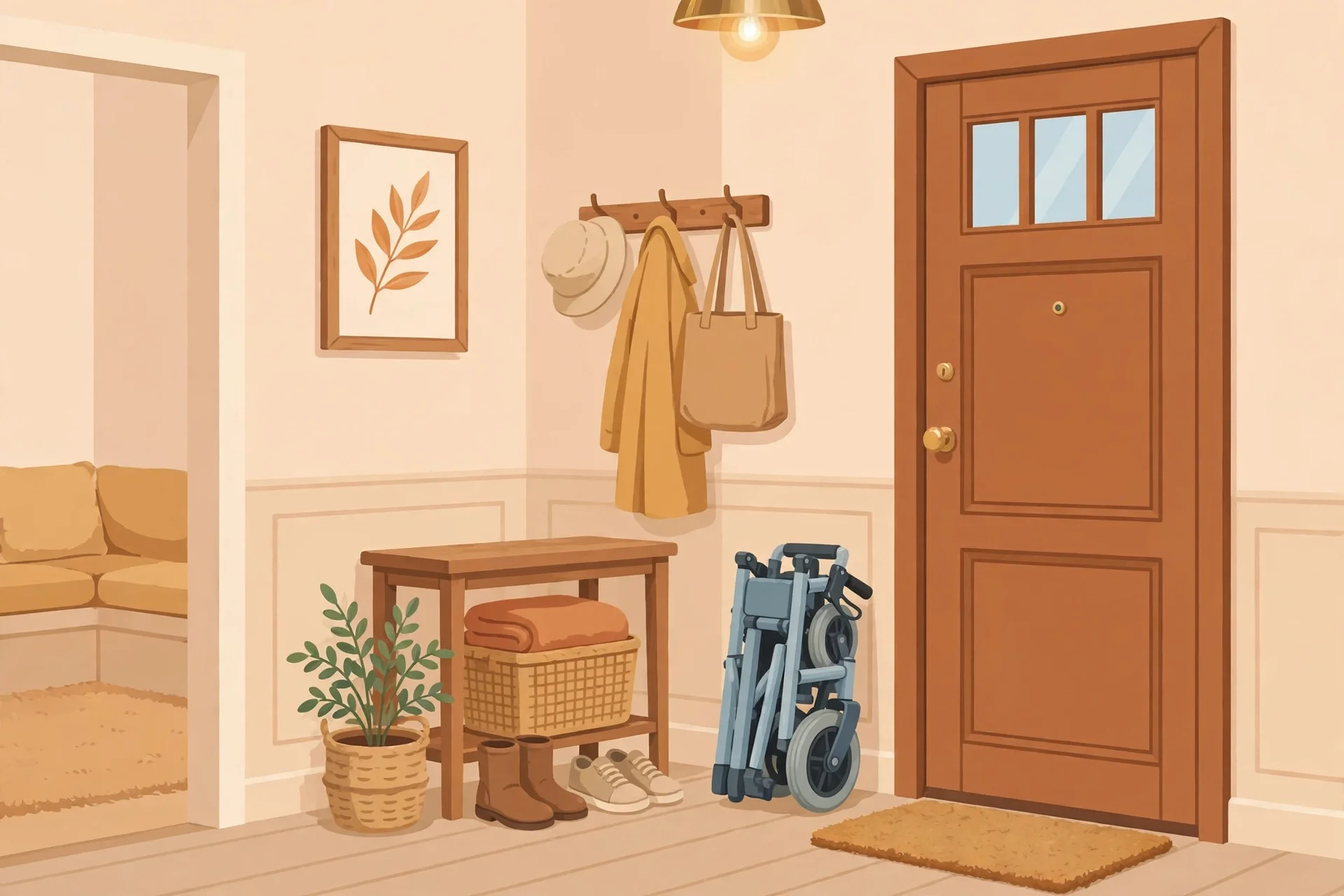
A power wheelchair looks permanent until you learn its folding sequence. The retailer's folding guide and manufacturer manuals describe the same order: lock the brakes on a flat surface, clear the area, then remove anything detachable — cushion, side guards, footrests that swing away or lift off — before collapsing the backrest and armrests and engaging the frame's folding mechanism. Once folded, check that the locking mechanism holds so the chair cannot unfold in a hallway. For non-folding power chairs, the trick is disassembly rather than folding: lift off the seat assembly, swing away or remove the footrests, and on models with quick-release batteries, pull the pack and store it separately on a shelf. That alone can cut the parking footprint nearly in half. One warning worth keeping from the WHILL manual: never lay the device on its side, and do not stack heavy objects on a stored chair — the frame, controller, and connectors were not designed to carry that load.
The parking-spot checklist
A good parking spot answers five questions before you commit. Use this checklist for every candidate corner: - Is there an outlet within the charger's cord reach? The chair should live where charging is effortless, not where you have to unplug something else every night. - Is it indoors or at least covered? Manufacturer storage rules forbid rain and direct sunlight; a covered hallway or bedroom corner beats a balcony or an unheated garage. - Is the surface flat, dry, and level? Damp and inclined spots are both on the manufacturer's don't list — moisture corrodes, and an incline stresses brakes and frame. - Can the chair turn in and out? Standard interior doorways run 28 to 32 inches wide and hallway turns trap bulky chairs; folding models collapse to a narrow profile that clears them. Test the full path: doorway in, turn, and doorway out. - Does it block anyone's exit or daily path? A wheelchair parked across the only route to the bathroom or the building exit creates a hazard for everyone in the home.
Battery care while the chair sits parked
Parking is only half the job; the battery degrades fastest when a chair sits ignored. WHILL's manual is explicit: if the device will not be used for a long period, store it with the battery fully charged and recharge it at least once a month — a depleted pack may refuse to take a charge at all. For sealed lead-acid chairs, Sunrise Medical's care plan offers the other valid approach for idle periods longer than about two weeks: fully charge the batteries, then disconnect the main battery lead, since leaving the charger plugged into a switched-off socket will slowly drain the pack. Pick one regime and stick to it; what kills batteries is the middle ground of being half-forgotten. During the parking period, glance at the battery terminals for corrosion when you do the monthly charge, keep the charger accessible but off the floor where it can be tripped over, and do not store the battery or the chair near flames, flammable gas, or heat sources. Temperature bounds from the manuals are worth knowing: WHILL lists minus 15 to 40 degrees Celsius for the device and 0 to 40 for the battery and charger, with humidity between 8 and 90 percent — a normal lived-in room satisfies both.
Keeping it clean and ready in tight quarters
Storage in a small home doubles as maintenance, because a dusty corner works against the chair. A simple cover over the folded chair keeps dust out of the controller and connectors; the retailer's storage guidance lists dryness, moderate temperature, and a cover as the three basics. Once a month, wipe the frame and tires down, check tire condition, and make sure the folded locking mechanism still engages cleanly. Keep the user manual where you can reach it — the back of the parking spot, not the bottom of a moving box — because the exact folding sequence and torque specs are model-specific and you will want them on the day something feels off. If space is truly at the limit, use the vertical dimension: batteries and cushions on a shelf, the folded frame against the wall behind the door that opens least. Just keep the controller off the ground and nothing heavy on top of the folded chair. A parked chair that is clean, charged, and locked in its folded position is not clutter; it is the fastest path from your doorway to the street.