Applies to UK homes; both suppliers (Stiltz and Handicare for Age UK Trading stairlifts) install nationwide across the UK.
The question that decides everything: person only, or person plus chair?
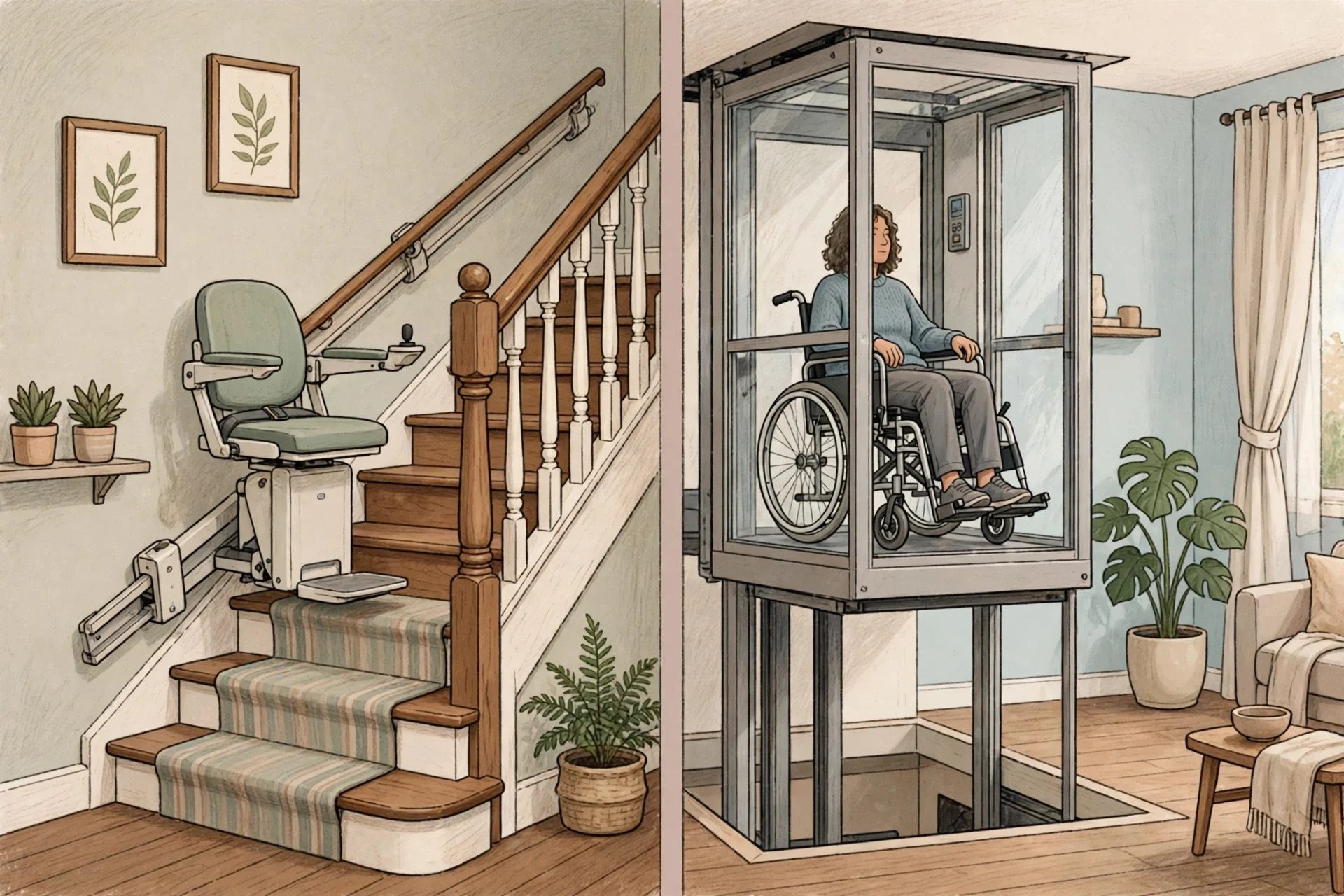
If you live in a two-storey house and use a wheelchair, one fact settles the whole debate before you look at prices or brochures: a stairlift moves you, not your chair. Every stairlift on the market — straight, curved or perch — is a seat that runs on a rail fixed to your staircase. You transfer out of your wheelchair at the bottom, ride the seat up, and transfer again at the top. Your wheelchair waits downstairs. That works if you can manage two transfers per trip and have somewhere to leave the chair — and, ideally, a second chair or walking frame waiting on the landing for the rest of the floor. For many powerchair users, and for anyone whose condition makes repeated transfers risky or exhausting, that is not a real solution; it is a compromise you will regret by the second week.
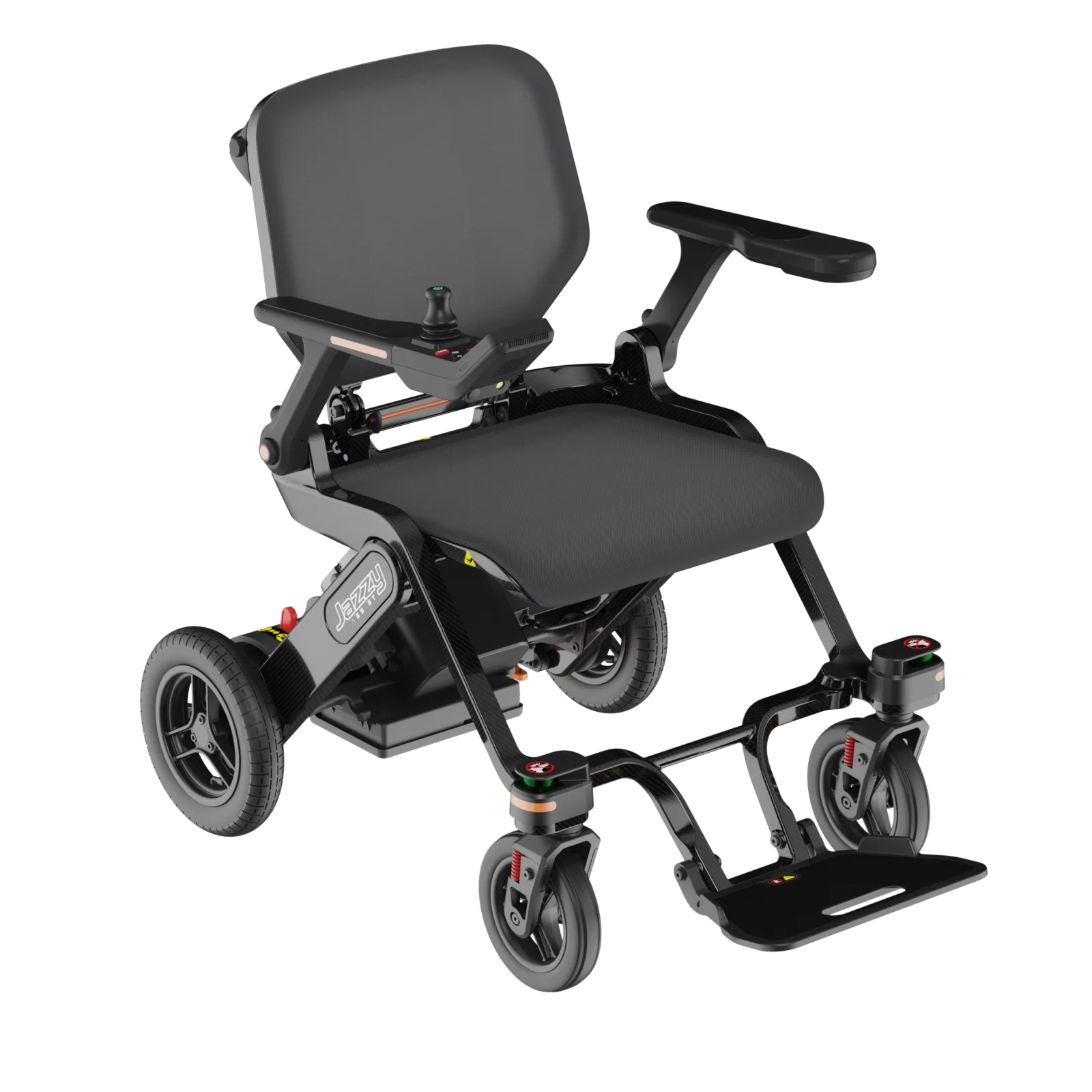
A through-floor home lift takes the opposite approach. Instead of hitching a ride to the staircase, it is a small cabin that travels vertically through a cut-out in the ceiling and floor above. The wheelchair-accessible version, Stiltz's Trio+, is built around a gently-angled ramp and an automatic door: you wheel straight in, the door closes, and the lift carries you and the chair together between floors. No transfers, no second chair, no balancing act on the stairs. Stiltz's smaller Duo model is the two-person option for homes where the user can transfer or walk with assistance — compact at just 0.55 square metres of footprint, and still a full through-floor cabin rather than a seat on a rail.
So the first decision is not about money at all. Ask yourself, or your occupational therapist: can I safely transfer twice for every single trip between floors, every day, for years to come? Will someone be there to help on the days I am tired or unwell? If the honest answer is no — or 'not reliably' — the stairlift is off the table and a through-floor lift (or rethinking the layout of the house) is the only serious option. If you can transfer confidently and only need the upstairs occasionally, a stairlift becomes a legitimate, cheaper candidate. Get this question right first, and everything else — budget, staircase shape, installation disruption — falls into place naturally.
One more scenario worth naming: in a busy family home, a stairlift’s rail and folded seat still occupy stair width for everyone else using the stairs, while a through-floor lift leaves the staircase completely clear. And if your condition is progressive, choose the option that still works on your worst days, not just your best ones — needs change, but a ceiling cut-out does not. Before spending any money, get an occupational therapist to assess your transfer ability formally; their professional verdict settles the stairlift question more reliably than any brochure.
Head to head: space, stairs, installation and upkeep
Once the wheelchair question is settled, the practical differences decide the details. Here is how the two options compare, based on what Stiltz publishes about its home lifts and what Handicare publishes for Age UK Trading stairlifts.
**Space.** A stairlift's rail lives on the staircase itself, so it eats into stair width — a real consideration in narrow Victorian terraces or homes where other family members still use the stairs. A Stiltz Duo occupies 0.55 square metres of floor space, roughly the size of an armchair, and the Trio+ is larger but still compact. Both travel on self-supporting guides, so they do not need a load-bearing wall and can be fitted almost anywhere in the home — you are not tied to the staircase at all.
**Staircase shape.** Straight stairlifts suit straight staircases and are the simplest to supply; curved or spiral stairs need a bespoke curved rail — Handicare's 4000 curved, Freecurve and perch-curved models are made to measure for your stairs, which adds lead time and cost. A through-floor lift ignores the staircase entirely, so awkward bends, narrow turns and half-landings simply do not matter.
**Installation and disruption.** Handicare says a stairlift typically takes around a day to install. Stiltz also quotes a typical one-day installation, thanks to a modular design that fits under most doorways and ceilings with minimal building work and disruption. Both options plug into normal household life more easily than people expect: Stiltz lifts run from a standard 13-amp power socket like any other appliance, and use no noisy hydraulics or vacuum systems — the company says this makes them quieter than many stairlifts.
**Servicing and upkeep.** Handicare recommends a service once a year for new stairlifts and every six months for reconditioned models, with engineers covering the whole of the UK. Reconditioned stairlifts are the budget route — second-hand, adapted to fit your home, and sold as matching the safety levels and quality of new models. Age UK Trading stairlifts are supplied by Savaria Lifts (UK) Ltd, trading as Handicare (registered office at Kingswinford, West Midlands), which offers free home surveys, transparent written quotes and a price-match promise on like-for-like written quotations from other reputable UK companies.
**Track record.** Stiltz has been designing and manufacturing home lifts in its own factory at Kingswinford since 2013, and says its lifts are now sold in 50 countries. Handicare's engineers install nationwide across England, Wales and Scotland, so neither option depends on finding a local specialist.
**Cost positioning.** Neither supplier publishes headline prices on the pages checked, and both insist on a home survey before quoting — treat any ballpark figure you see online with suspicion. What the sources do confirm is the shape of the market: reconditioned stairlifts are the cheapest route between floors, bespoke curved rails add cost and lead time, and through-floor lifts sit above straight stairlifts. Both suppliers offer free first steps — a free information pack and quote process from Stiltz, and free no-obligation home surveys with written quotes from Handicare — so there is no reason to decide on price guesswork.
Your decision checklist and next steps
Run through this checklist with your occupational therapist or with the surveyor who visits your home — the free survey is where the real specification happens.
1. **Transfers.** Can you get on and off a seat twice per trip, safely, every day? Yes → a stairlift is a genuine candidate. No → through-floor lift, or rethink the layout. 2. **Staircase shape.** Straight stairs keep stairlift supply simple and quick. Curved stairs mean a made-to-measure rail — get the free survey and written quote (Handicare offers free no-obligation home visits with measurements) before comparing prices. 3. **Floor space.** Is there roughly an armchair-sized footprint free on both floors? If yes, a through-floor lift is physically possible almost anywhere, since it needs no load-bearing wall. 4. **Budget.** Reconditioned stairlifts are the cheapest way between floors; bespoke curved stairlifts and through-floor lifts sit higher. Ask about rental too — Handicare offers stairlift rental for short-term needs. 5. **Disruption tolerance.** Both options typically install in about a day with minimal building work, but a through-floor lift needs a ceiling cut-out — factor in the dust and noise of that one job. 6. **Noise and power.** If a bedroom sits next to the installation, ask about running noise. Stiltz's electric drive with no hydraulics is designed to run whisper-quiet, and it plugs into a standard 13-amp socket with no special wiring.
**Next steps.** Book free surveys from both sides: Handicare's surveyors will measure your staircase and leave you with a written quote, and Stiltz offers a free information pack and quotation process through its website. Bring your wheelchair's exact dimensions to any through-floor lift survey — the Trio+ fits a standard-sized wheelchair, but 'standard' deserves verifying against your own chair. Ask your local council about home adaptation grants such as the Disabled Facilities Grant. And keep every written quote: Age UK Trading's price-match promise only applies to like-for-like quotations provided in writing, so paperwork is part of the saving. Whatever you choose, do not order from a brochure alone — no two staircases are the same, and the survey is where the decision gets made.
**Renting and leasehold.** If you rent, or own a leasehold flat, get written permission before anyone cuts a ceiling or fixes a rail to the stairs. A stairlift rail is the easier sell to a landlord because it is removable; a through-floor lift is a structural alteration, though Stiltz’s self-supporting design means no load-bearing wall is touched. Factor the permission step into your timeline — it is the most common cause of delay, not the installation itself, which both suppliers say typically takes about a day.