London bus rules summarized from the Royal Borough of Kensington and Chelsea's accessible transport guide (rbkc.gov.uk) and TfL's official boarding procedure for wheelchair users (foi.tfl.gov.uk), verified 2026-10-18. London-specific; other cities differ.
What Every London Bus Already Has
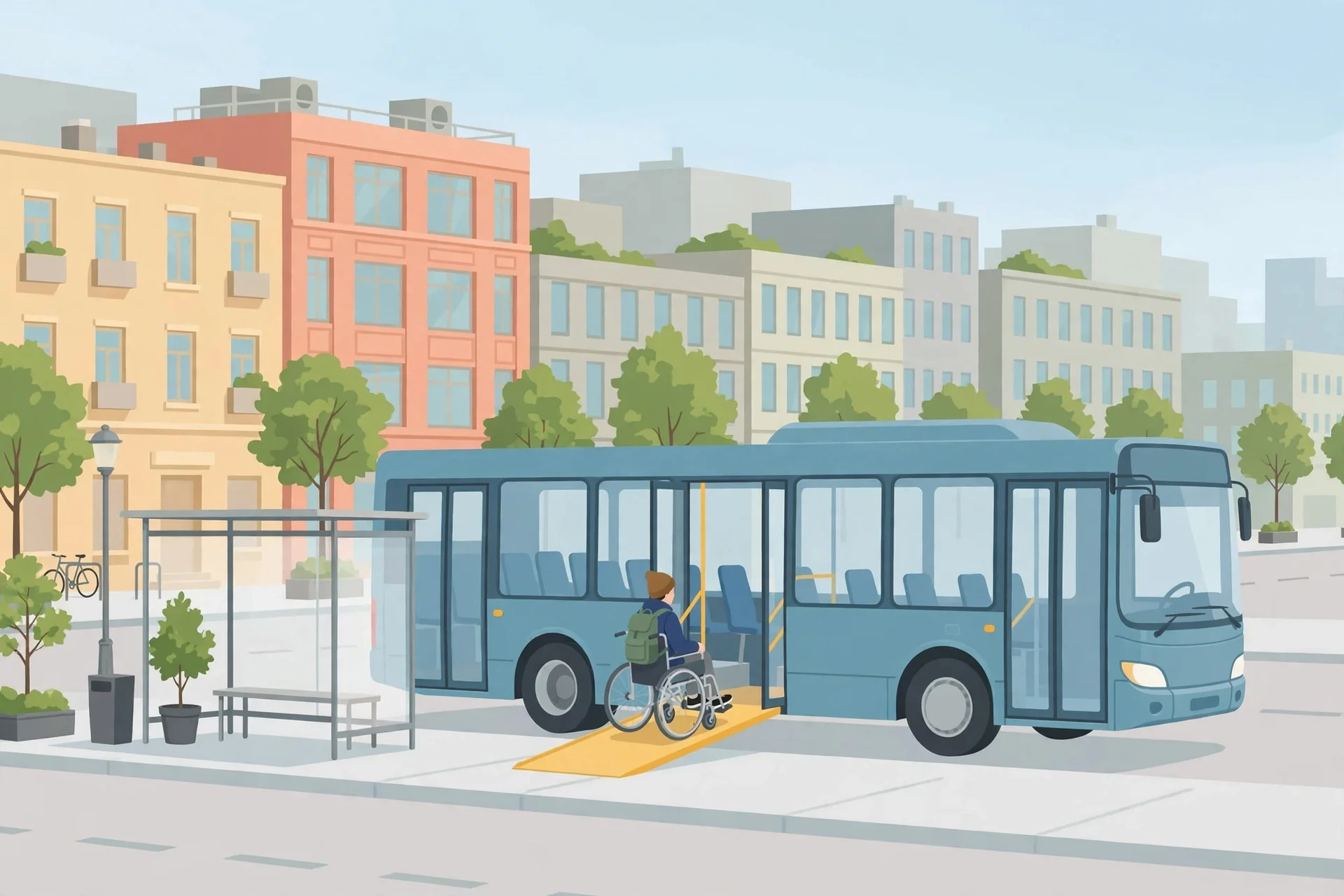
London's buses are built for this. With the exception of heritage routes 9 and 15 — the old Routemasters kept for nostalgia — every bus in the city is a low-floor vehicle whose suspension can drop to curb height. Each one carries a wheelchair ramp and one designated wheelchair space.
That means no booking, no special service, no waiting for the 'accessible one.' Turn-up-and-go is the official policy: you flag the bus, and you board like anyone else. This is the baseline, and it applies across the whole network.
Near the front you will also find priority seats — marked for disabled and older passengers, pregnant people, and those traveling with small children. They are a separate thing from the wheelchair space: the seats are for people who can transfer out of a chair or walk short distances, while the wheelchair space is the spot with the backrest and the floor anchors.
One more thing worth knowing: this entire guide is London-specific, straight from TfL's own boarding procedure and the Royal Borough of Kensington and Chelsea's transport guide. Other UK cities run different systems, so don't assume the rules travel with you.
Boarding, Step by Step
Flag the bus clearly as it approaches — a raised arm works. The driver is supposed to pull in tight to the curb, lower the bus body, and deploy the ramp if you ask for it. You do not need to explain yourself; just ask.
Here is a London-only detail worth memorizing: on dual-door buses, the front door stays closed so wheelchair users can board through it first. You go on before everyone else, which is exactly how it should be.
Roll up the ramp and position yourself in the designated wheelchair space with your back against the backrest panel and your brakes on. It takes a few seconds, and you will get faster with practice. The backrest is doing the important safety work on hills and stops, so sit into it properly rather than perching.
If the bus has an iBus announcement system, the driver can trigger a recorded request asking passengers to clear the wheelchair space — or make the ask over the PA themselves. Drivers are officially expected to require other passengers to give the space to wheelchair users, not merely to suggest it politely.
While you ride, keep your brakes engaged. When your stop comes, press the bell well ahead of time so the driver can plan the curb stop, and let them deploy the ramp again for the way down. The whole dance takes under a minute once everyone knows their part.
The Space Is Taken — Now What?
Q: A parent with a pushchair is already in the wheelchair space. Do I have to wait for the next bus? A: No. Under TfL's boarding procedure, wheelchair users have priority for the wheelchair space — even when it is already occupied by a pushchair. You do not lose your spot because someone got there first.
Q: Will the driver actually do anything about it? A: Yes, that is literally part of the job. Drivers are expected to ask — and if needed, require — other passengers to make room for a wheelchair user, using the iBus recorded announcement or the PA system. You should not have to negotiate with strangers yourself.
Q: What if nobody moves? A: This is rare once the driver makes the announcement, but if it happens, stay calm and let the driver handle it. They have the authority on their vehicle. You can also note the bus number and report it to TfL afterward — the procedure is written down in their official guidance, which is exactly why it exists.
Q: Can I just fold my chair and sit in a priority seat instead? A: You can, and some people prefer it on short hops — the priority seats near the front are there for disabled and older passengers. But know that you are never obligated to fold up. The wheelchair space is yours by priority, not by luck.
Backups and Free Extras
Even the best bus day can go sideways, so know your backups. Dial-a-Ride is a free door-to-door service for people who cannot use buses or the Underground — it exists precisely for the days when the network does not work for you. Check your eligibility and register before you actually need it.
For a gentler start, look into TfL's travel mentoring, which is free. A travel mentor rides with you, helps you practice the boarding routine, and builds your confidence on the routes you actually use. It is less a service and more a rehearsal with a friendly coach.
There is also the Mobility Aid Recognition card: a travel mentor accompanies you on a journey to check that your mobility aid fits the bus dimensions, and shares boarding and alighting tips tailored to your setup. It is a smart move before a big trip across town — discovering a fit problem at the curb is no fun.
None of this costs anything. The mentoring, the card assessment, Dial-a-Ride — all free. London's message here is refreshingly direct: the system expects wheelchair users, and it has built the scaffolding for the days when things don't go to plan.