SSR code definitions are industry-standard IATA codes; assistance scope rules are jurisdiction-specific. US details apply to flights under DOT rules; EU/UK rules apply to their respective regimes.
What the three wheelchair codes actually mean, and the equipment codes that travel with them
Special Service Request (SSR) codes are the short, standardised codes airlines attach to your booking record to tell every airport team – check-in, assistance desk, gate, ramp – what help you need. They were standardised through IATA so that a code entered by a travel agent in one country is understood by ground staff in another, and the three wheelchair codes are used consistently across the industry. WCHR, wheelchair to ramp, applies when you can climb and descend steps and make your own way to and from the cabin seat, but you need a wheelchair to cover the distance to and from the aircraft. Think of the passenger who walks fine around the house but cannot manage a half-mile terminal walk or standing in a long boarding queue. WCHS, wheelchair to the top of the steps, applies when you can walk on level ground but cannot manage stairs, so you need to be taken to the aircraft door and can then reach your seat yourself. This is the code for someone who walks into the terminal unaided but cannot climb the aircraft's own steps, and it is the code most often chosen wrong – staff see a walking passenger and assume no help is needed at the aircraft, when the steps are exactly the problem. WCHC, wheelchair in the cabin, applies when you are completely immobile for boarding purposes: you need an aisle chair to reach your seat and may need to be carried to and from the cabin seat where steps or lifts require it. These definitions come from the industry SSR lists that airlines themselves work from, and the same three codes appear on crew paperwork, gate screens and boarding documents worldwide, which is why learning them repays the effort on every future trip. Beyond the three passenger codes, airlines also record the equipment you are travelling with, and these matter just as much. WCMP indicates you are travelling with a manual or power wheelchair; WCBD marks a dry-cell (non-spillable) battery wheelchair; WCBW marks a wet-cell battery wheelchair, which triggers extra handling and packaging requirements at the airport. WCOB is a separate code noting that you need on-board or in-flight assistance, such as help reaching the lavatory with the aisle chair during the flight. If your airline asks whether you can climb stairs or walk to your seat, it is almost always trying to choose between WCHR, WCHS and WCHC on your behalf, so answer precisely in those terms – 'I need WCHS, I can walk on the flat but cannot do steps' – rather than simply saying you use a wheelchair, which tells the agent nothing about which code fits.
How to request the right code when you book, and how to keep it on the booking
Do not rely on the code being chosen correctly without your input, because it frequently is not. When you book, find the airline's special assistance section – most airlines have a dedicated web form, a dropdown menu during booking, or a phone line – and describe your abilities using the code language itself. Say, for example, that you need WCHS because you can walk on flat surfaces but cannot climb steps, or WCHC because you travel in your own power wheelchair and need an aisle chair to your seat. If the form only offers vague options such as 'wheelchair required', call and ask the agent to read back the SSR codes attached to your booking, and correct them on the spot if they are wrong. This read-back step is the single most effective thing in this guide: agents routinely default to WCHR for anyone who mentions a wheelchair, and a thirty-second confirmation call prevents a day-of-travel failure. Check the codes again after any schedule change, rebooking or partner-airline segment, because assistance requests are regularly lost when itineraries are reissued – a rebooked flight is, to the system, a new flight, and the SSR does not always follow. Request assistance at least 48 hours before departure; this is the window most airlines and airports use to roster assistance staff, and late requests can still be made but are handled on a best-effort basis, which in practice means waiting longer at the gate. If you travel with your own wheelchair or scooter, also make sure the equipment codes are present: a lithium-powered chair should be noted as such, and a wet-cell chair needs its battery handling noted well in advance so the airport has time to prepare the special packaging. Keep a note on your phone of the codes on your booking, the confirmation reference, and the airline's assistance phone number. When you check in online, confirm the wheelchair request still shows on the booking, and if anything is missing, call the airline before you leave for the airport rather than hoping the airport team will sort it out on the spot – the airport team can only deliver what the booking tells them to deliver. One more habit that pays off: after the agent confirms the codes, ask them to add a free-text note to the booking as well – something like 'PAX uses own powerchair, needs aisle chair to seat, cannot do steps.' The SSR code drives the system, but the note is what the human at the assistance desk reads first, and the combination of structured code plus plain-language note is the most robust way to survive a handover between systems that do not always pass SSRs cleanly.
What happens on the day, from kerb to seat
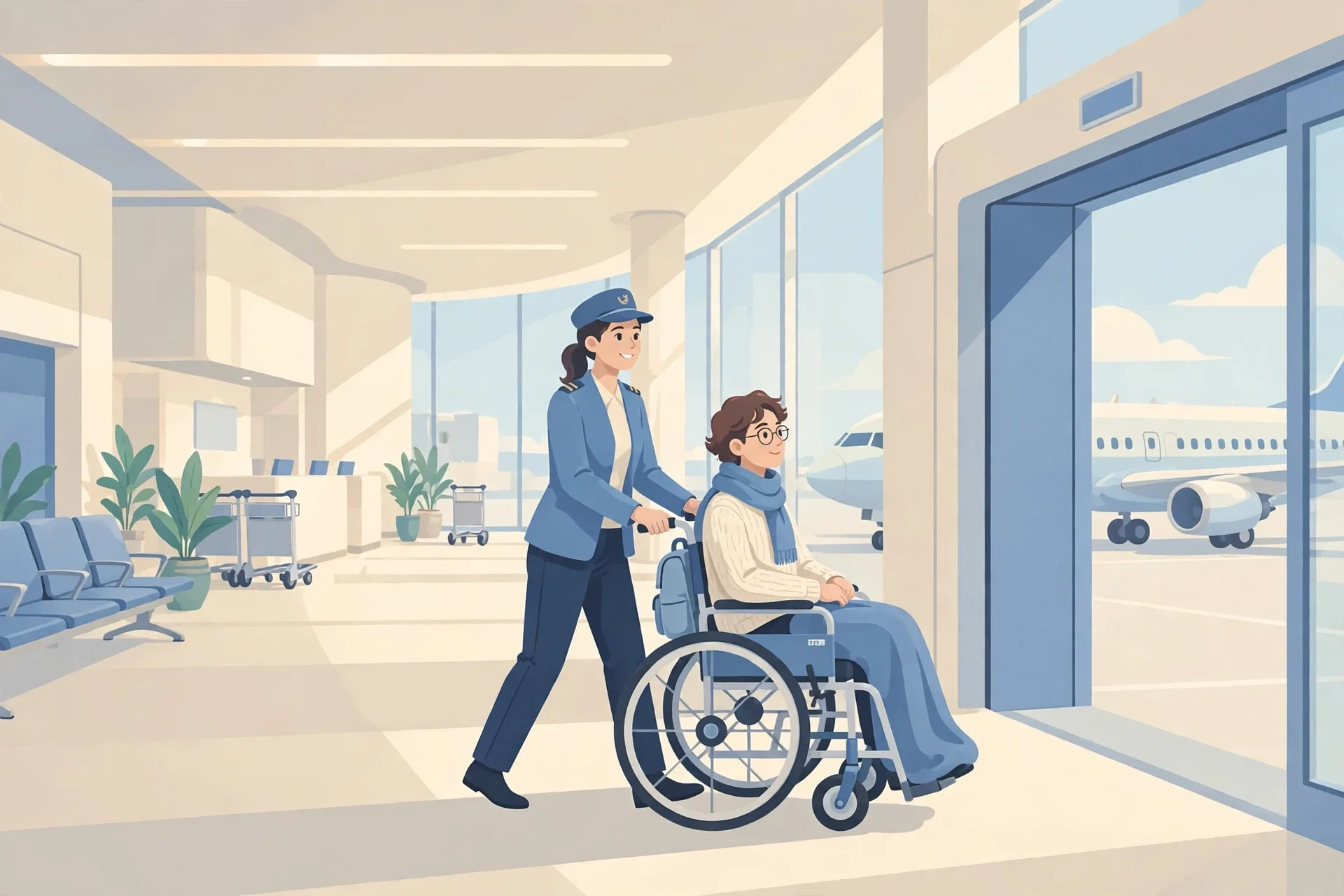
At the airport, your SSR codes drive everything the assistance team does. The assistance desk or check-in agent sees your code and dispatches the right level of help: a WCHR request usually means a wheelchair and a pusher for the long walk to the gate; a WCHS request means the team will plan for the high-lift vehicle or boarding ramp where aircraft steps are involved, and will have staff ready at the aircraft door; a WCHC request means an aisle chair and trained staff for the transfer into your seat, with a plan for getting you up the steps or into the lift. Knowing this lets you spot problems early – if you booked WCHC and the person who arrives has only a terminal wheelchair and no plan for the aircraft steps, something is wrong with the handover, and flagging it at the assistance desk is far easier than flagging it at the aircraft door. For WCHR and WCHS passengers on airlines serving the United States, assistance is generally expected from the terminal door through boarding and again on arrival when requested, since US rules extend the scope of required assistance to the terminal entrance rather than just the check-in counter. If you are connecting, the codes travel with your booking to the next airline, but confirm at each airport – handover failures between airlines and airports are one of the most common reasons assistance goes missing on tight connections, and a quick word with the arrivals assistance desk ('I am WCHC through to my next flight, can you confirm the codes are on my onward booking?') takes a minute. At the gate, the boarding pass or the gate agent's screen may show the code, and staff will usually call wheelchair assistance passengers to board early. If the assistance that arrives does not match your code, point to your booking and ask for the correct service before the aircraft boards; it is much harder to fix once boarding has started and the aisle chair you need is on the other side of the terminal. For passengers using an aisle chair to the seat, carry a small card with your transfer preferences and any safety instructions you want the crew to follow – which side you transfer from, whether you can bear weight, how your chair's brakes work – since the crew on any given flight may not have your profile memorised, and a card removes the need for a shouted conversation in a crowded aisle.
When the wrong code is attached, and the rights behind the codes
The most common failure is not a missing request but a wrong one. A WCHR entered for someone who cannot do stairs leads to staff expecting you to climb aircraft steps, with an argument at the bottom of the steps as the reward. A WCHC entered for someone who only needs distance help can mean unnecessary and undignified handling you never asked for – being lifted when you could have walked to your seat with a steadying arm. A missing WCOB means no plan for the lavatory on a long flight. If you discover the error at the airport, ask the assistance coordinator to correct the code in the booking record, not just to patch the immediate problem – the record follows you to your return flight and your connections, so a correction now pays off repeatedly. If the airline refuses the assistance you requested, note the names, the time and what was offered, and ask to speak to the airline's complaint resolution official or equivalent; in the United States, Department of Transportation rules require airlines to provide safe and dignified assistance and set detailed standards for how passengers with disabilities are helped, and a rebuttable presumption now applies when a wheelchair is mishandled, meaning the airline is presumed at fault unless it proves otherwise. In the European Union, Regulation 1107/2006 gives passengers with reduced mobility the right to free assistance at airports and on board, and the assistance must be provided without additional charge. In the United Kingdom, the Civil Aviation Authority enforces equivalent protections for passengers departing UK airports. Whatever the jurisdiction, the practical rule is the same: the SSR code is your booking's official statement of need, so getting it right at booking time is the single most effective thing you can do, and keeping your own written record – the codes, the confirmation, the name of the agent who confirmed them – is your backup if the system fails. Codes are boring administrative plumbing until the day they are the difference between boarding with dignity and not boarding at all; treat them with the seriousness they deserve. Finally, remember that the codes describe the assistance, not your identity – needing WCHC on a long-haul flight with a tight connection does not stop you requesting WCHR for a short domestic hop where you feel stronger, and many passengers use different codes for different journeys. What matters is that the code on each booking matches what you need on that trip, because the airport team can only deliver what the booking asks for. When in doubt between two codes, choose the higher level of assistance: it is easier to decline help you do not need than to conjure help the system never rostered.