Facts checked against the linked sources on 2026-11-02. Prices, dates and session details can change; confirm with the provider before booking or ordering.
Start at 16 if you qualify
The usual minimum age for driving a car is 17, but if you receive Personal Independence Payment at the enhanced mobility rate, or the higher-rate mobility component of Disability Living Allowance, you can start at 16. The first step is a provisional driving licence application, in which you declare any condition that may affect your driving. The licensing agency will assess the declaration with medical advice and issue the provisional licence if your condition does not prevent safe driving. If you are unsure what to declare, get advice from your doctor, optician, or a specialist at a local Driving Mobility centre before you apply, rather than leaving something out. One scope note: the detailed government page used here is Northern Ireland's, where the Driver and Vehicle Agency handles tests; in Great Britain the equivalent body is the Driver and Vehicle Standards Agency, and the same pattern of declaring conditions and requesting adjustments applies.
Find a specialist instructor
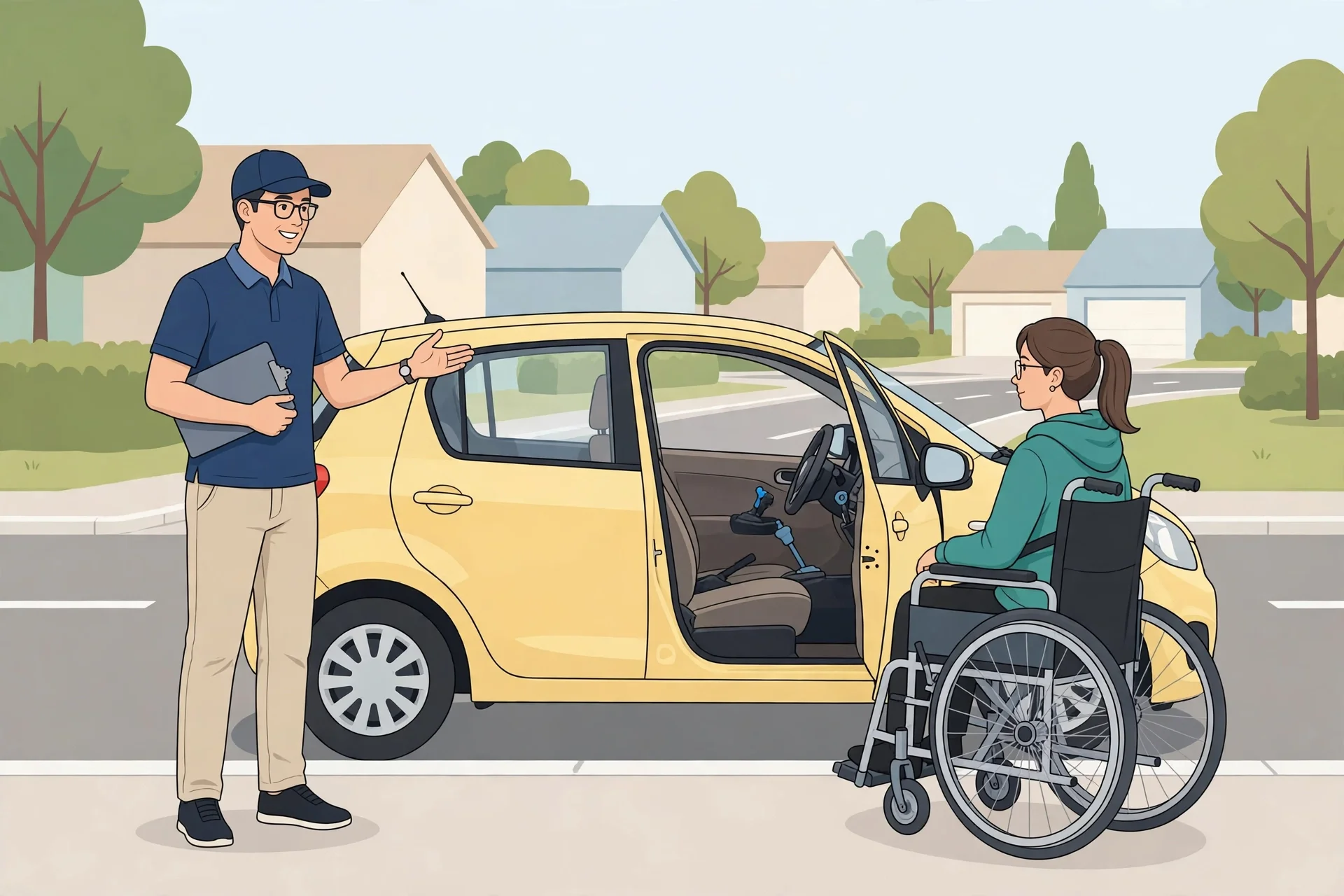
All new drivers should take professional lessons, and disabled learners should look for instructors with specialist knowledge. An experienced specialist instructor can teach more than driving: how to get in and out of the car more easily, how to get your wheelchair in and out of the car, and how to work any adapted controls. Increasingly, instructors and driving schools have simple hand controls fitted to one or more of their fleet vehicles and offer specialist tuition. If you are aged between 16 and 24, Motability may be able to offer financial support towards lesson costs, and a Driving Mobility centre can assess which adaptations suit you and help you find an instructor with a suitable vehicle.
The theory test
Book the theory test once you have a thorough knowledge of the Highway Code and hazard awareness, and remember you must pass it before you can book the practical test. It has two parts taken in the same sitting: multiple choice, with a pass mark of 43 out of 50, and hazard perception, with a pass mark of 44 out of 75. If you do not pass the practical test within two years of the theory test, you take the theory test again. Test centres are generally wheelchair accessible with specialist facilities, and arrangements can be made to take the test at home or at a different centre if your local centre is not accessible. The test system is available in spoken as well as written format, a British Sign Language video version exists for deaf candidates, and you can ask for extra time on the multiple-choice element with supporting evidence. Tell the booking agency about your needs when you book, including wheelchair access, hearing loss, dyslexia or reading difficulty.
The practical test
The practical test is the same test as every other candidate takes, regardless of impairment or condition. When you book, tell the agency if you are deaf or have hearing loss, are restricted in your movements, or have any physical disability. Disabled drivers may be allowed extra time for the test, to explain the nature and function of any adaptations to the examiner and to allow extra time to get in and out of the car, and examiners are trained to understand the needs that can arise. You may use your own adapted car, and you should be fully comfortable with your controls before test day: practice in the same vehicle, with the same adaptations, under test-like conditions.
Help with the cost of lessons
If you qualify, the Motability Driving Lessons Grant Programme can pay for up to 40 hours of driving lessons, and you can also ask for help with familiarisation lessons, which are useful if you are returning to driving after a long break or getting used to a new adaptation. To qualify you need to receive a qualifying mobility allowance, receive a government-assessed means-tested benefit, and currently lease a Motability vehicle or have one on order, with other conditions applying. All Motability grants are means-tested. Motability tends to use BSM and the AA Driving School, whose specialist instructors are spread across the UK; if an automatic gearbox or special adaptations are needed, the school will try to find a specialist instructor with a suitable vehicle, or refer you to a Disability Driving Instructors member or a tutor linked to a local Driving Mobility centre.