General guidance; individual choice should follow professional assessment. Prices are UK guide figures from NHS.
Start with your body and your days, not the catalogue
Manufacturers and the NHS agree on the starting point: the choice between powered and manual usually depends on the user's level of independence. Before comparing models, map your reality. Can you self-propel, and for how long before fatigue or pain sets in? Will you be pushing yourself or pushed by someone else? How often will you use the chair, and where — indoors only, or outdoors, work, transport? Can you transfer yourself to a car seat, bed or toilet? Is your condition stable, or likely to change in the next few years?
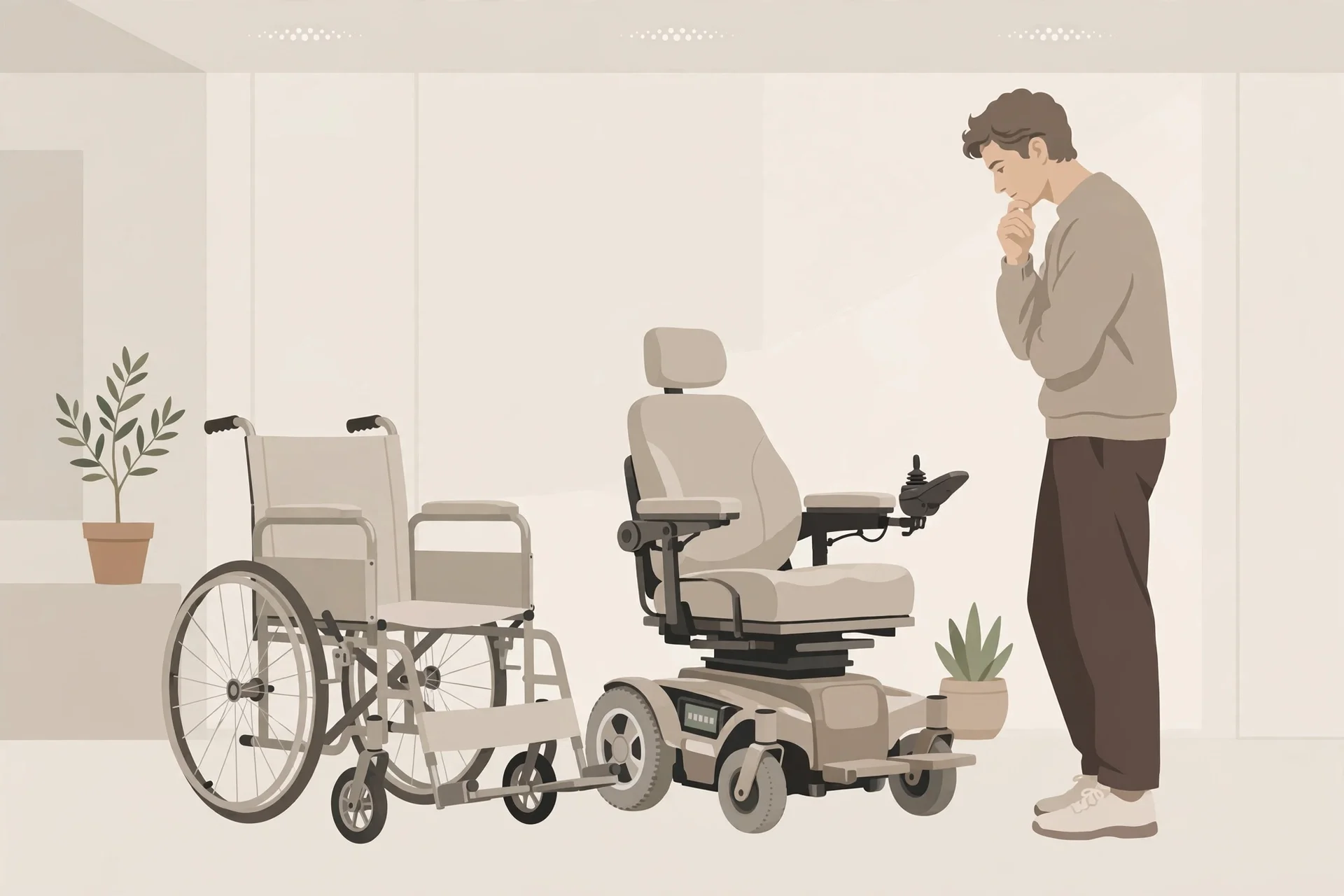
Sunrise Medical's choosing guide adds practical checks people skip: your size and weight (as a rule the seat should be 1–4 cm wider than your hips, and the chair must be approved for your weight), whether you need to fold the chair regularly for a car, whether you play sport, whether you navigate tight spaces, and what your surroundings demand — a compact indoor chair, a mixed indoor/outdoor chair, or something that handles tougher terrain. Budget matters too: manual chairs start around £150 while basic electric chairs start around £2,000, and you should look into grants, Motability or NHS wheelchair vouchers. And whatever you lean toward, try different types before deciding — the NHS says this explicitly, and reputable dealers will arrange it.
Manual wheelchairs: the real trade-offs
Manual chairs split into two families. Self-propelled chairs have larger rear wheels and suit people with a high degree of independence who can push themselves. Attendant-propelled (transit) chairs are narrower with smaller rear wheels and are designed to be pushed by another person — simpler and often cheaper, but your independence depends on having someone with you.
Frame material is the next decision, and it is a straight weight-versus-cost trade: steel is heavier but sturdy and resistant; aluminium is light and easy to transport; titanium is lighter still; carbon fibre is ultralight and expensive. Then rigid versus folding: a rigid frame has no joints or hinges, so it is lighter and propels more efficiently — the choice for active users and sport — while a folding chair is easier to transport and store, though the folding mechanism can slightly compromise propulsion efficiency.
The honest downsides of manual chairs: they demand upper-body strength and stamina, which can mean shoulder strain over years of heavy use; attendant chairs trade your autonomy for simplicity; and even the best manual chair is hard work over long distances, slopes or rough ground. Their advantages are real too: lighter, simpler, cheaper to buy and maintain, easier to lift into a car, and no batteries to charge or replace. If your needs are intermittent or someone reliable pushes you, manual is often the sensible answer.
Power wheelchairs: when they earn their price
Powered chairs are typically for people who cannot propel themselves — or who could, but only at the cost of pain, fatigue or injury. If that is you, the decisions shift to configuration. First, the drive base: rear-wheel drive combines manoeuvrability with outdoor performance, mid-wheel drive gives the smallest turning circle for indoor use, and front-wheel drive helps with kerbs and off-road terrain. Second, the control system: most people use a joystick, but alternative controls exist for operating other technology from the chair, and your assessment should cover what suits you.
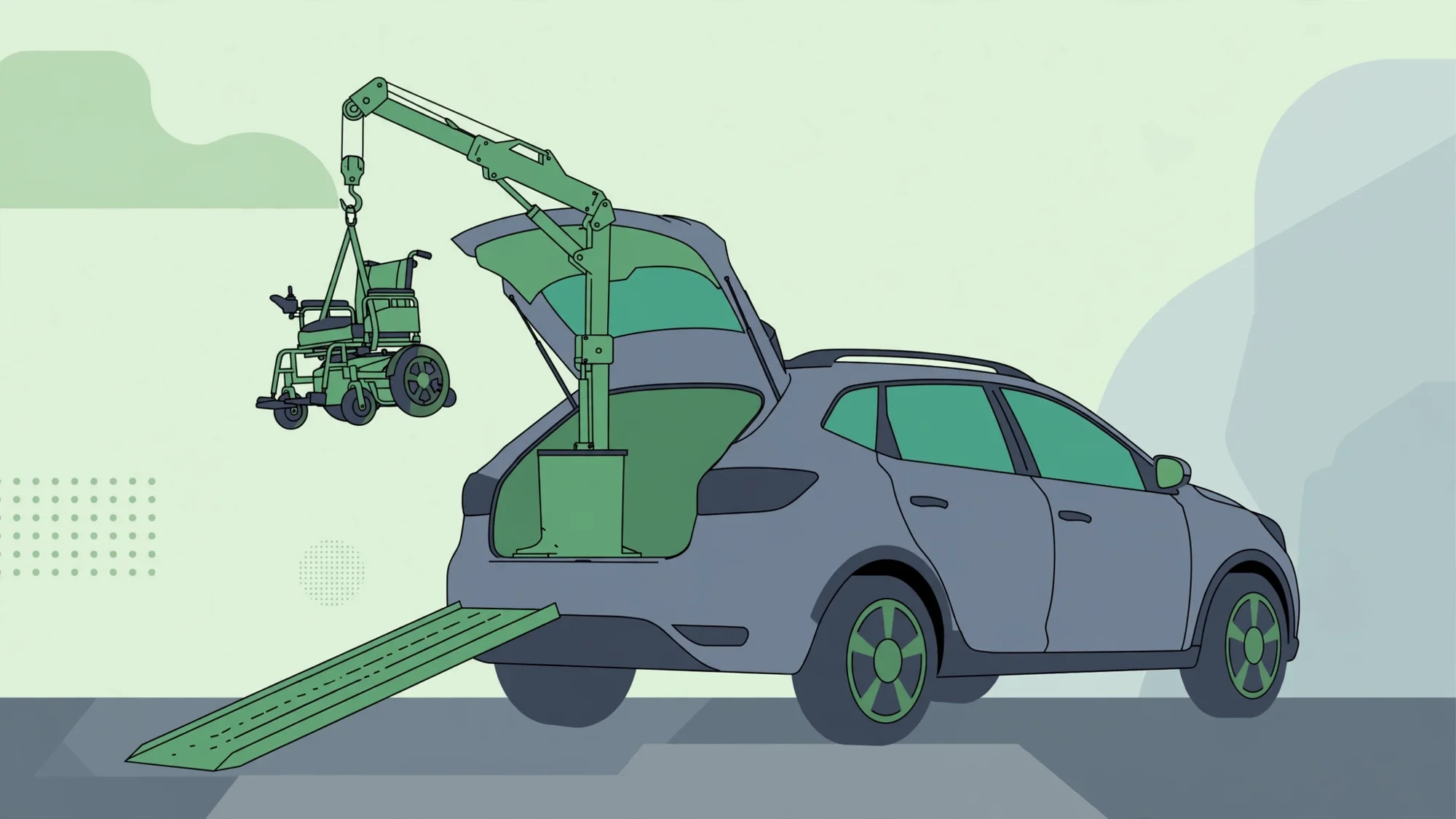
Then the practicalities. A power chair is a commitment: purchase prices start far higher than manual, you need somewhere to charge it, batteries need care and eventual replacement, and servicing matters more because there is more to go wrong. They are heavier — often too heavy to lift into a car without a hoist or ramp — and you need to check doorway widths, turning space and transport before buying, not after. On the other hand, a well-fitted power chair can be life-changing: independent travel over real distances, powered seating options (tilt, recline, elevation) that manual chairs cannot offer, and the ability to keep going when your body cannot.
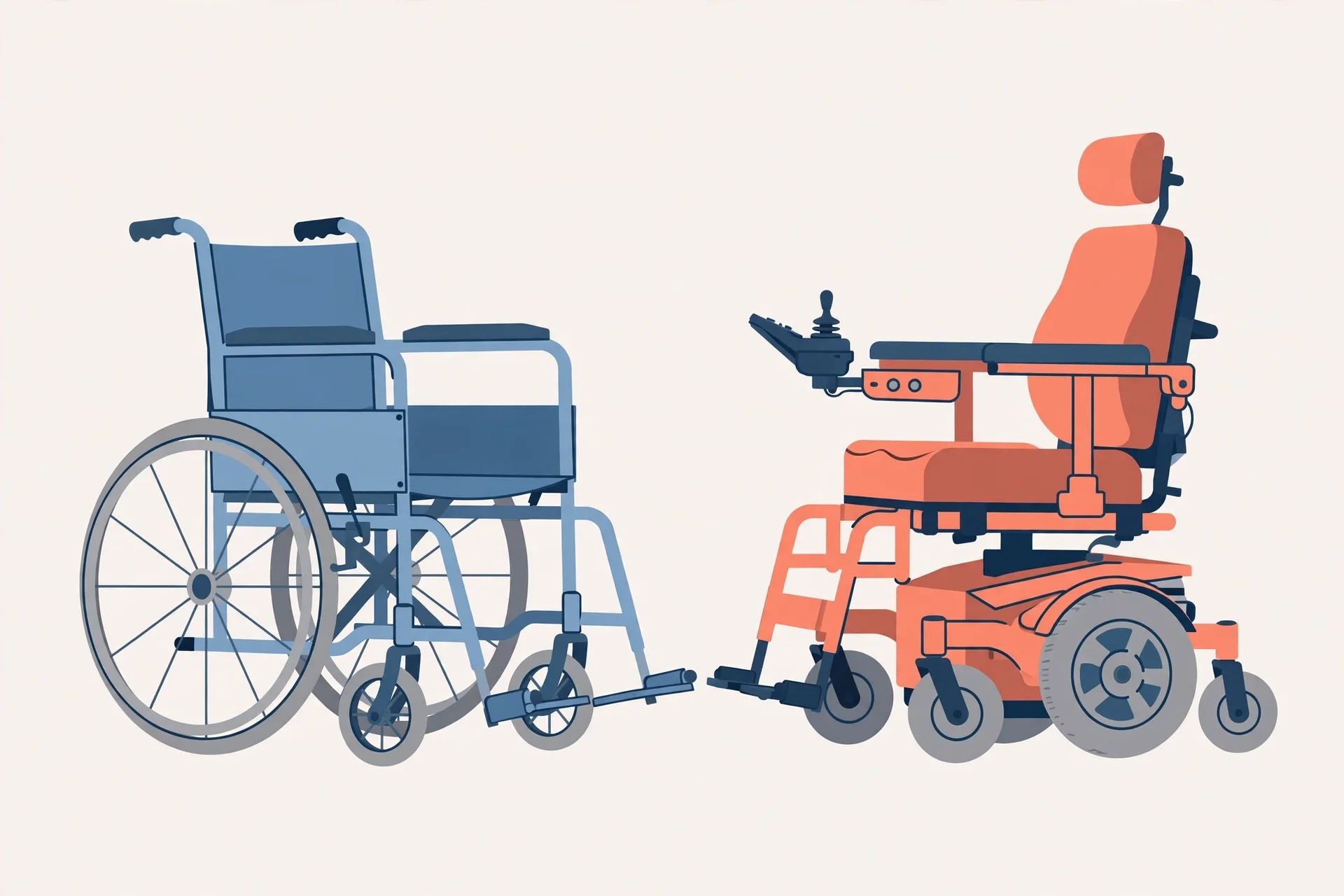
A quick comparison to take to your assessment: manual wins on cost, weight, simplicity and transportability; power wins on independence over distance, terrain and for users who cannot self-propel. Either way, get assessed — by a dealer or your NHS wheelchair service, ideally including your home environment — because the right answer depends on measurements and trials, not brochures. And remember all wheelchairs are configurable: seat size and position, armrests, footrests, cushions and accessories can be adapted, which is worth knowing if your needs are likely to evolve.