Footrest options from Sunrise Medical user manuals and Ottobock's active wheelchair pages, verified 2026-10-18. Adjustments affecting posture should be done by trained personnel.
The Menu: What You Can Actually Order
Footrests are not a single part — Sunrise Medical's RubiX2 user manual lists footrests and footplates as separate configurable options, which tells you how modular this area of the chair is.
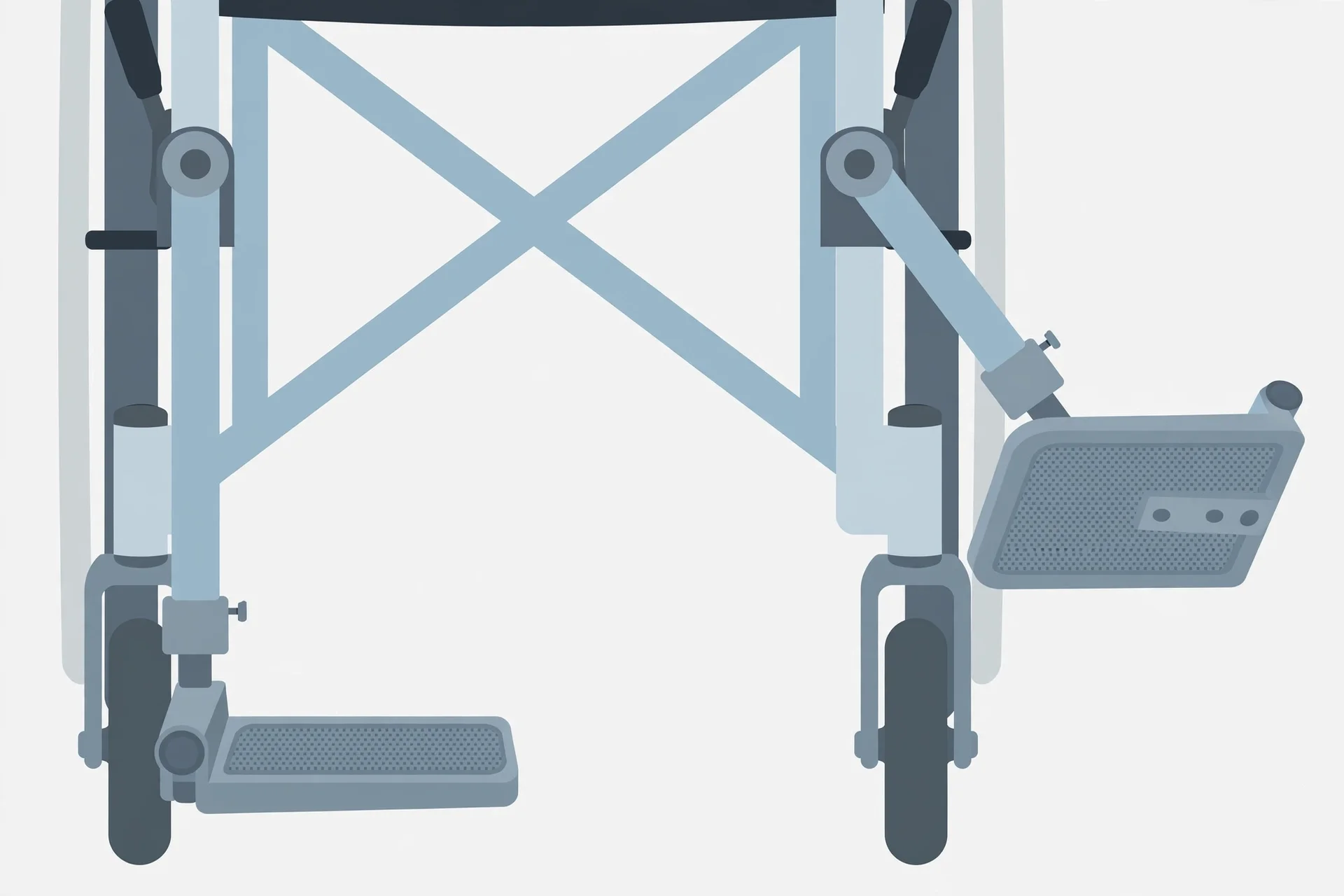
The workhorse is the swing-away hanger: the whole footrest assembly pivots out of the way so you can get close to a bed, toilet, or car seat. Sunrise's Zippie manual offers these hangers in 60°, 70°, and 90° angles. Fitting one means inserting the pivot saddle into the front frame and rotating inward until it locks; pressing the release latch swings it away again.
Then there are elevating leg rests, which raise to support your legs and lock automatically when lifted — you lower them by holding the release lever. An articulating legrest variant adjusts through a range of positions. Ottobock's Avantgarde DV takes a different route, shipping with swing-away or removable leg supports as standard, which also helps you get close to objects and even foot-propel the chair.
Footplates — the flat platforms your feet rest on — are their own adjustable component, and their height can be tuned to your leg length.
Match the Footrest to Your Transfers and Legs
If you transfer in and out of your chair often, swing-away hangers earn their place: pivoting the footrest out of the way gives you a clear path and keeps your feet from catching. The 60°, 70°, and 90° hanger angles exist because different chairs and different leg lengths need different geometry — your dealer will match the angle to your frame.
If your legs need raising during the day, elevating leg rests are the purpose-built answer: lift them and they lock on their own, hold the lever to bring them back down. If you want positions in between rather than just up and down, ask about the articulating legrest variant.
If you rarely transfer and value simplicity, fixed or fully removable supports have fewer moving parts to think about. And if you sometimes foot-propel your chair — pushing along with your feet — Ottobock notes that removable leg supports on chairs like the Avantgarde DV help you get close to the ground and to objects around you.
Whichever style you lean toward, confirm the footplates adjust to your actual leg length. A footrest that is too high leaves your thighs unsupported; one that is too low drags your posture down with it.
Get the Height Right — and Build Safe Habits
Height matters more than it looks. Sunrise's manual sets the minimum footplate clearance at 2 inches (50 mm) above the ground, and the height is adjustable to your leg length. Because footrest position affects your posture, Ottobock says the foot position should be adjusted by trained personnel — this is a dealer or therapist job, not a guess.
Two habits protect you daily. First, never stand on the footplates when transferring: flip them up or swing them away first, so your full weight lands on the seat and not on a component designed for resting feet. Second, never lift the whole chair by the leg rests — they are not carry handles.
A quick monthly glance keeps small problems from becoming transfer hazards: are the plates level, do the latches lock with a clean click, and has the height drifted? Five seconds of attention here pays off every time you get in and out of the chair.