Tire performance facts from Sunrise Medical's clinical article on rolling resistance (sunrisemedical.ca) and Schwalbe's official tire pages (schwalbe.com), verified 2026-10-18. General information only; tire choice should be confirmed with your dealer or clinician.
How Your Tires Shape Every Single Push
Before comparing types, it helps to know what your tires are actually fighting against. Rolling resistance is the force that resists rolling, and the lower it is, the less effort every push takes — which also lowers the risk of wearing out your shoulders and arms over time, according to Sunrise Medical's clinical guide.
Research cited in that guide shows solid tires have higher rolling resistance than pneumatic (air-filled) ones, and the penalty grows with body weight: the heavier the user, the more extra effort a solid tire demands. Tire pressure matters less than most people think. Rolling resistance shows no significant change until pressure drops to about 50% of the recommended value — and even at half pressure, a pneumatic tire still rolls easier than a solid one.
Two more design factors are worth knowing. Low-profile tires have lower rolling resistance than high-profile ones, and larger wheel diameters roll easier than smaller ones. None of this means everyone needs the lightest, biggest setup — it just means tire choice is one of the highest-leverage decisions on your chair, because it quietly affects every meter you travel.
The Four Tire Types, Side by Side
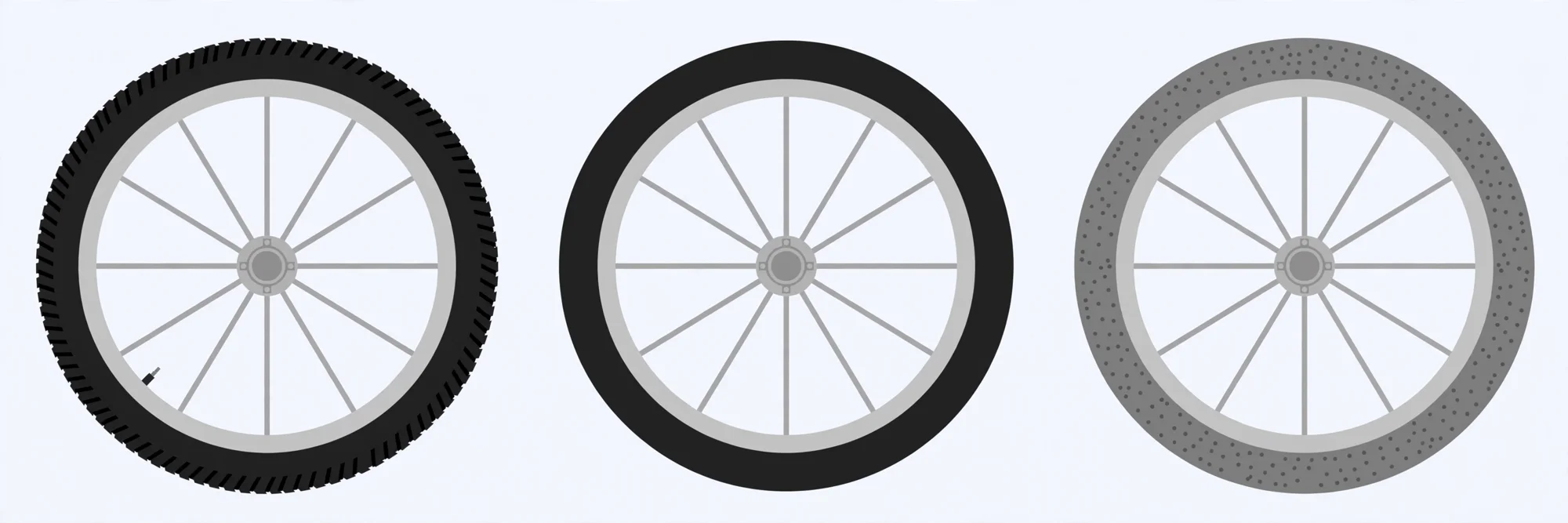
Most manual wheelchair tires fall into four families. Here is how they stack up:
| Type | What you get | The trade-off | Best for | |---|---|---|---| | Pneumatic (air-filled, like a bicycle tire) | Lowest rolling resistance and the most comfortable, cushioned ride | Needs pumping roughly once a month; punctures can happen | Daily self-propellers, heavier users, and anyone covering long distances | | Solid (no air at all) | Zero maintenance and impossible to go flat | Highest rolling resistance and a harder, less forgiving ride | Occasional users, mostly indoor or car-based use, and anyone who cannot pump a tire | | Foam-filled (foam core, no air) | No pumping plus a softer feel than a solid tire — a middle ground | Rolling resistance slightly higher than a pneumatic tire | People who want low maintenance without the harsh ride of solids | | Puncture-resistant pneumatic (air tire with an anti-puncture layer, e.g. Schwalbe's SmartGuard) | Close to flat-free while keeping the easy-rolling feel of a pneumatic; Schwalbe calls its Marathon Plus "the flat-less tire" and "the most puncture resistant pneumatic tire there is," with a 5 mm SmartGuard layer | Still needs occasional pressure checks like any pneumatic tire | Outdoor daily users who are tired of flats but don't want to give up pneumatic comfort |
A few notes on what those facts mean in practice. The weight penalty of solid tires is real: because rolling resistance climbs faster for heavier users on solids, someone above average weight feels the difference every day, not just on paper. Foam-filled tires deserve more attention than they get — they keep you rolling where a puncture would have stranded you, and their slightly higher resistance is a small price for users who value reliability over maximum efficiency. And if you love pneumatic feel but hate flats, puncture-resistant models like Schwalbe's Marathon Plus — the brand's bestseller with a 5 mm SmartGuard layer — are the compromise the market keeps coming back to. One detail worth respecting: set pressure with a gauge. Schwalbe warns that squeezing the tire with your thumb tells you nothing about the real pressure.
Match the Tire to Your Life
Start with your body weight. Heavier users feel the solid-tire penalty most, so pneumatic or foam-filled tires make more daily difference for them than for lighter users.
Next, your terrain. Mostly smooth indoor floors? Almost any tire works, and solids are at their least punishing there. Rough sidewalks, gravel paths, or daily outdoor commuting? Pneumatic tires cushion the bumps and roll easier, and a puncture-resistant model like the Marathon Plus earns its keep where debris is common.
Finally, be honest about maintenance. Pneumatic tires lose 10–25% of their air in the first two weeks after inflation and 25–40% over a month, so plan on pumping roughly once a month. If no one in your household can reliably do that — and your dealer cannot do it for you at service visits — solid or foam-filled tires are the honest choice. A tire you cannot maintain will underperform a tire chosen for your real routine.
Talk it over with your dealer or clinician before swapping types: changing tire diameter or profile can alter seat height and handling, and what looks like a simple swap sometimes needs a small setup adjustment.
After You Choose: A Two-Minute Routine
Whatever you pick, the routine is short. If you run pneumatics, check pressure about once a month with a proper gauge — the thumb-squeeze test does not work, as Schwalbe points out. Remember that resistance stays roughly flat until pressure falls to about half the recommended value, so you are not in crisis if you are a week late; you are just leaving free efficiency on the table.
Watch for replacement cues: tread that has gone smooth, sidewall cracks, or a tire that keeps losing air between checks. Bring those to your dealer rather than riding them out.
With solid or foam-filled tires, the monthly pump disappears from your calendar — just check that the tire still sits firmly on the rim and the tread is not worn down. And if your chair ever gets harder to push for no obvious reason, the tire is one of the first things to rule out before blaming the bearings or your own energy.