Product examples and specifications from US/UK retail listings; availability and prices vary by market and change over time. Funding and assessment information is England-specific (Age UK factsheet 42, March 2026); Scotland, Wales, and Northern Ireland have separate arrangements.
What Threshold Ramps Solve, and What They Don't
A threshold ramp handles small, abrupt changes in level at doorways: the wooden or metal lip at a front door, a patio door track, a single shallow step into a porch or conservatory. These little rises cause outsized trouble. For a manual wheelchair user, bumping over a threshold jars the body, risks tipping the castors, and can make an independent trip out of the house impossible without help. For an attendant pushing, it is a daily heave. Smoothing that one bump can be the difference between using the front door freely and planning every exit.
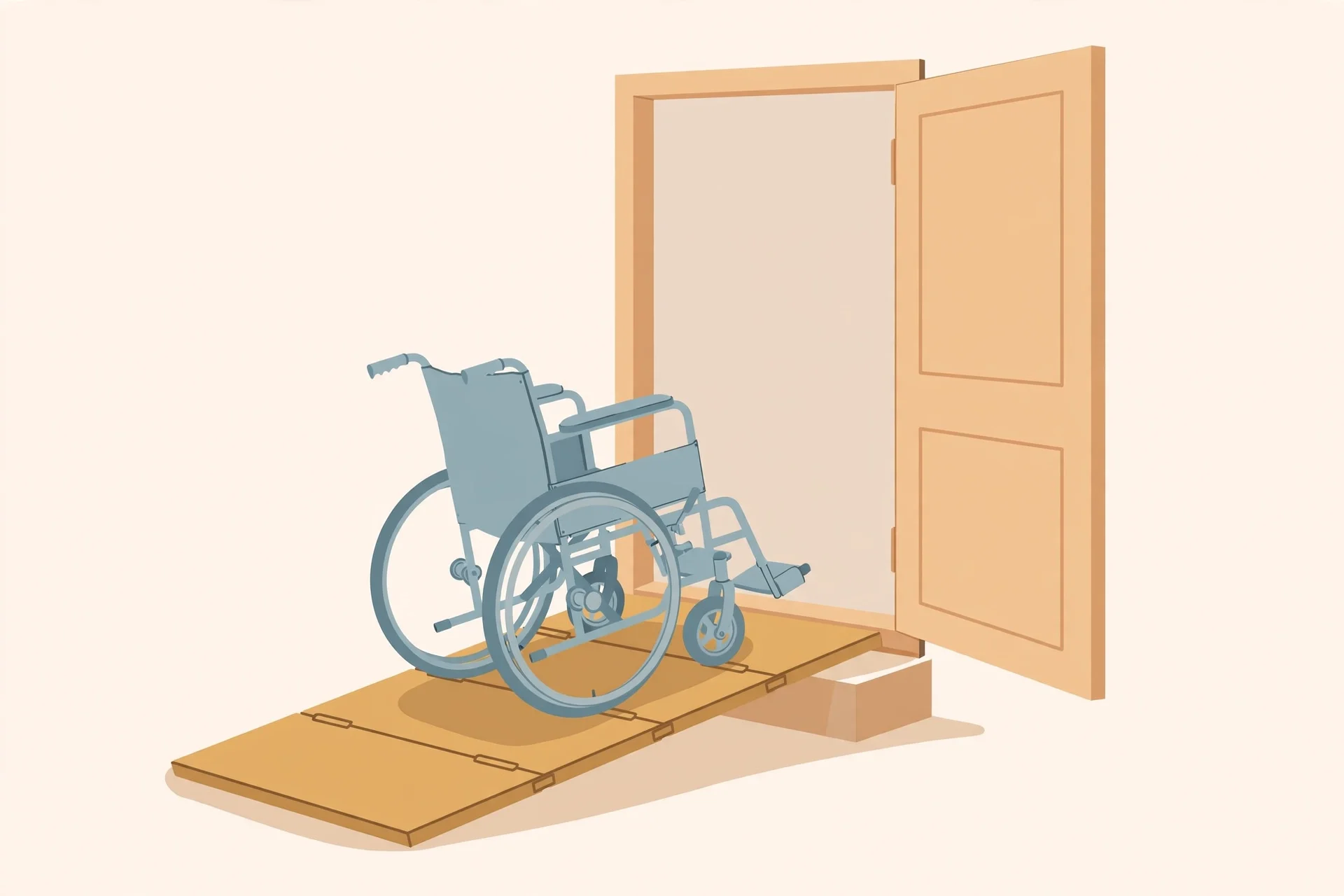
Portable is the key word. A portable threshold ramp is set down in seconds and lifted away just as fast. That makes it ideal for renters who cannot alter the property, for travellers who need access at different houses, and for temporary needs such as recovery after surgery. There is no installation, no fixings into the doorframe, and no planning permission.
It is worth being clear about what this guide does not cover. Threshold ramps are not vehicle ramps, which are longer and built for the steeper angle of a car boot or van floor, and they are not the long modular ramp systems used for flights of steps or raised entrances. Those are different products with different safety rules. Everything here stays at the doorway: small rises, portable solutions, home thresholds only.
Three Types Compared
Portable threshold ramps fall into three broad types, and the right one depends on your rise height, how often you will move it, and your budget.
- Rubber threshold mats and wedges. Solid, self-supporting wedges made from dense recycled rubber that sit against the threshold under their own weight. They are quiet under wheels and feet, need no fixings, and some can be trimmed to fit an awkward profile. They suit low rises best, typically the smallest door lips, and they stay where they are put, which is a plus for a main entrance you use many times a day. - Folding portable ramps. The versatile middle ground: panels that unfold accordion-style across the threshold. DecPac's fibreglass models are representative, with a rigid foam core, a non-slip deck surface, safety tape marking the edges, ribbed grip edges that hold position, and a built-in carry handle. Sizes range from a compact 2 ft 4 in ramp for rises up to about 7 in, to a 2 ft 10 in version handling rises up to 9 in, all rated to 660 lb. Longer multipurpose folding ramps, from 4 ft 4 in to 6 ft 6 in, handle rises up to 13 to 20 in. They fold flat for the car boot or a cupboard, making them the traveller's choice. - Adjustable aluminium threshold ramps. A newer category with legs that adjust to the exact threshold height. Prairie View Industries' Elev8 line, for example, adjusts from 1 3/8 in to 6 in of rise, carries up to 800 lb on a grooved slip-resistant aluminium deck, and comes in 32 and 36 in widths with a limited lifetime warranty. The adjustability is the selling point: one ramp copes with thresholds that differ between the front and back doors.
| Type | Best for | Portability | Watch-outs | | Rubber threshold mat | Low lips, everyday main entrances | Heavy enough to stay put; trims to fit | Check door swing clearance | | Folding portable ramp | Medium rises; travel and visiting | Folds flat, carry handle | Heavier long models need two hands | | Adjustable aluminium ramp | Varying heights, precise fit | Sturdy; heavier to move | Verify capacity covers chair plus user |
Prices vary widely by size, brand, and retailer, so treat any figure as a snapshot. As one verified anchor, the adjustable aluminium Elev8 range was listed from about $123 to $578 depending on size on a US retail site. Always check current listings before budgeting, and buy from a reputable mobility retailer rather than a generic marketplace listing with no specification sheet.
Measuring Your Doorway in Three Steps
Buying the wrong size is the most common threshold-ramp mistake, and it is entirely avoidable with a tape measure and five minutes.
- Step 1: measure the rise. This is the vertical height from the lower surface to the top of the threshold. Measure both sides of the doorway, because floors are rarely perfectly level, and work with the larger figure. Write it down in both inches and centimetres; product listings use both. - Step 2: measure the width. Check the clear width of the doorway and compare it with your wheelchair's overall width, leaving comfortable clearance on each side. Also note which way the door swings: a ramp that sits where an opening door needs to travel will either block the door or get shoved out of place. - Step 3: match ramp length to rise. The governing principle, stated plainly in DecPac's own guidance, is to measure the rise first, because the longer the ramp, the gentler the grade you have to climb. A short ramp on a tall threshold creates a steep, hard, and potentially unsafe slope. Choose the shortest ramp that still gives a comfortable angle for your strength and your chair, and if the rise is above about 6 in, recognise that portable options are running out: that is permanent-ramp or lift territory.
Two more checks before you commit. The surface the ramp sits on must be firm and level; a ramp rocking on gravel or a cracked slab is not safe. And if the threshold is outdoors, think about rain and drainage: a non-slip deck matters, and water pooling at the base of the ramp will undermine it over time.
Safety, Limits, and When to Get Help
A threshold ramp is simple, but it still has rules. Check the weight capacity against the total load: the wheelchair, the user, and anything carried on the chair. Folding ramps in the 660 lb class and adjustable ramps at 800 lb cover most combinations comfortably, but verify rather than assume, especially with power chairs.
Place the ramp fully and squarely, with both ends seated on firm surfaces. Folding ramps with ribbed grip edges resist creeping, but give the ramp a firm shove before first use to confirm it stays put. Non-slip deck surfaces and edge markings matter most in wet conditions; if the ramp will live outside, weather resistance is worth paying for.
Respect the maker's limits. Every ramp has a suggested maximum rise for its length, and exceeding it turns a helpful aid into a launch ramp. Longer ramps with raised edge barriers reduce the risk of rolling off the side, which matters more as the rise grows.
Finally, know when a portable ramp is not the answer. If the rise is too tall, if the doorway needs widening, or if the whole entrance needs rethinking, a proper assessment will serve you better than the longest portable ramp. In England, a local authority needs assessment, often carried out by an occupational therapist, can lead to funded help: minor adaptations costing up to 1,000 pounds, such as short ramps, are provided free, and larger works may be covered by a Disabled Facilities Grant. That funding guidance comes from Age UK's March 2026 factsheet on disability equipment and home adaptations and applies to England; Scotland, Wales, and Northern Ireland have their own arrangements. Asking for an assessment costs nothing and is the right move when the threshold beats the portable options.