General guidance drawn from Pride/Quantum Rehab (Go Chair) and Power Plus Mobility (NV Tilt) owner manuals; designs and clearance specifications vary by model. Adjustment work should be done by an authorized provider or qualified technician. Manuals verified on 2026-10-17.
What Anti-Tip Wheels Do
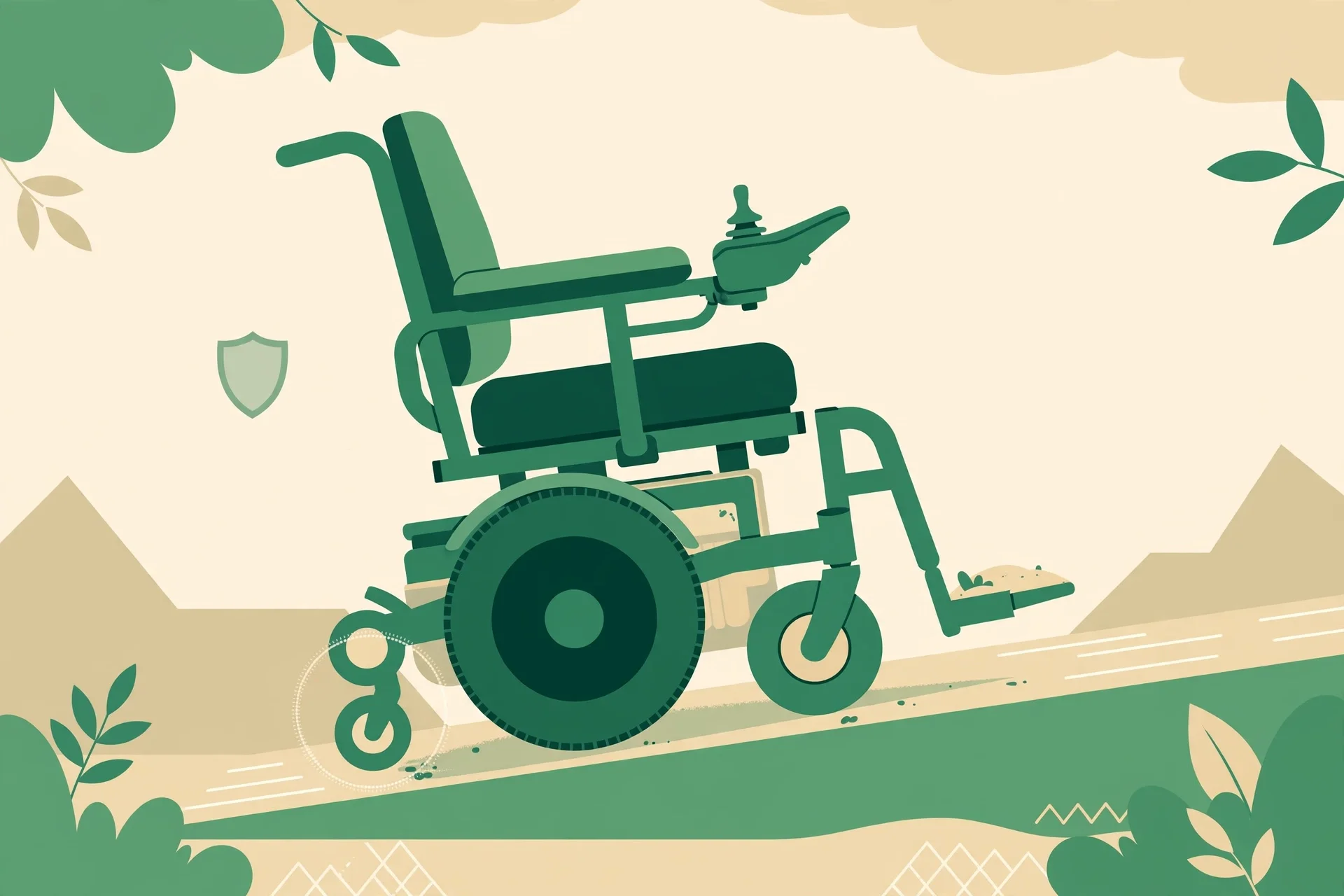
Anti-tip wheels are the small wheels mounted at the rear of many power wheelchairs, behind and below the drive wheels. Their job is simple: they limit how far the chair can tip backward. On Pride's Go Chair travel power chair, the owner's manual lists two anti-tip wheels as part of the power base assembly and notes that they are bolted to the frame at the rear of the chair.
Because they are safety hardware, the manuals are strict about them. The Go Chair manual marks removing the anti-tip wheels as a prohibited action, and the Quantum Rehab consumer safety guide states the rule directly: do not remove anti-tip wheels. The Go Chair manual also distinguishes a related feature — curb assist wheels, which aid in obstacle climbing and are bolted to the caster forks when used — and applies the same prohibition: do not remove them.
Tilt chairs use closely related hardware. Power Plus Mobility's NV Tilt owner's manual explains that its anti-tippers prevent the chair from tipping over while in tilt. The principle is the same across designs: these small wheels are a factory-installed safeguard against rearward tipping, not an accessory you can take off for convenience.
Why Their Height Matters
For anti-tip wheels to do their job, they must sit at the right height above the ground — close enough to catch a tip early, high enough not to scrape every threshold. Manufacturer manuals specify a safe clearance rather than leaving it to guesswork: Power Plus Mobility's manual, for example, directs that anti-tippers be adjusted to a safe height of at most 2 inches from the ground.
That clearance is not a set-and-forget number. The same manual notes that whenever the seat height is adjusted by moving the wheels, the anti-tipper height must be adjusted as well — changing one geometry changes the other. A wheel that hangs too low will catch on ground irregularities; one set too high may not engage in time. Getting this balance right is why the manuals treat the setting as a technician's job rather than a user preference.
When to Have a Professional Check Them
Any inspection or adjustment of anti-tip wheels belongs with a qualified technician — not because the parts are exotic, but because their position is a safety setting. Contact your authorized provider or dealer if any of the following apply:
- The wheels are damaged, bent, or visibly worn. - You hear rattling or notice looseness at the rear of the base. - Your seating was changed or the seat height adjusted, since the anti-tipper height may need to be re-set to match. - The chair was recently disassembled for transport and reassembled. - You are simply unsure whether the wheels are at the right height.
Both manuals behind this article point to the same person for this work. Pride's manuals require an authorized Pride provider or a qualified technician to perform the initial setup and the procedures in the manual, and Power Plus Mobility recommends that periodic maintenance be carried out by your servicing dealer. When you call, mention the exact model and what you observed — that gives the technician the information needed to check the setting against the factory specification.