Applies generally to power wheelchairs with sealed 24V battery systems; exact fuse location, breaker type and service network vary by brand and model — follow your own model's user manual and contact your authorised dealer. Never bypass a fuse or open electrical components yourself.
Where the fuses are and what they protect
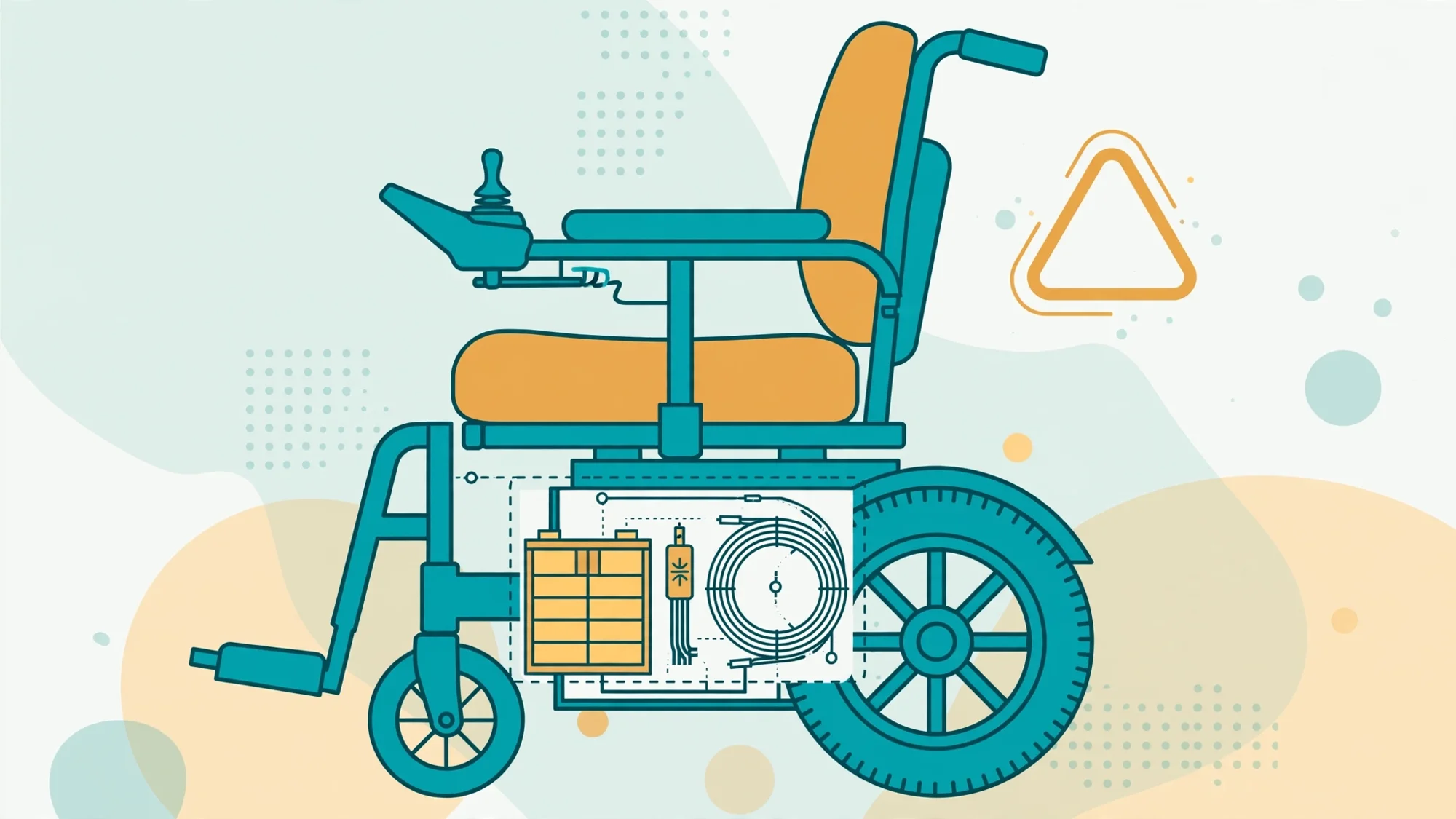
Every power wheelchair carries electrical protection between the batteries and the rest of the chair, and most owners never see it until something goes wrong. The main fuses sit on the positive battery cables — Invacare's manuals describe the entire electrical system as protected against overload by main fuses mounted on the positive battery leads. On many chairs there are also fuses built into the battery looms: their job is to automatically isolate the battery from the wheelchair's wiring and control systems if a short circuit occurs. The control system itself is safety-critical — it drives the motors, the brakes and the joystick — so the fuse's real job is to take the hit instead of the electronics. There is usually a fuse in the charger too, most commonly in the charger's mains plug, and many battery packs have a circuit-breaker button that pops out when the electrics are overloaded. None of these parts is exotic; they are the same principle as the fuse box in your home, sized for a 24-volt system and the high currents that electric motors draw. They are deliberately out of reach, because the battery cables carry enough energy to cause severe burns or start a fire if shorted — battery terminals must never be bridged by tools, jewellery or anything conductive, and protective caps belong on the terminals for a reason.
Warning signs a fuse or breaker has gone
A blown fuse rarely announces itself directly — you notice what stops working. The classic sign is in the charging: if the charger indicator light goes green immediately after being plugged in instead of charging the batteries, the problem is likely a blown fuse, a popped circuit breaker or a similar malfunction, according to Invacare's ROVI X3 user manual. If the charger does not come on at all, the charger fuse itself is a suspect. Other signs point the same way: the battery gauge shows empty even after a full charge, the chair will not drive at all, or you find the breaker button on the battery pack has popped out. Pride Mobility's Fusion E manual gives its chairs a self-diagnostic controller that sounds a sequence of audible beeps when it detects an error — counting the beeps helps you or your service agent identify the fault, and the manual's troubleshooting tables link fuse and charger faults to specific symptoms. One sign needs its own warning: if the chair starts smoking, sparking or burning, that is not a fuse to replace — stop using the chair immediately and get it serviced, because misuse or damaged wiring can cause fire. Whatever the symptom, treat it as a signal to investigate, not as an instruction to open anything.
What you can do — and what you must never do
There is a short list of safe checks anyone can do, and a long list of things only a qualified technician should touch. Safe: try a different wall socket to rule out the mains supply; check that the charger plugs and battery looms are firmly connected; switch the chair off and press a popped circuit-breaker button back in; switch the power off and on again to clear a transient controller fault. Beyond that, every manufacturer draws the same hard line. Do not attempt to change the fuses yourself — the manuals are explicit: a blown fuse needs a full diagnostic first, because a replacement fuse fitted over an unresolved short will simply blow again, and fitting the wrong fuse is a fire hazard. Do not bypass a fuse under any circumstances. Do not open any part of the control system, battery pack, looms, plugs or charger — Pride's manual states the control system is safety-critical and has no user-serviceable parts. Do not remove a fuse or its mounting hardware from the battery cable. If you suspect the fuses have blown, the correct action is the one every manual repeats: contact your authorised dealer or provider as soon as possible, who will run a full diagnostic and find the cause of the original fault. Write down what you observed — which light, which beep sequence, when it happened — before you call; that is genuinely useful to the technician. The fuse did its job by protecting you and your chair. Let a professional do theirs.