Charging routine facts paraphrased from Permobil's official charging guide and Hilton's accessibility page, both opened and verified with browser_open on 2026-10-06. Hotel-booking and travel advice is practical guidance, not manufacturer instruction; no medical or legal claims are made.
The Routine Does Not Change on Vacation — Only the Room Does
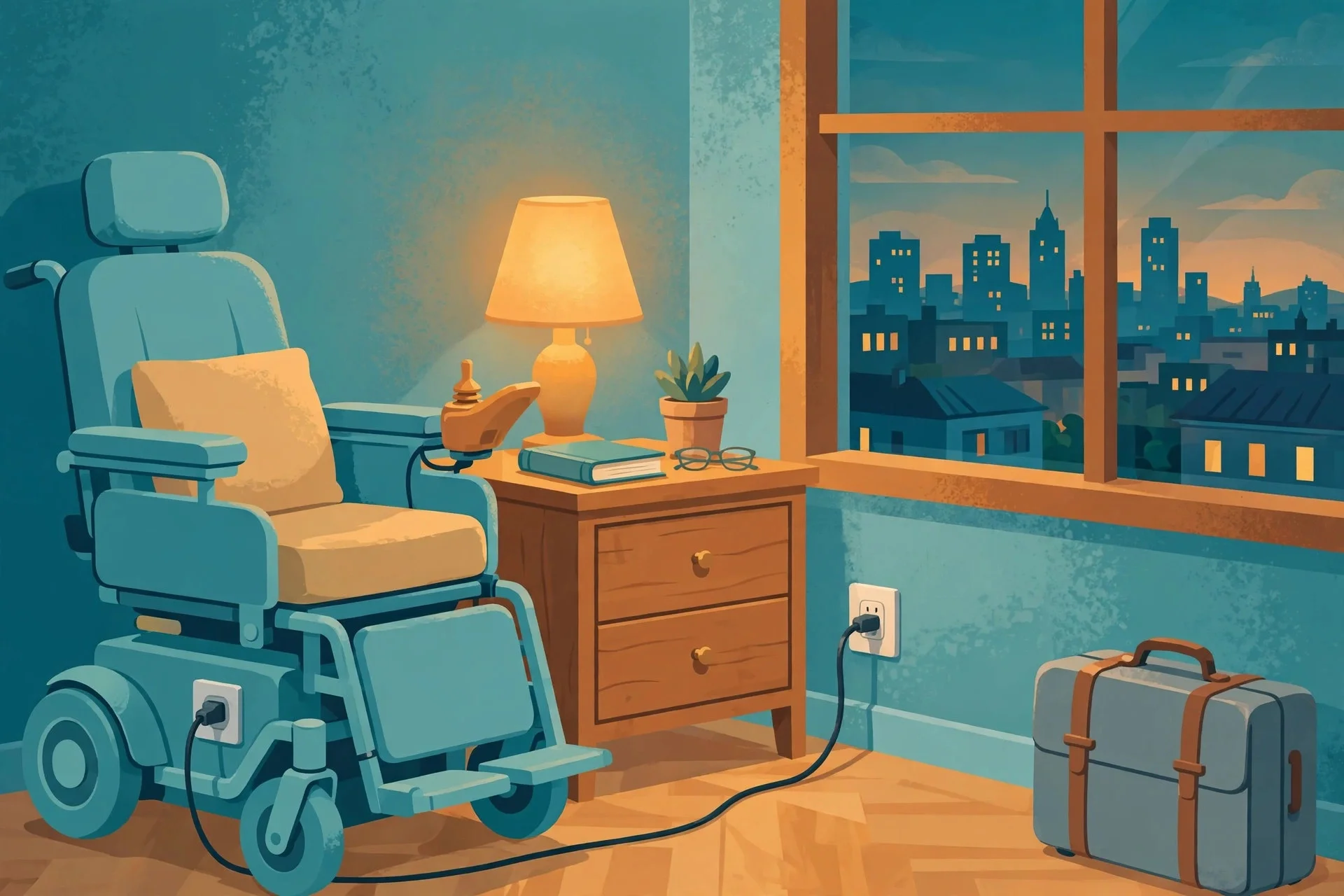
The best news about charging on the road is that nothing about the routine itself is special. Permobil's official charging guide for its power wheelchairs recommends charging the chair every evening or night, once you are finished driving for the day and the chair is parked. The steps are the same in a hotel room as in your own living room: connect the charger plug to the charging socket — on the joystick pod, the control panel, or an external charging port — and then plug the charger into a wall outlet. The charging process begins automatically.
That routine is also refreshingly low-maintenance. Permobil says the charger operates automatically and does not need to be monitored, and it should not be connected to a socket with a timer. You can leave the charger connected until the next time you use the wheelchair. When you finish charging, disconnect in the right order: first the plug from the wall socket, then the charging plug from the wheelchair.
What does change on a trip is timing, and here the travel schedule works in your favor. A normal charging session should last at least 8 hours, and fully discharged batteries need roughly 12 hours to reach a full charge — the guide explicitly says not to interrupt charging before it is complete. Eight to twelve hours happens to be exactly the length of a hotel overnight stay. Roll back to the room in the evening, plug in, and by morning the chair is as charged as it will ever be. There is no special equipment to buy for this; the charger that came with the chair and any ordinary wall outlet are the whole kit.
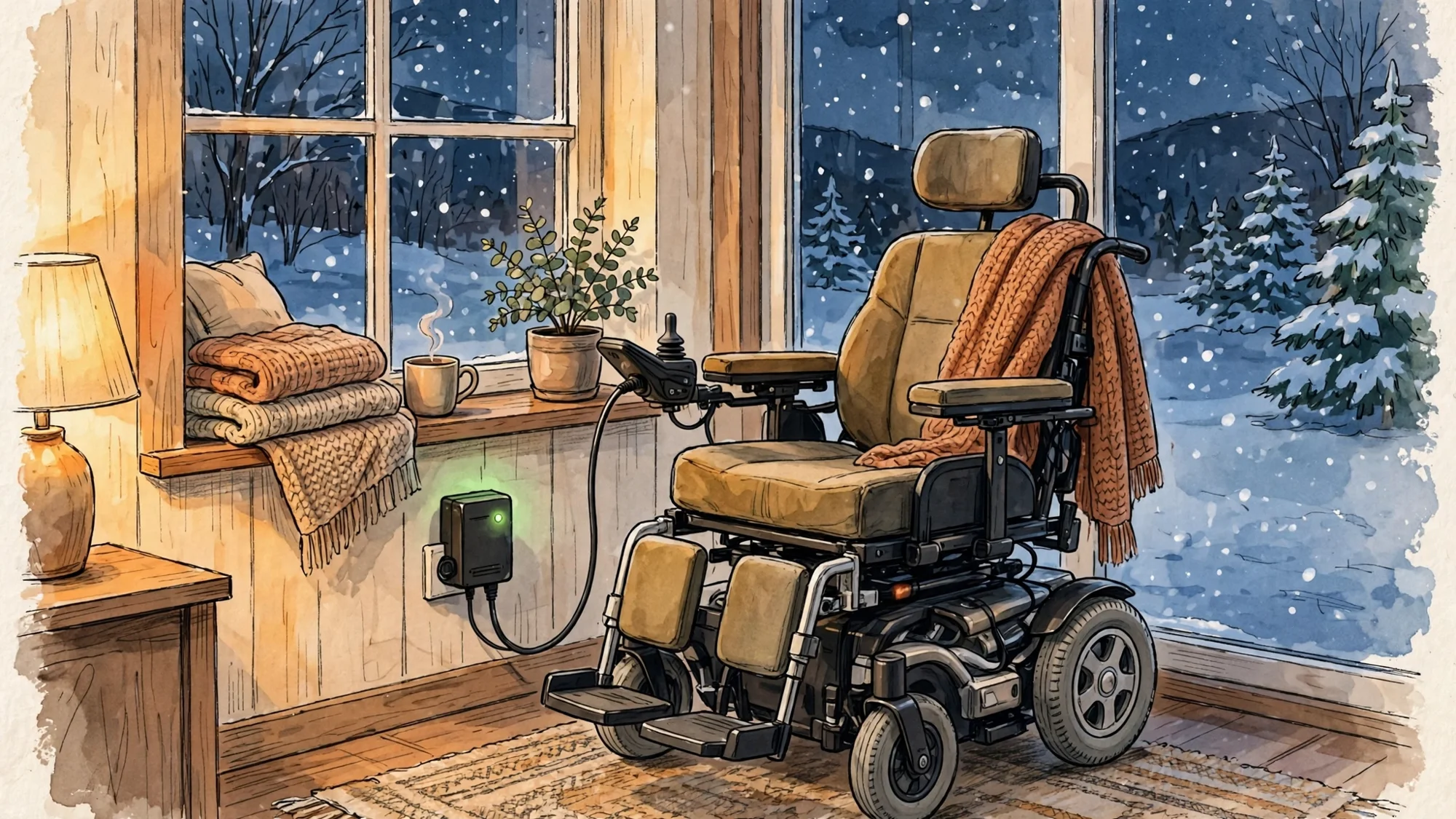
One travel detail worth planning for is temperature. Permobil recommends charging and storing the wheelchair at a normal indoor temperature of around 20°C, noting that in colder conditions charging can take longer and battery capacity can drop, reducing how far the chair travels per charge. A heated hotel room is fine; the chair left in a cold car overnight before an early checkout is not. If you are winter-traveling, bring the chair indoors with you — which also happens to be where the outlet is.
Before You Book: Three Things to Confirm With the Hotel
Charging works anywhere there is a wall outlet, but the trip goes smoother when the room itself fits the routine. Big hotel groups now publish their accessibility features online — Hilton, for example, shows a dedicated view of each hotel's accessible room options, gives detailed descriptions of accessibility features, and lets you filter search results to narrow down accessible room choices. Use those filters when booking, and then do what Hilton itself advises: contact the hotel directly with any questions about its accessibility features or disability-related requests.
Three questions to put to the front desk before you arrive will cover most charging situations.
First: can the chair park next to a reachable wall outlet? Power wheelchairs charge while parked, so what you need is a spot where the chair can sit all night with its charger cable comfortably reaching a socket — not stretched across a walkway, and not behind heavy furniture you would have to move. Ask where the outlets are relative to the bed or desk area, and whether a ground-floor room or a room near the elevator would put you closer to the entrance with less corridor to cover.
Second: is the accessible room actually booked for you, not just promised at check-in? Accessible rooms are limited at every hotel, and the one room type with step-free bathroom access and wider doorways is also the one where a wheelchair can be parked, charged, and serviced most easily. Confirm the accessible room is blocked on your reservation, in writing, before you travel.
Third: for international trips, what plug shape and voltage will you find? The charger's label states the voltage range it accepts — read it before you pack, and bring a plug adapter that matches your destination's socket type. A universal travel adapter is light and cheap insurance, and the hotel front desk can usually confirm which adapter standard the country uses if you ask while booking. Confirming this before departure beats discovering the mismatch at midnight in a foreign room.
On the Road: Daytime Top-Ups and Cold-Weather Realities
Not every day ends at 8 hours of driving — but travel days are exactly the days when range gets tested: new cities, longer distances between sights, unfamiliar terrain, and the habit of saying yes to one more thing. Because the charger needs nothing but a standard wall outlet, you can carry it with you for the day. A restaurant table, a museum lobby, a train station waiting area — anywhere you stop for a while can give the chair an hour or two of extra charge. That is not a replacement for the overnight session Permobil recommends; it is a buffer that keeps the battery comfortably away from empty on your longest days.
A few ground rules travel well. Keep the charger on you rather than leaving it buried in the hotel room, so the option is there when you need it. Protect the charger and its cable in your bag the way you would any electronics — the plug pins that mate with the joystick socket are the part most likely to suffer from being tossed loose in luggage. And when you plug in during the day, let the session run its course instead of unplugging after twenty minutes if you can help it; the guide's "do not interrupt" advice applies to partial sessions too.
Cold deserves its own warning because it hits travelers hardest. Permobil's guide is explicit: colder conditions make charging take longer and can reduce battery capacity, which directly cuts the travel distance per charge. If your trip includes winter destinations, plan your days with a wider range margin than you would at home — assume the chair will not quite reach its usual distance between charges. Park the chair indoors overnight rather than in a vehicle or an unheated space, and give charging a little extra time in the morning before rolling out. None of this requires new gear or special knowledge. It just asks for the same discipline that keeps the chair healthy at home — nightly charging, uninterrupted sessions, reasonable temperatures — applied in a room that happens to have a hotel name on the door.