Both sources opened and verified on 2026-10-13: Quantum Rehab's TRU-Balance basic operation instructions (7 in / 17.78 cm lift, 300 lbs capacity, quarter-speed drive inhibit and tilt lockout while elevated) and Permobil R&D's published evidence summary on power seat elevation (tested 8 in / 12 in heights, functional-reach findings). iLevel 12-inch figures are from Quantum Rehab's official product specification pages.
What seat elevation is and what it does
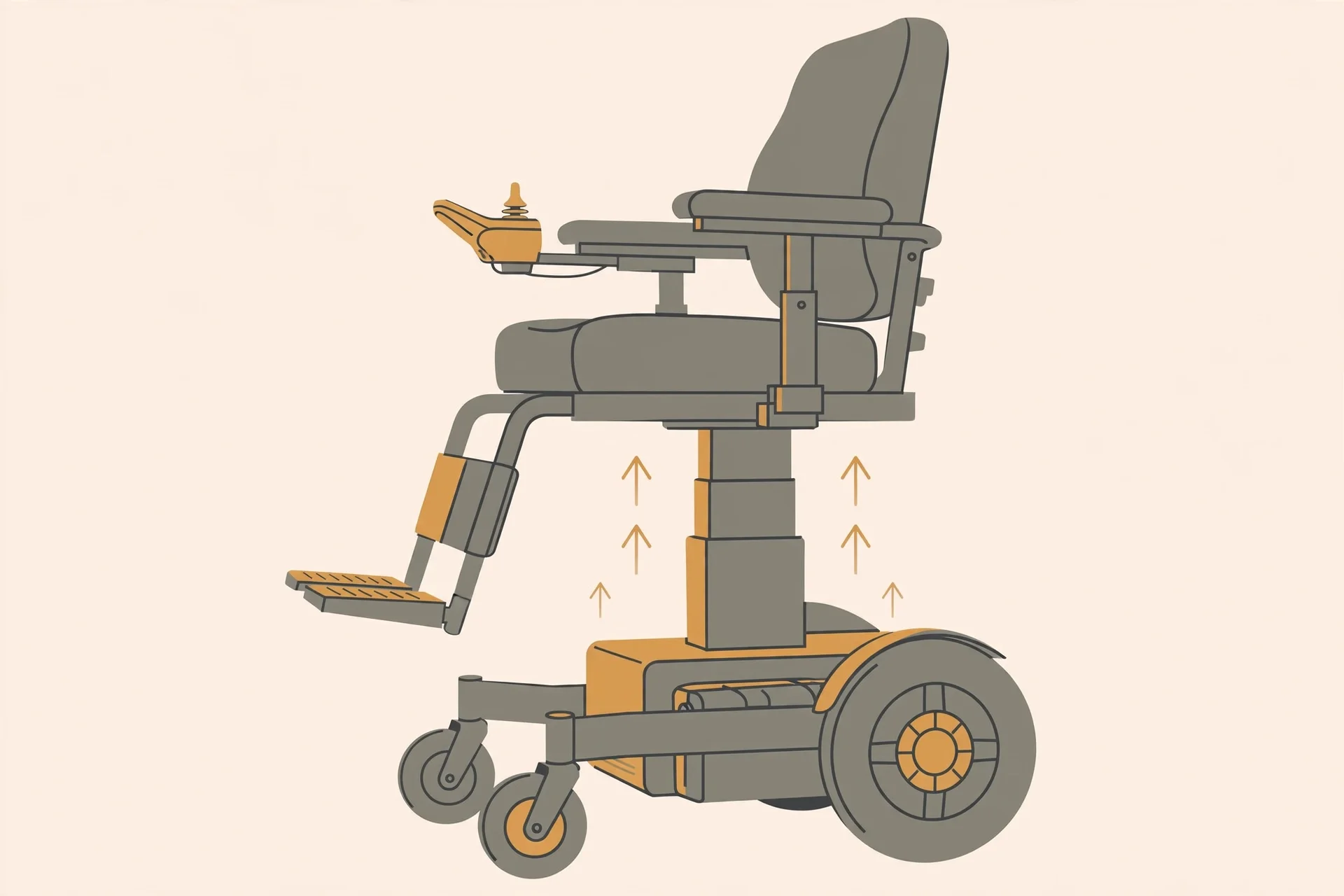
Seat elevation — sometimes sold as a seat lift or power seat elevator — is an actuator-driven function that raises the entire seating unit above its normal position on the drive base. Quantum Rehab's TRU-Balance documentation describes the mechanism plainly: a single post plate and actuator provides up to 7 inches (17.78 cm) of lift from the power base, operated through the power chair's controller or a toggle switch. Pull the toggle back and the seat rises; push it forward and it lowers. On some Quantum models a newer iLevel setup offers up to 12 inches of power-adjustable seat height, and Permobil's published testing covers 8-inch (20 cm) and 12-inch (30.5 cm) elevation heights, with the test chair reaching a maximum seat-to-floor height of 29.8 inches (75.7 cm).
The point of the extra height is functional reach. At normal driving height, much of daily life sits above a seated person's comfortable reach — wall cupboards, checkout counters, the top of a wardrobe, a colleague's face in a standing conversation. Raising the seat brings those things closer without requiring the person to stretch or to transfer out of the chair. Permobil's R&D summary of the evidence puts it in similar terms: elevation increases the possible functional reach and thereby increases environmental access at a variety of heights, which facilitates independent activities of daily living, transfers and communication.
Transfers deserve a separate mention because elevation changes the geometry of getting in and out of the chair. Permobil's summary notes that elevation lets the user make the height gap between the wheelchair and the transfer surface as small as possible, which can improve the ergonomics of transfers — sliding across to a bed or a car seat is easier when the two surfaces are level. That is a property of the mechanism, not a guarantee about any individual's transfer, and transfer technique is still a matter for the person's own assessment.
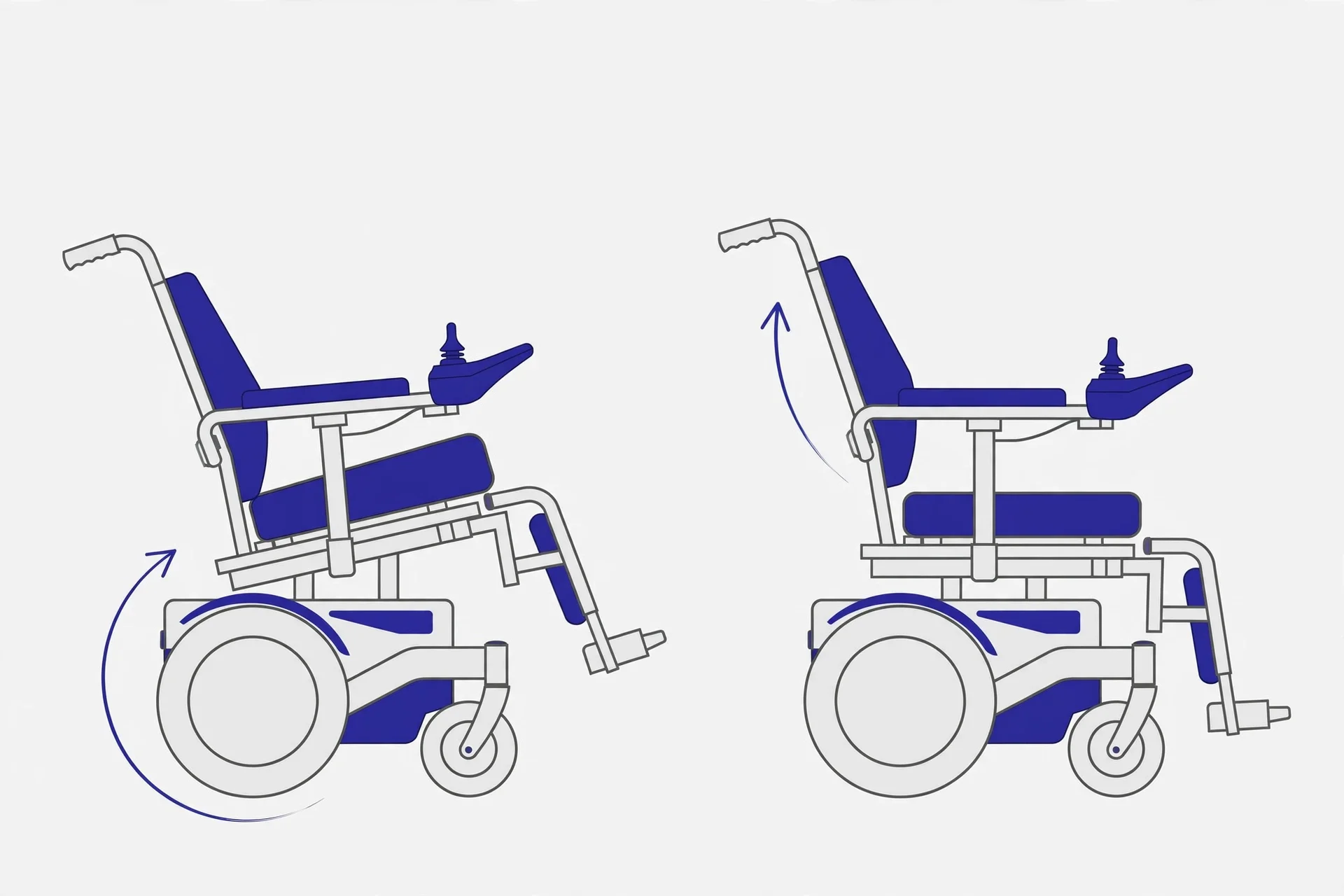
It is worth distinguishing seat elevation from the other powered seating functions it is often bundled with. Tilt changes the seat angle, recline changes the backrest angle, and elevating legrests raise the legs — elevation is the only one that moves the whole seated person vertically. On many chairs these functions share the same controller: the joystick or a switch box selects which actuator moves. Quantum's manual notes one interaction explicitly — when the seat is elevated, you can no longer tilt the seat — so the functions are not all available in every combination.
Finally, a note on what elevation is not. It is not a standing function: even at full height the user remains seated, with knees bent and feet on the foot platform. Standing wheelchairs are a separate category with their own frames, knee supports and safety systems. And it is not a substitute for an accessible environment — it extends reach within the world as it is, which is exactly why buyers tend to value it most in kitchens, workplaces and shops rather than as a general mobility aid.
Buying checklist: lift height, weight capacity and how the chair drives while raised
Start with the numbers, because they differ more between brands than brochures suggest. The first figure is lift height — how far the seat travels from its lowest to its highest position. Quantum's TRU-Balance power seat elevator is specified at up to 7 inches (17.78 cm). Quantum's iLevel option on models such as the Edge 3 Stretto is specified at up to 12 inches. Permobil's research testing used 8-inch and 12-inch elevation settings. Ask the dealer for the figure on the exact model and seating combination you are ordering, because the same base can offer different lift heights with different seating, and the number in the brochure may describe only one configuration.
The second figure is weight capacity. Quantum's manual states the power seat elevator's maximum weight capacity as 300 lbs (136 kg), and adds that the limit is the weight capacity in the power chair owner's manual or 300 lbs, whichever is less. That 'whichever is less' clause is the part buyers miss: a lift rated to 300 lbs on a chair rated to 250 lbs is a 250-lb system. Check both numbers and take the lower one.
The third thing to check is what the chair does while elevated. Manufacturers deliberately change the chair's behaviour at height, and the manual spells out how. On Quantum's TRU-Balance systems, elevating the seat engages a drive inhibit that limits the chair to one-quarter of its normal speed, and tilt becomes unavailable until the seat is lowered again. On iLevel-equipped Quantum models, the specification allows driving at up to 3.5 mph while elevated — still well below the chair's full speed. These are manufacturer-stated operating limits, and they are there because a raised seat changes the chair's centre of gravity and handling. Read the 'while elevated' section of the manual before you decide how you will actually use the function day to day.
Two smaller manual notes are worth surfacing because buyers rarely ask about them. First, Quantum's documentation notes that if the TRU-Balance actuator is equipped with a power seat elevator, there are no safety pressure switches on that actuator — a detail about the hardware as supplied, not a comment on other brands. Second, the same manual reminds users that the seating system is not approved for use as a seat in a vehicle, and that the seats and occupant restraints of the vehicle itself should be used. Both are statements from the manufacturer about its own product; other brands publish their own equivalents.
Beyond the manual, the usual buying questions apply. Is elevation a factory option on the model you want, or only on certain seating packages? Quantum's documentation says the elevator is available on some models and advises contacting the provider for specifics — treat 'can it be added later?' as a question for the dealer, because retrofitting a lift to a chair that was not built for one is not always possible. Does it change the chair's folded or transport dimensions? Does it add enough weight to matter for your vehicle lift or ramp? And how is it funded where you live — in some systems powered seating functions are coded and funded separately, which affects both price and paperwork. None of these have universal answers, which is why the checklist matters more than any single specification.
Questions buyers ask, answered
Can seat elevation be retrofitted to a chair I already own? Sometimes, but do not assume so. Quantum's documentation describes the power seat elevator as available on some models and directs buyers to their provider for specifics. A lift needs the right base frame, the right seating interface, controller capacity for an extra actuator channel and wiring for it. If your chair was ordered without the lift provision, the honest answer usually comes from the dealer looking up your serial number, not from a general rule.
Will using the lift drain the battery noticeably? Any powered seating function draws from the same batteries that drive the chair, and the lift actuator is one of the heavier draws. Manufacturers do not publish a simple 'minutes of lift per charge' figure, because it depends on the user's weight, how often the lift cycles and the battery size. The practical approach is the one dealers suggest: if you plan to use elevation heavily through the day, size the battery option up and keep the charging routine the manual recommends.
Can I still use tilt and recline with a lift fitted? The functions coexist on the chair, but not always at the same time. Quantum's manual is explicit that when the seat is elevated, the seat cannot be tilted — the tilt function returns once the seat is lowered. Recline and legrest behaviour while elevated varies by manufacturer and seating system, so this is another 'check the manual for your exact combination' item rather than something to assume.
Does elevation affect the chair's stability or its ratings? Raising the seat raises the centre of gravity, which is why manufacturers impose the while-elevated drive limits described above — quarter-speed inhibit on some systems, capped speed on others. Crash-test and occupied-transport ratings are separate certifications: Quantum's manual states its seating system is not approved as a vehicle seat, and occupied-transport approval, where it exists, is always model-specific. If you travel seated in the chair in a vehicle, confirm the rating for your exact model and seating combination.
What maintenance does the lift need? The manual's care section is short and worth following: keep all hardware properly secured but do not overtighten, and clean the seating system with a cloth dampened with mild soap and water, drying it thoroughly before use. Quantum also asks users not to change the seating configuration without contacting the provider first, and to report loose fittings promptly. A lift that sounds strained, moves unevenly or will not hold height is a service call, not a DIY adjustment — actuators and their mountings are dealer-service items.