Mechanical definitions of power tilt, recline and elevating leg supports from Permobil's official power seat functions page; usage patterns and memory-position features from Sunrise Medical's Education in Motion clinical article. Available ranges and options vary by wheelchair model; this guide describes mechanical functions only and is not medical advice.
Tilt-in-space: the whole seat moves as one
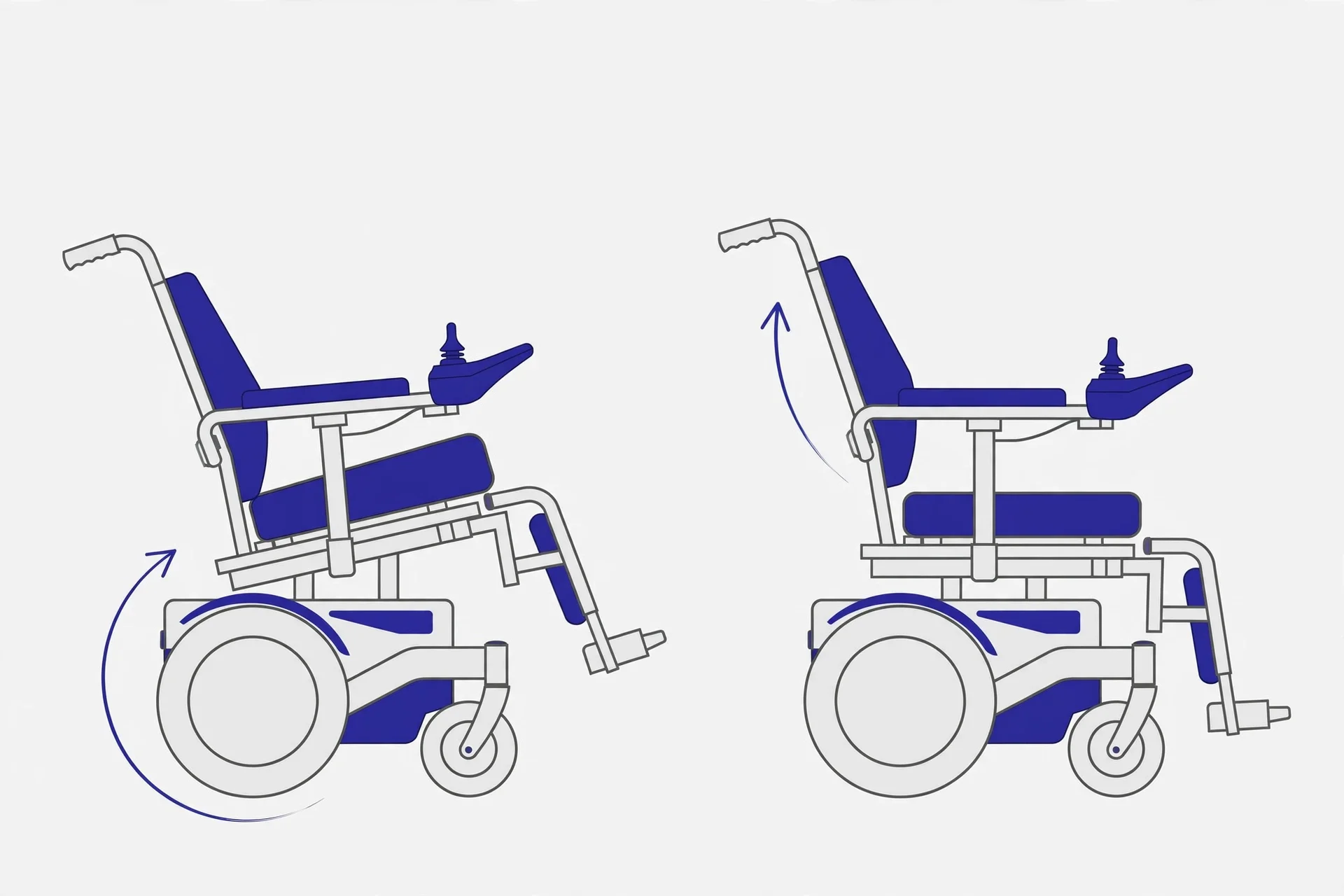
Tilt-in-space does exactly what the name suggests: the entire seating unit tips backward relative to the ground, and everything above the base moves together as a single piece. Permobil, one of the manufacturers that documents these functions in detail, defines power tilt as allowing a person to change their seat angle orientation in relation to the ground while maintaining a constant seat-to-back and seat-to-leg-support angle. In plain terms, your hips, knees and back stay folded at exactly the same angles; the whole posture simply rotates backward in space. This is the key mechanical distinction, and it shapes what tilt feels like in everyday use. Because your body does not change shape when you tilt, there is no sliding against the backrest and no change in how your weight is distributed across the seat and back. It feels like tipping back in a reclining armchair that carries you with it, rather than opening up like one. Users often tilt a few degrees simply to shift their line of sight, for example to look up at something high, or to settle back into a resting position without rearranging their posture. Small tilt angles are also the most commonly used day to day: Sunrise Medical's clinical education material notes that power seat functions are used most often for comfort, at modest angles, which matches how most people actually behave with the controls. Tilt range varies by model, with rehab-oriented chairs typically offering several dozen degrees of posterior tilt, so the spec sheet of the chair you are considering is the place to check. One more practical feature worth knowing: many power wheelchairs let you store favourite positions. Sunrise Medical describes programmable memory positions that can combine tilt, leg elevation and backrest recline into a single button press, so a position you use often — say, your preferred resting angle — is always one tap away rather than something you have to dial in manually each time. Tilt is operated from the chair's controls — typically the joystick, a switch box or remote buttons — and because the whole seat moves as one, the controls move with you, which is part of why tilt feels so stable. It is also worth knowing that tilt has a lesser-known sibling: some chairs offer a small amount of forward, or anterior, tilt as well, which tips the seat slightly toward the front and can help with reaching forward or positioning for certain tasks. Like posterior tilt, it moves the whole seat as a unit. When comparing models, look at both the maximum tilt angle and how smoothly the actuator moves through its range; a jerky tilt mechanism is something you will notice every single day, so this is worth testing in person rather than judging from a brochure.
Recline: the backrest opens while the seat stays put
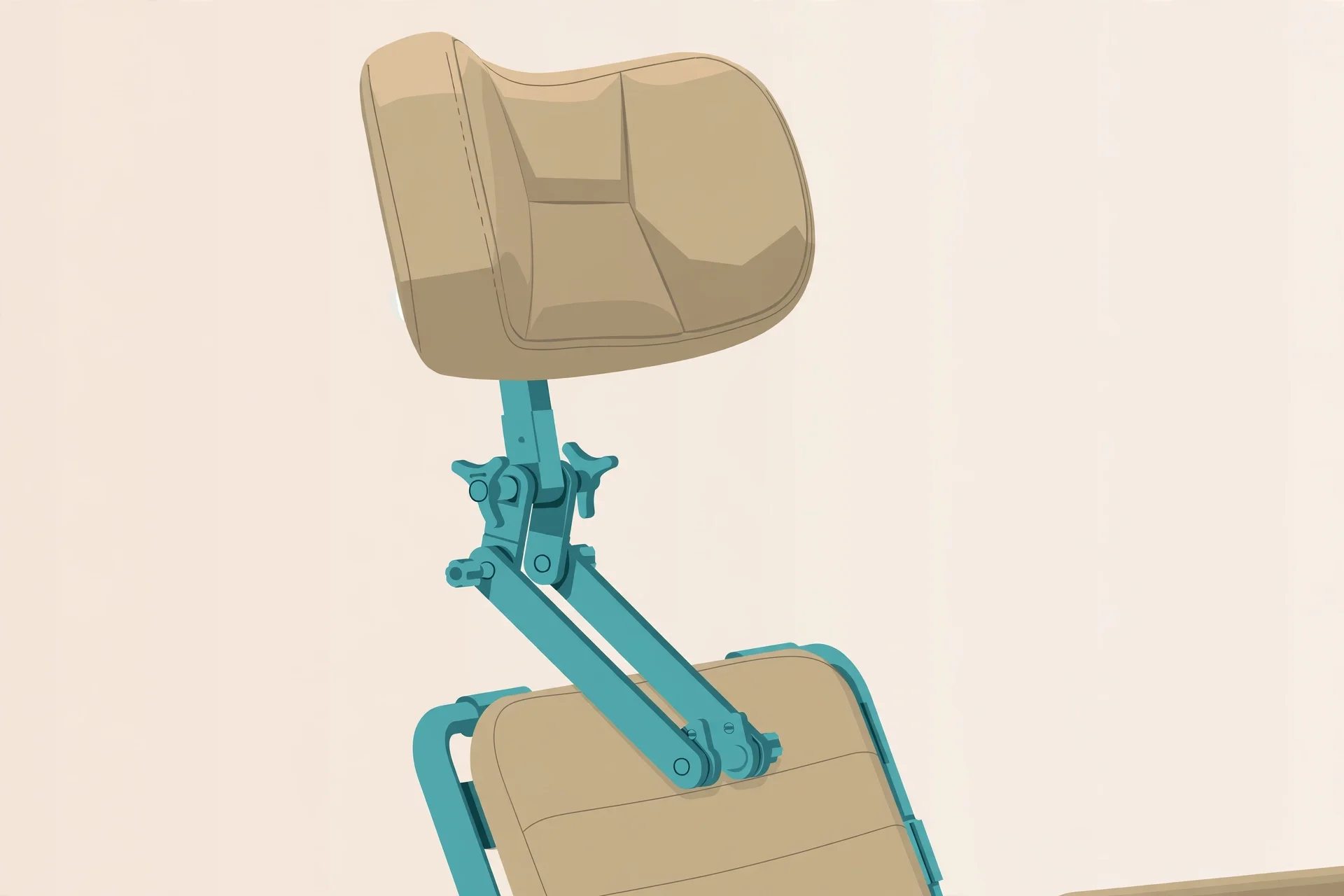
Recline works on a different axis. Instead of moving the whole seat, it changes the angle between the seat and the backrest while the seat base stays level with the ground. Permobil defines power recline as allowing a person to change their seat-to-back angle and maintain a constant seat angle with respect to the ground. Think of a standard reclining armchair: you lean back, the backrest opens behind you, and your seat stays where it was. Your hip angle opens up as you go, and on chairs with power elevating leg supports, the leg rests can rise to meet the new position — Permobil describes these as changing the leg support angle relative to the seat in order to flex or extend the knee. Recline ranges also vary by model, with many rehab power chairs offering a wide sweep from upright to near-flat, which is why recline is the function people reach for when they want to lie back properly rather than just tip back. Because the backrest moves relative to the seat, your body can shift slightly against the upholstery as you recline, which is why manufacturers engineer the pivot points of the backrest to follow the body's natural motion — Permobil, for instance, highlights biomechanically optimised pivot points in its Corpus seating system. In daily life, recline tends to be used for longer rest periods: leaning back to relax, changing out of an upright working posture, or making transfers and dressing easier by opening up the front of the body. It pairs naturally with elevating leg rests, since raising the legs while the backrest opens creates something close to a lying position without leaving the chair. One detail that matters in practice is how the backrest pivot is engineered. Because recline moves the backrest relative to the seat, a poorly designed pivot lets your body slide down the seat as the back opens; manufacturers address this with pivot points shaped to follow the body's natural movement, which is why seating geometry is a selling point on rehab-oriented chairs. Recline is also the function most often paired with elevating leg rests, and the combination is what creates the near-lying position: backrest open, legs raised, seat base level. Used thoughtfully, recline can turn the wheelchair into a place to rest properly during the day without transferring to a bed or sofa. The trade-off to be aware of is space: a fully reclined chair with elevated leg rests is considerably longer than the same chair upright, so think about where you will actually use the reclined position — at home it may be fine, in a crowded café considerably less so.
Tilt vs recline at a glance
The mechanical difference is simple once you see it, but it is easy to mix up when you are reading spec sheets. Here is the comparison that matters: | | Tilt-in-space | Recline | |---|---|---| | What moves | The entire seat unit rotates relative to the ground | Only the backrest moves, opening backward | | Seat-to-back angle | Stays the same throughout | Changes — the hip angle opens up | | Seat-to-ground angle | Changes — the seat tips back | Stays the same — the seat base remains level | | Leg supports | Move with the seat as one unit | Can be elevated independently to match the opened backrest | | Everyday feel | Like being tipped back without changing posture | Like leaning back in a recliner armchair | | Typical everyday use | Shifting position, resting while staying positioned, changing your line of sight | Resting more fully, opening the front of the body for transfers or dressing | A few practical consequences follow from this. Tilt keeps you in the same seated posture, which is why it is often described as the function that changes your orientation without changing your position in the chair. Recline changes your posture, opening you up, which makes it the closer match when the goal is to lie back. The two are not rivals: most mid-range and premium power wheelchairs offer both, and Permobil even provides an Independent Repositioning Mode that moves the power seat functions through a recommended sequence. Users commonly combine them through the day — a little tilt for comfort while working, a deeper recline with the leg rests up for a rest — and memory positions can store a favourite combination so you do not have to set each actuator separately. If you are still unsure which matters more to you, think about frequency. The function you will use ten times a day matters more than the one you will use once a week, even if the weekly one feels more dramatic. Someone who works at a desk and wants to shift position regularly through the afternoon will live in tilt; someone whose priority is a proper rest at midday will live in recline. Also consider who operates the chair: if a carer or attendant positions you, both functions need to be easy to operate from behind the chair as well as from the seating controls. And check how each function interacts with the rest of the chair — for example, whether the chair can still drive while tilted or reclined, and whether speed is reduced in those positions, since manufacturers handle this differently and it affects how freely you can move around the house.
Choosing: tilt, recline, or both
Start with an honest look at your day. If you mainly want to shift your position, rest briefly, or change your angle to the world while keeping the same seated posture, tilt is the function you will reach for most. If you want to lean back and open up — to rest more fully, or to make transfers and dressing easier — recline is the closer fit. Many buyers end up choosing both, because the two functions cover different moments: tilt for the small, frequent adjustments and recline for the bigger change of posture. Budget and complexity are real considerations, since each powered function adds actuators, weight and cost to the chair, and entry-level models may offer one but not the other. Check the spec sheet for the actual ranges on the model you are considering, because tilt degrees and recline degrees vary widely between manufacturers and product lines. Before deciding, try the functions in person. A dealer demonstration lets you feel the difference between tipping back as a unit and opening the backrest, and it shows you how the controls work — joystick menus, switch boxes or remote buttons — and whether they stay within easy reach in every position, a practical point Sunrise Medical's educators specifically flag. Finally, if your seating needs are complex, get an assessment from an occupational therapist or seating clinician before you buy. They can match the functions to how you actually sit, transfer and spend your day, which is a far better basis for the decision than a spec sheet alone. A dealer demonstration is the single most useful step, and it is worth preparing for it. Ask to try both functions through their full range, not just a quick nudge; operate the controls yourself, including any switch box or attendant control; check that the switches stay within comfortable reach when the seat is fully tilted or reclined; and try the positions you will actually use — your desk, your dining table, the transfer you do every morning. Ask about weight and transport too: power seat functions add actuators and structure, which adds kilograms, and that matters if the chair needs to go into a car. Ask what the warranty covers on the seating actuators specifically, since they are among the hardest-working parts of the chair. And be wary of choosing on price alone: a cheaper chair with a limited tilt range that you use constantly is worse value than a pricier one whose functions match your day. The right choice is the one whose movements line up with the movements of your life.