Function definitions from Permobil's official product and clinical pages (permobil.com, hub.permobil.com), verified 2026-10-18. General information only, not medical advice; seating prescriptions need a clinician assessment.
All Four in One Paragraph Each
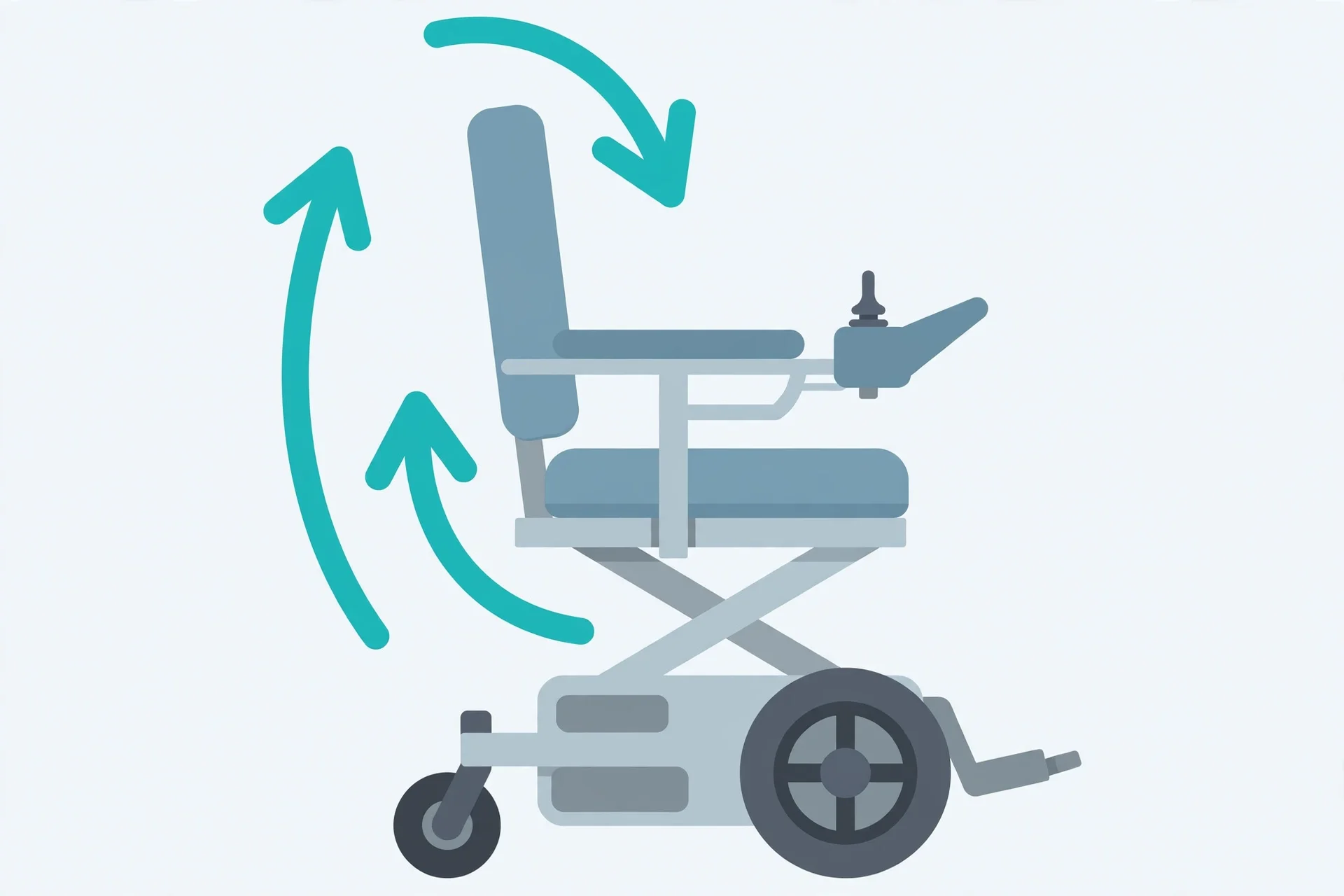
Let's meet the four functions before we go deeper. Power tilt tips the entire seat assembly forward or backward relative to the floor — like a rocking chair that stops wherever you tell it — while the angle between your seat and backrest, and between your seat and legrests, stays exactly the same.
Power recline does the opposite job: it opens or closes the angle between the seat and the backrest, while the seat's angle against the floor doesn't change. Think of a lawn chair tipping its back down.
Power elevating legrests swing the leg supports up and down relative to the seat, bending and straightening your knees. Articulating versions get physically longer as they extend, following the natural arc of your legs.
And seat elevation — Permobil markets it as ActiveHeight — raises or lowers the whole seating system straight up or down, without changing any of the angles between the supports. Your posture stays identical; your height changes.
Different mechanics, different purposes. The next sections spell out what each one is actually for, based on how manufacturers and clinicians describe them.
Power Tilt
Tilt is the one people often describe as the most used function on their chair, and the mechanics are simple: the whole seat changes its angle relative to the ground, while the seat-to-backrest and seat-to-legrest angles stay fixed. Your body position within the chair doesn't change — the entire seating system just leans back or forward.
Because nothing opens or closes inside the seating, tilt is the go-to for changing your orientation without disrupting your posture. Manufacturers and clinicians describe it as the primary tool for pressure redistribution and resting — leaning back to shift weight off the seat surface, then coming upright again to get on with the day. Independent Repositioning Mode, on chairs that have it, runs tilt and the other functions through a recommended sequence to land you in a pressure-relieving position.
Recline and Elevating Legrests: A Package Deal
Recline changes the angle between the seat and the backrest — you lie further back — while the seat's angle against the floor stays put. It is the lawn-chair motion: same base, more laid back.
Elevating legrests change the angle of the leg supports relative to the seat, bending and straightening your knees. Articulating legrests physically lengthen as they rise, tracking the way your legs actually move rather than pulling your feet along an arc that isn't theirs.
Here is the pairing rule manufacturers keep repeating: use the elevating legrests together with recline. The hamstring is a two-joint muscle — it crosses both the hip and the knee — so straightening the knee without reclining the backrest can drag the pelvis into a posterior tilt, the classic slumped position. Reclining first gives the pelvis somewhere to settle. Articulation helps too, by keeping the thighs pressed onto the cushion so you don't slide out of position as the legrests rise.
Short version: recline opens the back, legrests lift the legs, and they work best as a team.
Seat Elevation: The Height Advantage
Seat elevation is the odd one out, because it doesn't change any angles at all. The whole seating system goes up or down — Permobil's version is called ActiveHeight — and your posture stays exactly the same, just higher or lower. (That definition comes from Waugh & Crane, 2014, which is the one clinicians tend to quote.)
Manufacturers and clinicians describe a long list of everyday uses: reaching the top shelf in your kitchen, cutting down on the overhead reaching that wears out shoulders and arms, getting through a work task at a normal counter height, transfers that start from a safer height, holding a conversation at eye level instead of looking up, and a better view when you are out and about in the community.
Pair it with a little anterior tilt — the seat tipping slightly forward — and you get a more natural forward-leaning posture for working at a desk or a sink. If tilt and recline are about rest and repositioning, elevation is about participation: being at the right height for the world you're in.
Choosing With Your Clinical Team and Dealer
Knowing the definitions is the easy half; getting the right combination prescribed is the other half, and that is a conversation, not a shopping cart. A clinician's seating assessment looks at how you sit now, where pressure builds up, and what a typical day demands — then matches functions to that reality.
When you talk to your dealer or therapist, bring specific scenarios: the shelf you can't reach, the transfer that feels sketchy, the afternoon when your back aches. Those details decide whether you need all four functions or just two, and they matter for funding paperwork too.
And one honest note to close on: this guide is general information, not medical advice. It explains what the buttons do. Which ones you need, in what combination, is a prescription question for the clinical team who has actually assessed your seating.