Guidance applies across cold-climate regions; Permobil/ Pride storage advice is written for sub-freezing conditions and may be less relevant in mild winters.
How Cold Weather Affects Your Power Wheelchair's Batteries
Cold weather hits power wheelchair batteries harder than almost any other part of the chair. Most power chairs run on sealed lead-acid (SLA/AGM) batteries, and these chemistries are sensitive to temperature. According to Permobil's official guidance, low temperatures reduce driving range and make charging slower — so the same chair that comfortably covers your full day in summer can run out noticeably sooner in January, and the charger can take longer to bring the batteries back to full.
Pride Mobility states the chemistry risk even more bluntly: storing SLA or lithium batteries for long periods below freezing (32°F / 0°C) gradually drains their capacity and can eventually kill the battery outright. That damage is cumulative. Once a battery pack has been weakened by sustained deep cold, no charger can fully bring it back, and you end up replacing an expensive battery pack far earlier than you should.
A few practical consequences follow directly from this. First, never judge remaining range by warm-weather experience alone. In winter, charge the chair every day, even after short outings — Permobil recommends daily charging for its AGM maintenance-free batteries as standard practice — and build a generous safety margin into every trip. Second, expect a full charge to take its normal 8–12 hours (Permobil's guidance for a complete charge), or a little longer; do not assume that a two-hour top-up is enough when it is cold. Third, always use the charger supplied with your chair. Permobil warns specifically against substitute chargers, and a wrong-specification charger shortens battery life year-round, not only in winter.
Finally, remember that cold amplifies the effect of an aging battery. A battery pack that already holds a little less than it used to in autumn may cross the line into "not quite enough" once temperatures drop. If you notice a sharp, sudden drop in range in late autumn, have the batteries tested before the real cold arrives rather than after you get stranded on a dark December afternoon. Most local mobility dealers can load-test a battery pack in minutes.
One rule worth memorizing: after a cold outing, bring the chair indoors and let it warm up before connecting the charger — charging a freezing-cold battery pack is inefficient and, repeated over a whole winter, shortens its service life. Permobil's warning against charging and storing in freezing environments exists precisely for this reason. An unheated garage that dips below zero overnight is exactly the scenario to avoid, even when the charger is plugged in and glowing green.
Where to Store and Charge It Over Winter
Where your chair sleeps in winter matters almost as much as how you charge it. Both manufacturers are consistent on this point: the ideal is a dry, indoor space at room temperature — Permobil suggests around 20°C — with reasonable ventilation, and the charger connected in that same space. Do not store or charge the chair in a freezing environment, such as an unheated garage in a cold climate, and do not leave it there for days on end in winter.
Pride Mobility makes a similar recommendation: during colder weather, keep the mobility product in a garage, shed, or indoors with at least some cover — and crucially, never leave the batteries exposed to prolonged freezing. Pride adds a useful option for owners whose living space is tight: on many of its models the batteries can be removed and brought indoors for charging, so the chair itself can stay in the colder space while the vulnerable part of the system stays warm.
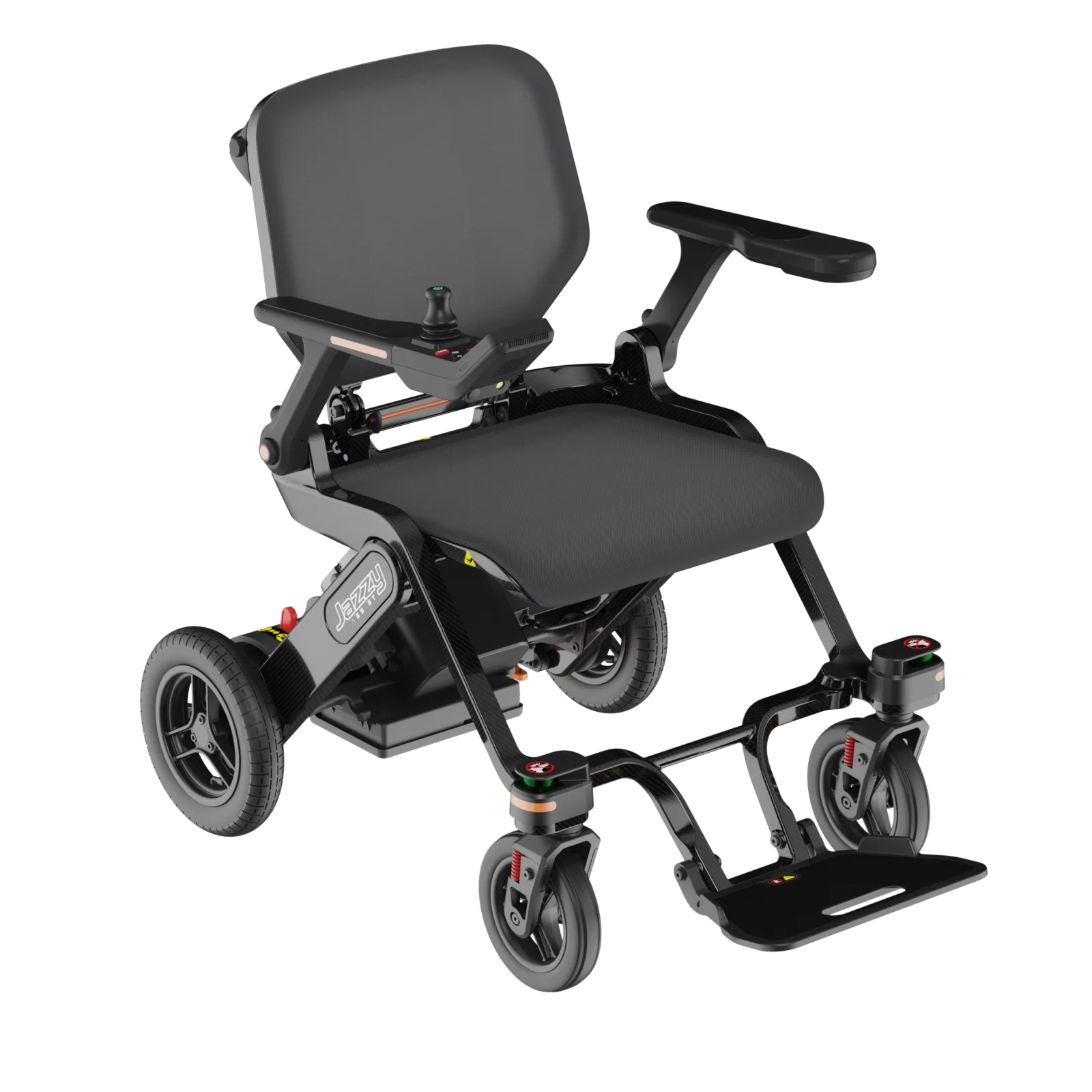
If indoor floor space is genuinely scarce, plan ahead rather than improvising in January. Pride notes that folding portable models can be folded and stored in a closet or under a bed for the season, and a fitted weather cover adds a useful extra layer of protection against dust, damp, and knocks. Just remember that a cover is not insulation: it keeps the chair clean and dry, but it does not protect the batteries from freezing temperatures, so the batteries still need warmth or to be charged regularly.
A quick pre-winter storage decision tree: (1) Can the chair live in a heated room or hallway? That is the gold standard. (2) If not, can the batteries be removed and charged indoors while the chair stays in the garage? Many chairs allow this — check your manual. (3) If neither is possible, is the garage at least kept above freezing? If yes, a weather cover plus frequent charging is a workable compromise; if the space regularly drops below 0°C, you need a different storage plan before winter sets in, because the cost of a replacement battery pack will exceed any storage hassle.
One more storage trap: the boot of a car is effectively an unheated space. On winter trips with longer stops, bring the chair — or at least its batteries — into the warm building rather than leaving it in a freezing car park for hours. The same applies to garden sheds and balconies: convenient, but no warmer than the night air.
A Winter Care Routine: Charging, Cleaning and Weekly Checks
With storage sorted, winter care becomes a routine — and routines are where most cold-weather problems are prevented rather than repaired. The single most important habit is daily charging. Permobil's batteries are designed around being charged every day, and Pride recommends charging at least once a week even when the chair sits unused for long stretches. A battery that is kept full is far more resilient to cold than one sitting half-empty, because a discharged battery is both weaker and more vulnerable to temperature damage.
Cleaning deserves a winter upgrade too. Road salt and grit are corrosive, so after outings on salted paths, wipe down the chair with a dry cloth and check around the joystick, casters, and battery area for salt residue. Permobil's cleaning guidance is straightforward: the chair handles light rain but is not waterproof, so avoid heavy rain and puddles, wipe the chair dry after it gets wet, and do not start charging until it is fully dry. Always power the chair off before cleaning, and never use high-pressure water on the joystick or battery compartment.
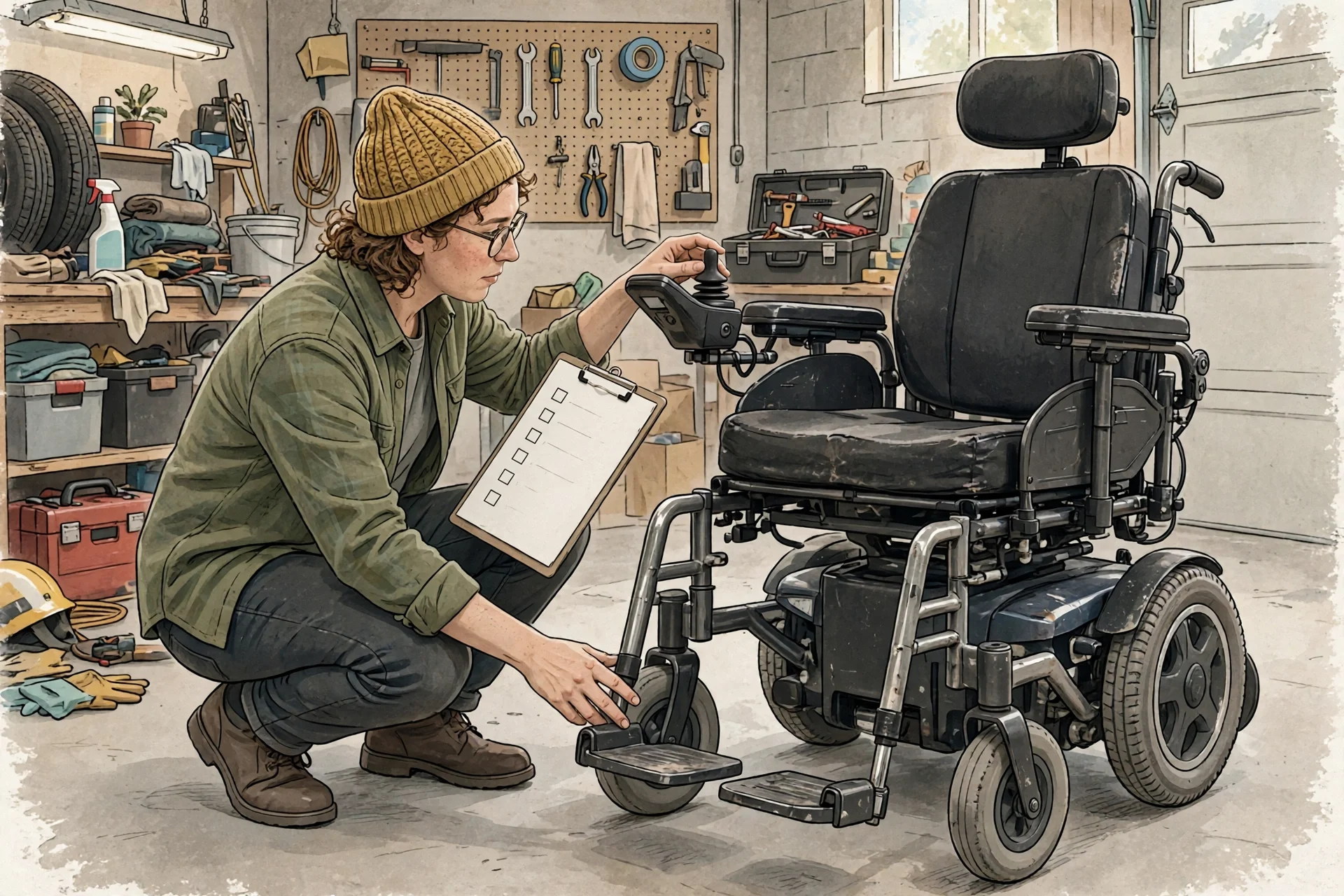
Then build in a short weekly inspection. Permobil recommends regularly checking tyres and casters, listening for unusual sounds, and confirming that everything moves and locks as it should. Here is a practical winter checklist you can run every Sunday:
- Charge status: batteries at full, charger functioning normally, cables and connectors clean and undamaged. - Tyres and casters: check for wear, cuts, and correct pressure on pneumatic tyres; confirm casters swivel freely and are not clogged with salt or grit. - Frame and seating: look for new cracks, rust spots, or loose bolts, especially after outings on salted roads. - Joystick and controls: test responsiveness in all directions; confirm the rubber boot around the joystick is intact, because moisture ingress here is a common winter fault. - Brakes and locks: test that the brakes hold on a gentle slope and that any manual freewheel levers are back in drive mode after transport. - Charger: always the original unit supplied with the chair; confirm the charging port is clean and dry before connecting.
Work through that list once a week and the vast majority of winter surprises — flat spots on tyres, seized casters, sluggish joysticks, range that quietly halves — get caught early, when the fix is cheap and convenient.
Getting Out and About Safely in Snow and Ice
A well-kept chair is only half the winter equation; the other half is how you use it. Start with the water rules. Your power wheelchair copes with light rain, but it is not waterproof — Permobil is explicit about this. Avoid riding through deep puddles or slush that can splash up into the motor and electronics housings, and if the chair does get wet, wipe it down with a dry cloth and let it dry completely before charging. Charging a wet chair risks short circuits at the charging port.
Snow itself brings specific challenges. Fresh, deep snow increases rolling resistance dramatically, which drains batteries faster and strains the motors. Plan routes on cleared, gritted paths, and allow extra range for the return leg — remember that cold is already reducing your range, so a trip that used 40% of the battery in summer can need substantially more in winter. If the casters are small, expect them to dig in and drag in anything deeper than a light dusting; folding chairs with small casters are the most affected.
Ice is the real danger, not just an inconvenience. No power wheelchair tyres are designed for black ice, so treat icy slopes and pavements with extreme caution: slow down, avoid sudden turns, and never attempt a slope you would not walk down in the same conditions. If your chair has a slower speed setting, use it outdoors in winter. Salt and grit on the path protect your tyres but attack the chair — which is why the post-outing wipe-down in the routine above matters most on the days you travel furthest.
Finally, pack for the trip like a winter motorist would. Carry your phone, a small cloth for wiping down the joystick and seat, and — on longer outings — keep the route plan conservative enough that you could still get home if the battery indicator drops faster than expected. Let someone know your route on the worst days. Winter does not mean staying indoors all season; it means giving the chair, and yourself, the margin the season demands.
Finally, rehearse one small skill on a dry day, not in a snowdrift: the manual freewheel levers. If the chair ever gets genuinely stuck in deep snow, knowing how to disengage the motors and push it free — and remembering to re-engage drive mode before riding again — turns a bad situation into a minor one.