General guidance; sizing examples come from the retailers' own charts and differ between manufacturers. Tax/VAT relief rules mentioned in one source apply to the UK only.
Why your hands need their own protection
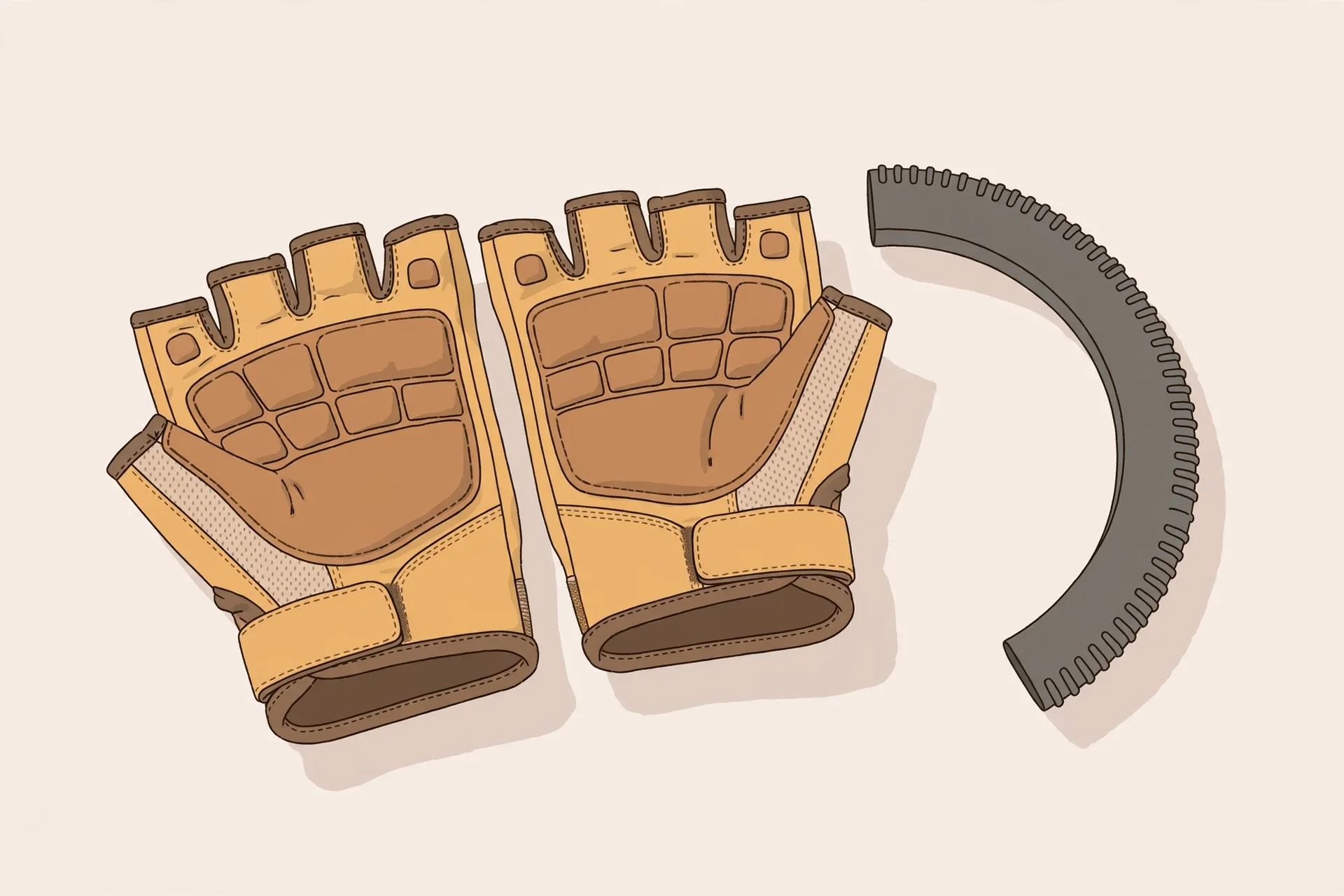
Every push stroke drags your palms across the hand rims. On a quick trip to the shops that is a minor irritation; over a full day out, repeated thousands of times, that friction becomes the whole story. The padding on a wheelchair glove sits exactly where your palm meets the rim, and its job is to absorb friction and pressure at that contact patch — the spot where blisters and hot spots start. A glove designed for pushing puts its thickest protection at this contact point, which is what separates a purpose-built push glove from a cycling or gardening glove that merely looks similar.
Grip is the second reason. Cold hands lose strength and feeling, and a wet rim turns slick just when you need to brake on a slope or hold a line across a cambered pavement. A mesh back helps here because a palm pressed against metal sweats in winter as readily as in summer, and trapped moisture against your skin makes blisters more likely, not less. Finger pulls, the small tabs on many push gloves, exist for one practical reason: a glove that takes ten seconds to peel off with wet hands gets left in a pocket and then lost.
There is also an honest limit worth stating before you spend anything. Researchers who study propulsion look at the wrist joint, not the palm, because that is where the loading happens. A padded palm does not change the path your wrist takes through the push stroke; it changes the skin between you and the rim. So gloves are genuinely useful for blisters, hot spots, cold hands, and a wet rim — but they are not treatment for wrist or shoulder load. Seat height, rim diameter, and technique are where that argument lives, not padding.
If you already have numbness, night-time tingling, or hand pain that does not settle, buy the gloves and then raise the symptoms with your wheelchair service or GP. Those are signs to investigate, not a shopping problem, and no product page should be allowed to tell you otherwise. Think of gloves as hand maintenance for the miles you push, and get the body mechanics checked separately.
Wet weather deserves its own note. Rain does not just make you damp; it changes the friction equation at the rim. A soaked cotton glove goes cold and stays cold, while a mesh-backed push glove dries faster and keeps some grip on a wet rim. If you ride through winter, think of your gloves as part of your wet-weather kit alongside whatever covers the rest of you — and keep a dry spare pair in your bag. Swapping into dry gloves halfway through a long wet day is one of the simplest comfort upgrades in wheelchair life.
The three styles you will find for sale
Walk into any mobility retailer and you will meet three broad families of glove, plus one feature that cuts across all of them.
Open-finger gloves, often sold as fingerless, leave the fingertips exposed. Their advantage is dexterity: you can manage everyday tasks — keys, phones, zips, door handles — without removing them, and the open design ventilates in warm weather. Retailers describe them as the everyday choice for indoor use and for people who are constantly handling small objects. The trade-off is obvious: exposed fingertips get cold, and they have no barrier against grit or damp.
Full-finger gloves close that gap. They protect against the elements and against abrasions, keep hands warmer, and create a barrier against dirt and debris. They are the choice for winter use, outdoor enthusiasts, and rural environments where the weather does the talking. The trade-off runs the other way: less ventilation, and you will be taking them off more often for fiddly tasks.
The feature that matters more than either style is the padded palm. Suede padded palms are designed for better traction on push rims and to reduce hand fatigue over long pushes, while the base materials do the rest of the work. Soft goat-skin leather is a common choice because it stays durable while remaining flexible enough for daily comfort; mesh backs let the hand breathe. Two construction details are worth checking on any listing: a Velcro strap closure, which gives a secure and adjustable fit you can tweak through the day, and reinforced stitching in the high-tension areas, which is what lets a daily-use glove survive months rather than weeks.
When you compare listings, read for the contact points described and ignore the adjectives. Padded palm, mesh back, full-length thumb, finger pulls: each is a specific answer to a specific problem. The glove with the longest feature list is not automatically the best one for your hands.
One last comparison point: price and lifespan. A budget pair with thin padding and single-row stitching may be fine for occasional use, but full-time pushers wear through contact points fast — reinforced stitching and denser palm padding are what separate a daily-work glove from a weekend one. Read the materials list the way you would read an ingredient label: quality leather or a good synthetic for the palm, padding at the contact patch, mesh for the back, and a closure you can operate yourself. If a listing cannot tell you what the palm is padded with, that is information, too.
Measure twice, buy once: fit and aftercare
Sizing is the least glamorous part of buying gloves and the part most likely to decide whether you wear them. The standard method is simple: measure around your palm at its widest point, excluding the thumb, and in some cases also from the wrist crease to the base of the middle finger, then compare those measurements against the manufacturer's own sizing chart. This last step matters because hand sizes vary significantly between brands — one maker's medium is another's large. One retailer's chart, for example, steps through small, medium, large, and extra-large by hand size in centimetres, but you should always use the chart printed by the maker of the glove you are buying.
If you fall between sizes, think about your priority: a slightly roomier fit suits circulation concerns, while a snugger fit gives more precise rim control. When the glove arrives, run a quick checklist before you commit to it. The Velcro should close securely without cutting in. You should be able to open and close your hand comfortably. There should be no pressure point over the knuckles or at the thumb, and no excess material bunching across the palm — loose folds become their own friction problem on the rim. Push your chair around the block in them; ten minutes of real pushing tells you more than any size chart.
Aftercare keeps a good pair good. Follow the manufacturer's washing instructions, and air dry the gloves away from direct heat rather than leaving them balled up damp in a chair pocket. Inspect the palms regularly: padding that has compressed flat, suede that has worn smooth, or stitching that is lifting at the thumb crotch — the spot where the thumb meets the palm that takes the most abuse — are all signs the protection is fading. Gloves are consumables, not heirlooms. Replacing a worn pair on time is cheaper than the blisters and grip problems a dead pair quietly brings back.