Special care criteria and equipment vary by local service; ask your dentist or GP about a referral to your local community dental service.
In brief
- Birmingham special care: adults 16+, including those unable to weight-bear and transfer without special equipment
- Barts Health: one of only four special care units in London; stretcher, wheelchair recliner and hoist available
- Both services need a professional referral - no walk-in service; domiciliary care may suit some housebound people
Start with an ordinary practice, and ask the right questions
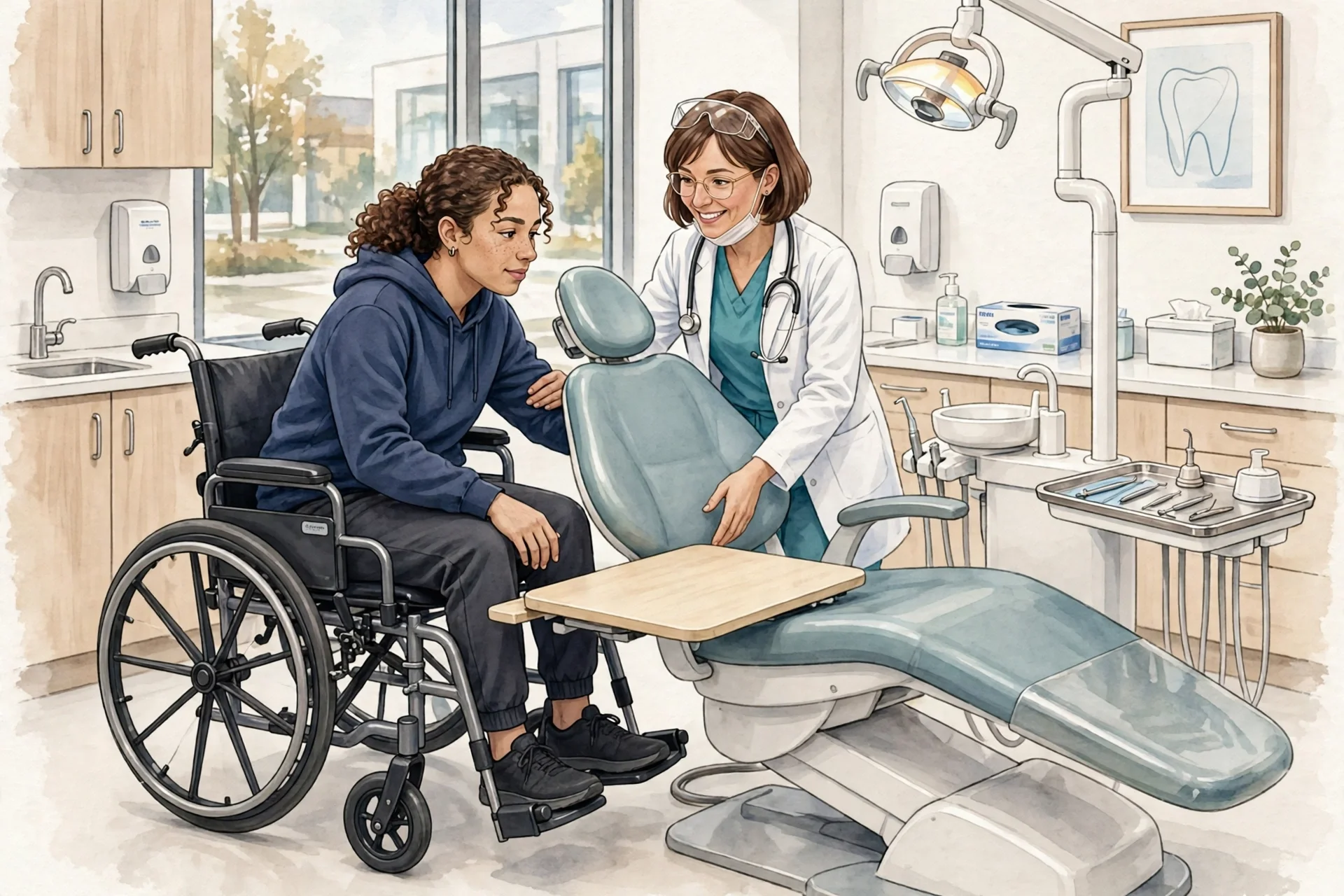
Many wheelchair users can be treated in an ordinary practice, and the questions to ask are practical: is there step-free access at the entrance and throughout, is there an accessible toilet, is there a wheelchair recliner or transfer equipment, and can the practice accommodate treatment in your own chair if transfer is not possible? NHS facilities pages for individual dental practices list exactly these headings, including step-free access, wheelchair access throughout, and dental treatments using a wheelchair recliner, so check the page for your practice rather than assuming. If the practice cannot answer, or if transfer into the dental chair is not possible even with help, that is not a dead end; it is the point at which a referral to special care becomes appropriate. Ask your dentist, doctor or other healthcare professional about a referral, and ask what equipment the receiving service has, so the referral goes to a clinic that can actually treat you.
What special care dentistry offers
Birmingham's community service is consultant-led and provides specialist care on referral for adults aged 16 and over who meet its criteria, which include severe difficulty communicating, giving consent or co-operating with treatment, complex medical conditions with significant risk, inability to weight-bear and transfer into the dental chair without special equipment, or severe and enduring mental health problems that restrict care. Specialist facilities such as sedation, general anaesthetic, wheelchair recliner, transfer equipment and bariatric chair are available at selected sites, with hospital-setting treatment available at Queen Elizabeth, Edgbaston and Russell's Hall. Barts Health describes a similar picture in London: patients aged 16 and over with medical and behavioural complexities, including physical disabilities, treated with multi-disciplinary surgery, sedation and general anaesthesia where needed, and barriers reduced through stretcher, wheelchair recliner, hoist and additional facilities. Both services require referral by a relevant medical, dental or social care professional; neither offers a walk-in service. Domiciliary care, treatment at home, is available in some circumstances: Birmingham notes that referrals may be accepted for some people who are housebound, and that those who only need dentures made at home should contact NHS 111 for general practitioners offering domiciliary care.
Making the referral work
A referral works best when it carries the right information: that you cannot transfer without special equipment, what equipment you need, any communication or medical complexities, and whether a home visit is needed because you cannot leave the house. Birmingham's referrals are assessed by a triage team to ensure the patient fits the criteria and is on the correct pathway, and referrals from general dental practitioners go through an electronic referral system. If you are outside Birmingham, ask for your local community dental service, since these services are organised locally and criteria vary. The key point is that special care is not a lesser service or a last resort; it is a consultant-led service with equipment and staff that ordinary practices do not have, designed for exactly the situation where transfer, communication or medical complexity makes ordinary treatment unsafe or impossible. Ask early, before a dental problem becomes urgent, because triage and referral take time.