Motorway bay audit surveyed November 2024 across 95% of Britain's motorway service stations; tracker attitudes are September 2026. Site facilities change - check the operator before travelling.
The headline numbers
The September 2026 tracker finds that 30% of Motability Scheme customers now feel positively towards electric vehicles, up from 26% in June 2025, yet 44% still rule out an EV for their next vehicle and 60% feel people like them are not being included in the transition. The reasons split by audience: for the wider public, upfront cost dominates, cited by 52% of those who feel excluded, while for disabled drivers practical charging problems matter more - 39% point to being unable to charge at home, and 31% of Scheme customers with EV experience cite accessibility issues such as heavy charging cables and narrow charging bays. The motorway audit behind those figures assessed 1,166 charging bays across 95% of Britain's motorway service stations, and found that just 28.6% met the British Standards guidance of at least 360cm total width, with raised kerbs and obstructions among the other common problems. Eleven service stations, roughly one in eight, had no accessible bay at all.
Where accessible bays are hardest to find
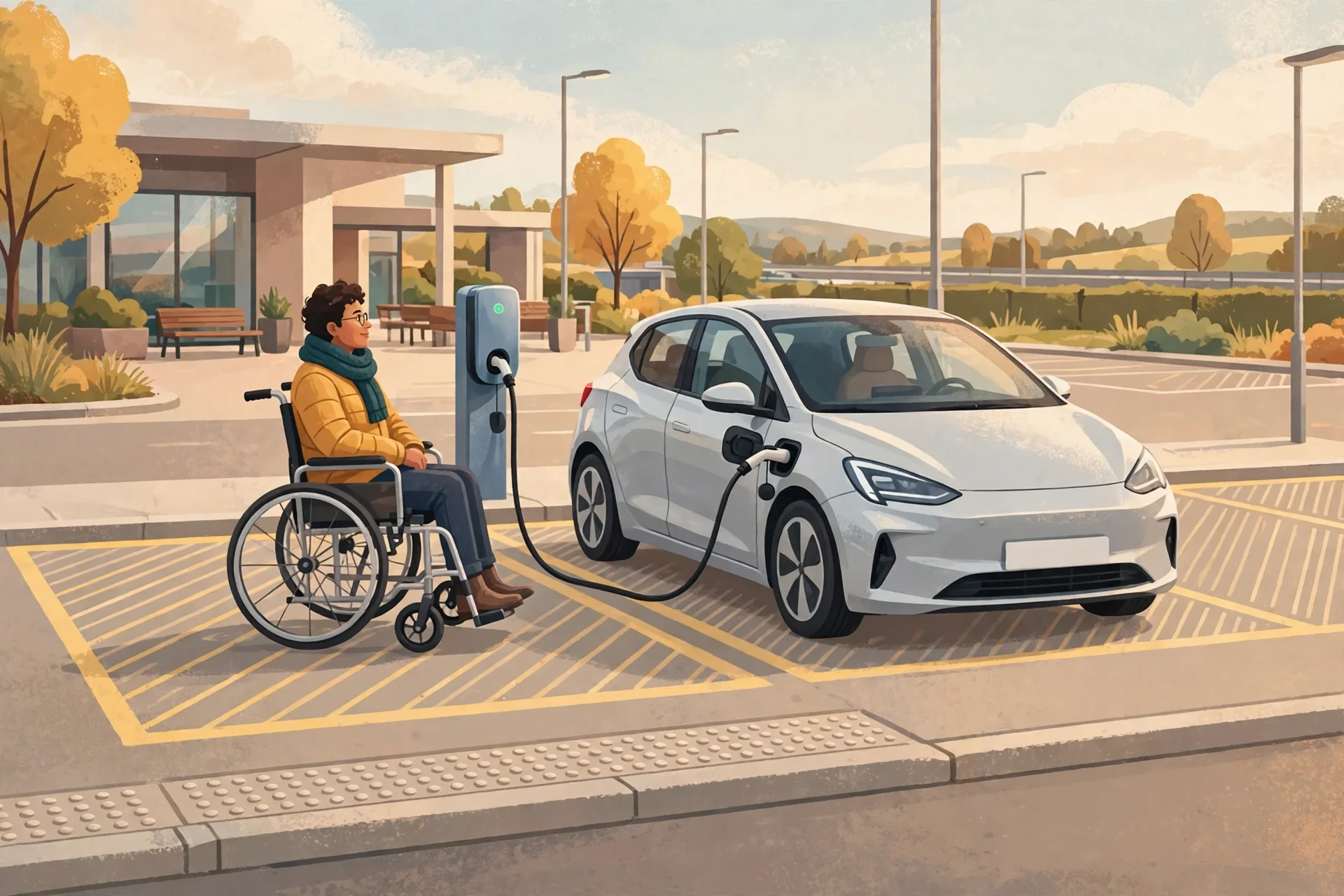
The regional picture is uneven. The East of England performed best at 43% of motorway bays meeting the width requirement, followed by the North West at 40%, while London and the South East both sat at 20% and the North East was weakest at just 16%. Motability's own summary rounds the national figure to 29% of motorway charging bays meeting the width requirement. For a wheelchair user, width is not a luxury: it is the space needed to open a car door fully, transfer, and manoeuvre around the car and the charger. A bay that is technically usable for a standing driver can still be unusable for someone who needs that extra room, which is why the audit's 360cm benchmark matters more than a simple count of chargers at a site.
What PAS 1899 is, and how to check before you travel
PAS 1899 is the accessibility standard for public charge points, co-developed by the Motability Foundation with the UK Government and the British Standards Institution, covering features such as bay width, cable weight, reach and kerbs. Motability argues that ensuring charging infrastructure meets PAS 1899 criteria will be vital to keeping disabled drivers in the transition. Until that is universal, the practical checklist for a journey is: check the bay width and surface in the charging app or the operator's site information where it is published, favour sites with level access and dropped kerbs, carry a note of the operator's helpline in case a charger is faulty or blocked, and plan a fallback charger rather than arriving at a single site on low charge. If you use the Motability Scheme, the audit results are available in the Motability Go app, which lets you check motorway sites before setting out.
Home charging changes the picture - when it is possible
The tracker also explains why home charging dominates disabled drivers' preferences: one customer quoted by Motability, an amputee on a second EV lease, says day-to-day driving with a home charger is easy, but motorway charging is the challenge, because enough room is needed to open the car door properly and get a leg out. Another says avoiding the public network altogether is the current strategy. That is why the 39% who cannot charge at home face the sharpest version of the problem: they depend on exactly the public network where only about three in ten motorway bays meet the width standard. If home charging is an option for you, it is worth pursuing before committing to an EV; if it is not, test the public chargers on your regular routes before signing, and treat bay width as a purchase criterion, not an afterthought.