Garden centre layouts and borrowed-wheelchair availability vary; confirm outdoor surfaces and booking rules with the centre.
In brief
- Dunbar: 9 Blue Badge bays, entrance 173cm wide, wheelchair to borrow, 2 accessible toilets
- Dobbies Perth: level pathways, lifts and ramps, wheelchair hire, fully accessible restaurant
- Check outdoor surfaces separately - concrete and tarmac differ sharply from gravel and bark
Start outside: surfaces decide the plant beds
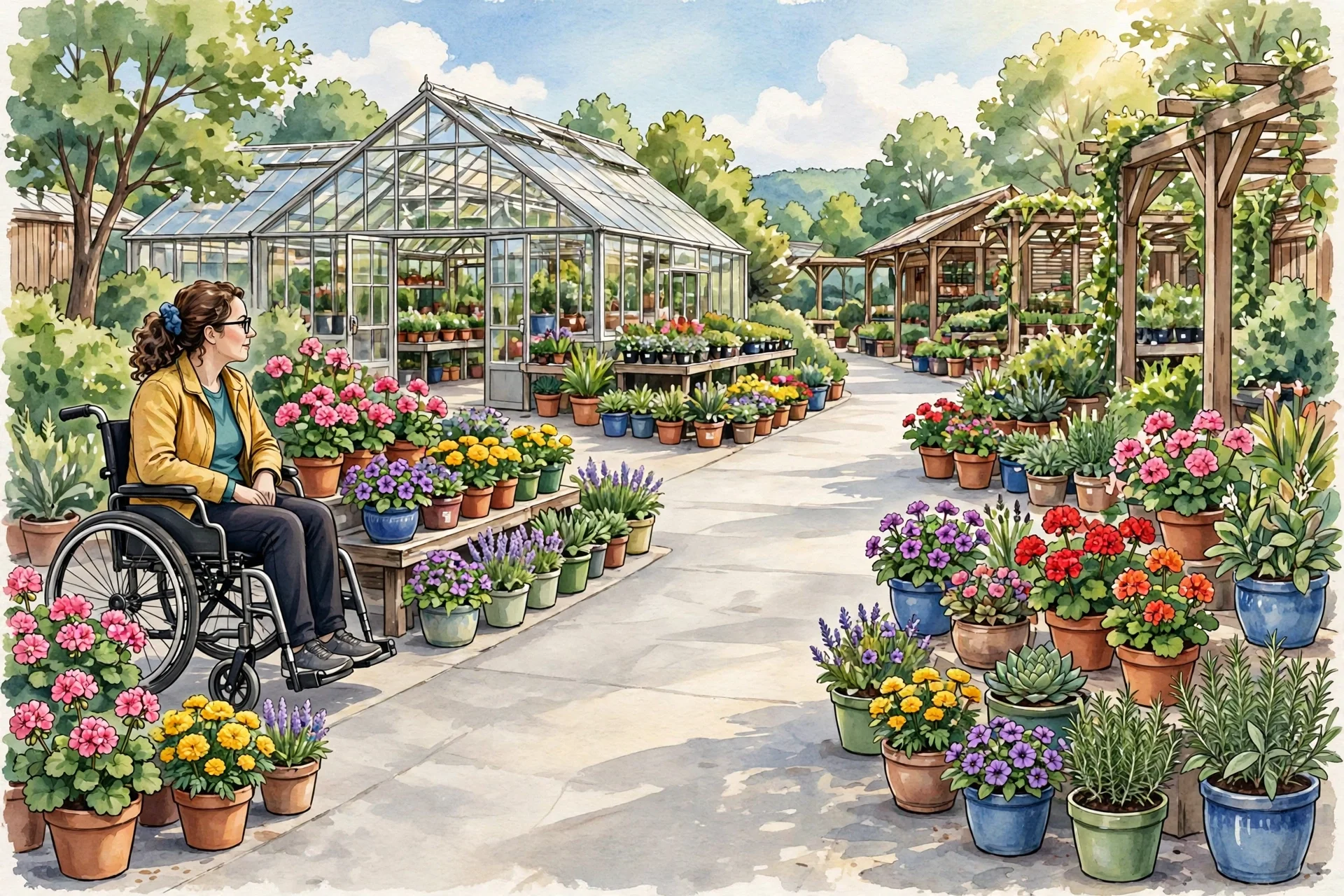
Outdoor plant areas are where garden centres differ most. Dunbar's guide is specific: the outdoor garden centre area has step-free level access, surfaces of concrete or tarmac, footpaths in all of the outdoor spaces, and most paths wide enough for wheelchair users, with bench seats along the paths for resting. That is a usable outdoor visit. But the same guide warns that the play area has loose wood chippings and no footpaths in all of it, which is a reminder to ask which outdoor zone you are actually visiting. Gravel, bark and grass behave very differently under a wheelchair from concrete and tarmac, and a centre that is perfect indoors can still be hard work outside after rain. Before you go, check the guide's outdoor surfaces line and its bench line; a centre with no resting seats along a long outdoor route is a shorter visit than it looks on the website.
Inside: aisles, tills and a chair to borrow
Dobbies in Perth is described as having smooth, level pathways throughout, lifts and ramps between levels, disabled toilets throughout, and a restaurant that is fully accessible with wide doorways and room to manoeuvre, plus wheelchair hire for visitors. Dunbar gives the measured version of the same idea: most shop aisles are 150cm or wider, there is step-free access to the tills, a portable card machine is available, and a standard wheelchair can be borrowed, while the till itself is 90cm with no low-level till for seated users. The two together make the indoor checklist: aisle width, till height, a portable card machine if the till is too high, and whether a wheelchair is actually available to borrow. Dunbar also records 2 accessible toilets, one about 40m from the main entrance in the restaurant area, with a cubicle 160cm by 222cm and a turning space of at least 150cm by 150cm. That distance matters: an accessible toilet at the far end of a large centre is a different proposition from one by the entrance.
The cafe test, and a garden centre checklist
End with the cafe, because it is where a visit succeeds or fails socially. Dunbar's restaurant has step-free level access, tables at 70cm to 80cm high, room for a wheelchair user to manoeuvre of 150cm by 150cm, and a mixture of chairs with and without armrests, but no low-level counter at the recommended 76cm to 86cm height. In other words, sitting down works, ordering at the counter may need staff help. Dobbies Perth, by contrast, is described as fully accessible in its restaurant with wide doorways and space to manoeuvre. Ask for table service or a staff member to take your order at the table if the counter is too high; most centres will do this if you ask before you queue. A short checklist covers the whole visit: Blue Badge bays and their distance from the entrance, outdoor surfaces, a wheelchair to borrow, aisle width, till height and portable card machine, accessible toilet location, and cafe table height. Dunbar passes most of that list with numbers to prove it; your local centre should be able to do the same.
What to ask before you go
If the centre has no AccessAble guide, phone with the checklist, not with a general question. Ask: how many Blue Badge bays, and how far from the entrance; are the outdoor paths concrete or gravel; is there a wheelchair to borrow, and must it be booked; how high is the till, and is there a portable card machine; where is the accessible toilet, and how far from the entrance; and can cafe orders be taken at the table. The answers, written down, are worth more than a website badge, and they let you pick between two centres on facts rather than hope.