Skip to content
HomeGuidesdaily living
Guides / DAILY LIVING

Wheelchair-Accessible Libraries: Reading Rooms, Loans and What to Ask Before You Visit

Libraries are free, warm and step-free more often than almost any other public building, but reading rooms have their own rules: membership, security checks, locker requirements and book retrieval can all surprise a first-time visitor. This guide uses the British Library and the UK's detailed access guides to show what to check before a library day out.

Wheelchair-Accessible Libraries: Reading Rooms, Loans and What to Ask Before You Visit

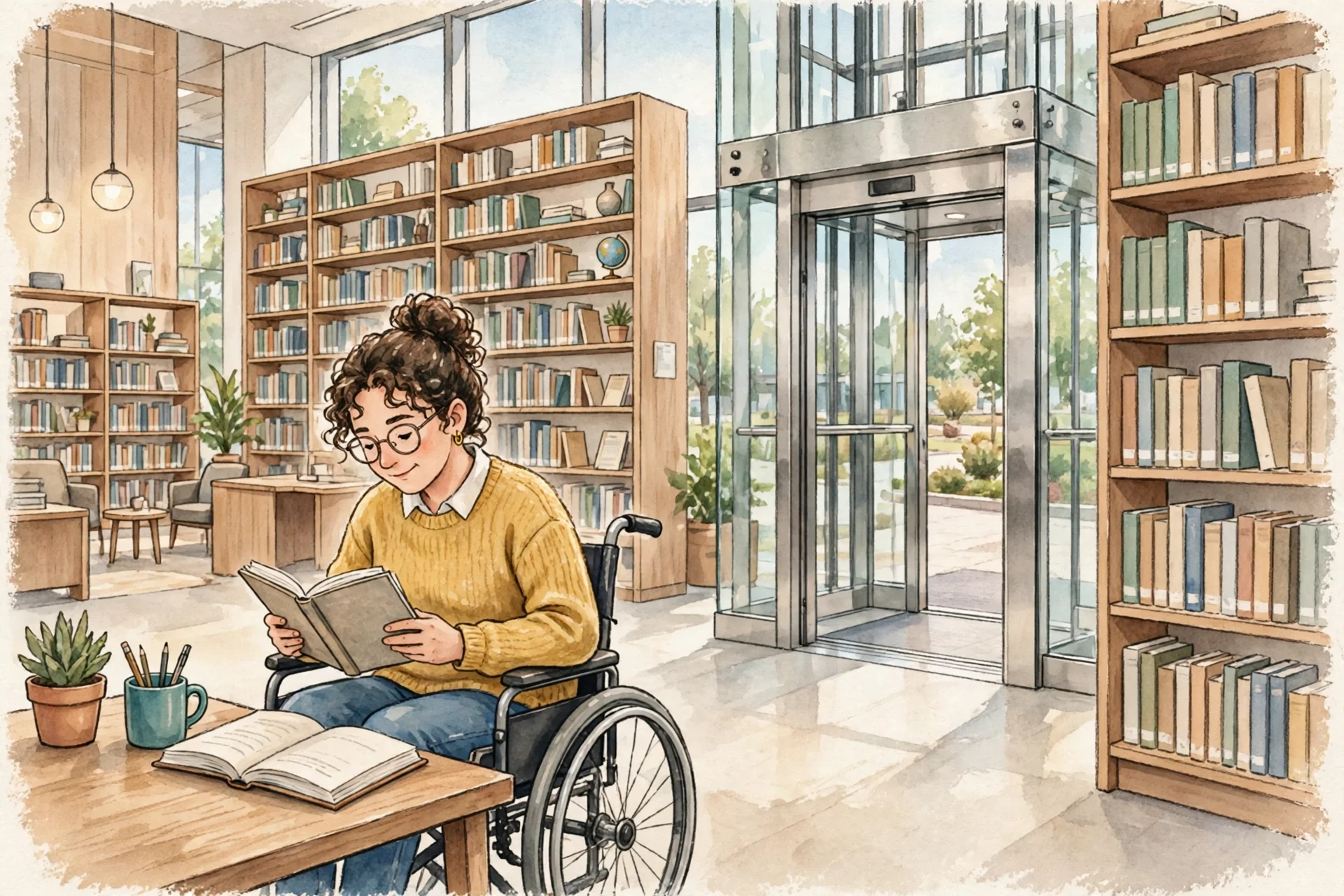
Illustration of a wheelchair user at a low reading table in a bright modern library, with tall bookshelves and a lift in the background.

Library access varies by building; measured guides and a phone call beat a general promise.

In brief

  • The British Library lends manual wheelchairs free, subject to availability
  • Measured guides give door widths and turning space; vague promises do not
  • Check membership, lockers and book retrieval before a reading-room visit

The British Library: step-free, with chairs to borrow

The British Library in London is wheelchair accessible, with step-free access throughout, accessible toilets on each floor and assistance dogs welcome. Manual wheelchairs can be borrowed free of charge from the British Library, subject to availability, by booking in advance or asking staff on arrival, although staff cannot assist with using the borrowed chair. Anyone can apply to become a member to use the Reading Rooms, although books cannot be taken out, and visitors should expect a security check and bag search on entry, with bags and coats left in the cloakroom or a digital locker before entering a Reading Room. Exhibitions and public spaces are open without membership, so a first visit need not involve any paperwork at all.

Use measured access guides, not vague promises

AccessAble publishes measured access guides for libraries and archives across the UK, recording door widths, lift access, turning space, hearing support and the distance from the lift to each room. The National Archives library and reading rooms guide, for example, measures a prayer room at 150 centimetres by 150 centimetres of manoeuvring space, an 87 centimetre door opening and a step-free route via lift. That level of detail is what to look for: a venue that says accessible tells you nothing, while a venue that publishes door widths, turning circles and the location of the nearest accessible toilet tells you whether your chair will fit. If your local library has no measured guide, call ahead and ask for the door width of the entrance and the reading room, the lift dimensions and whether staff can retrieve books from shelves you cannot reach.

A practical checklist before you go

Before you go, confirm four things: whether you need membership for what you want to do, whether you must book a wheelchair or a study space in advance, where the accessible toilet and the nearest Changing Places facility are, and whether staff can fetch material from inaccessible shelving. Bring photo identification for membership, expect to leave bags in a locker, and ask about large-print, audio and digital formats if print is difficult. Libraries also run exhibitions, talks and quiet study spaces, so a library visit pairs well with a step-free walk or cafe stop nearby, and costs nothing beyond the journey there.
Sources & further reading

Accessibility and facilities at the TuringAccessAble: The National Archives library and reading rooms

Our editorial approach

CONTINUE EXPLORING

A little more useful reading.

Wheelchair Access at Places of Worship: Seating, Toilets and a Warm WelcomeGUIDES

Wheelchair Access at Places of Worship: Seating, Toilets and a Warm Welcome

A place of worship can be welcoming in spirit and still hard to use in practice: the entrance may be step-free while the seating puts you alone at the back, or the service may be accessible while the toilet is not. Church of England guidance describes reasonable adjustments including step-free access, accessible toilets, hearing loops and clear signage, and a recent Parish Accessibility Fund offers small grants of up to £5,000 for practical improvements. This guide turns that picture into checks for your first visit to any church, mosque, synagogue, temple or meeting house.

Read the guide
Access to Work for Wheelchair Users: What It Can Pay For and How to ApplyGUIDES

Access to Work for Wheelchair Users: What It Can Pay For and How to Apply

If a disability or health condition means you need extra support to do your job, Access to Work may help with costs that go beyond what your employer is expected to provide. This guide explains who can apply, what kind of support is covered, and what to have ready when you contact the scheme, so you can apply with a clear picture rather than guesswork.

Read the guide
AccessAble's Accessibility Guides: How to Read Them and Plan a Trip Without the Phone CallsGUIDES

AccessAble's Accessibility Guides: How to Read Them and Plan a Trip Without the Phone Calls

AccessAble publishes free, surveyor-verified Detailed Access Guides for thousands of UK venues – not ratings or reviews, but measured facts, photographs and step-by-step descriptions of the whole visit, from parking to toilets. Used well, a guide answers the questions you would otherwise spend hours phoning venues to ask. This guide explains how to read one, how to use the symbols and filters to match your own needs, and where the limits of any access guide lie.

Read the guide