England rules are described here; Scotland, Wales and Northern Ireland run their own arrangements, so confirm local rules before booking.
The two-part eligibility test
A mobile sight test has two conditions, and both must hold. First, you must qualify for a free NHS sight test: the NHS lists groups including people aged 60 or over, people registered as partially sighted or blind, people diagnosed with diabetes or glaucoma, people aged 40 or over with a close relative diagnosed with glaucoma, and people receiving certain benefits or holding an HC2 certificate. Second, you must be unable to leave home unaccompanied because of physical or mental illness or disability. The Association of Optometrists puts it plainly: being housebound alone is not enough if you would not otherwise qualify for a free test, and qualifying for a free test does not automatically entitle you to a home visit if you can attend a practice. If either half fails, the home visit is a private service with a charge, so check both halves before you book.
What happens at a home visit
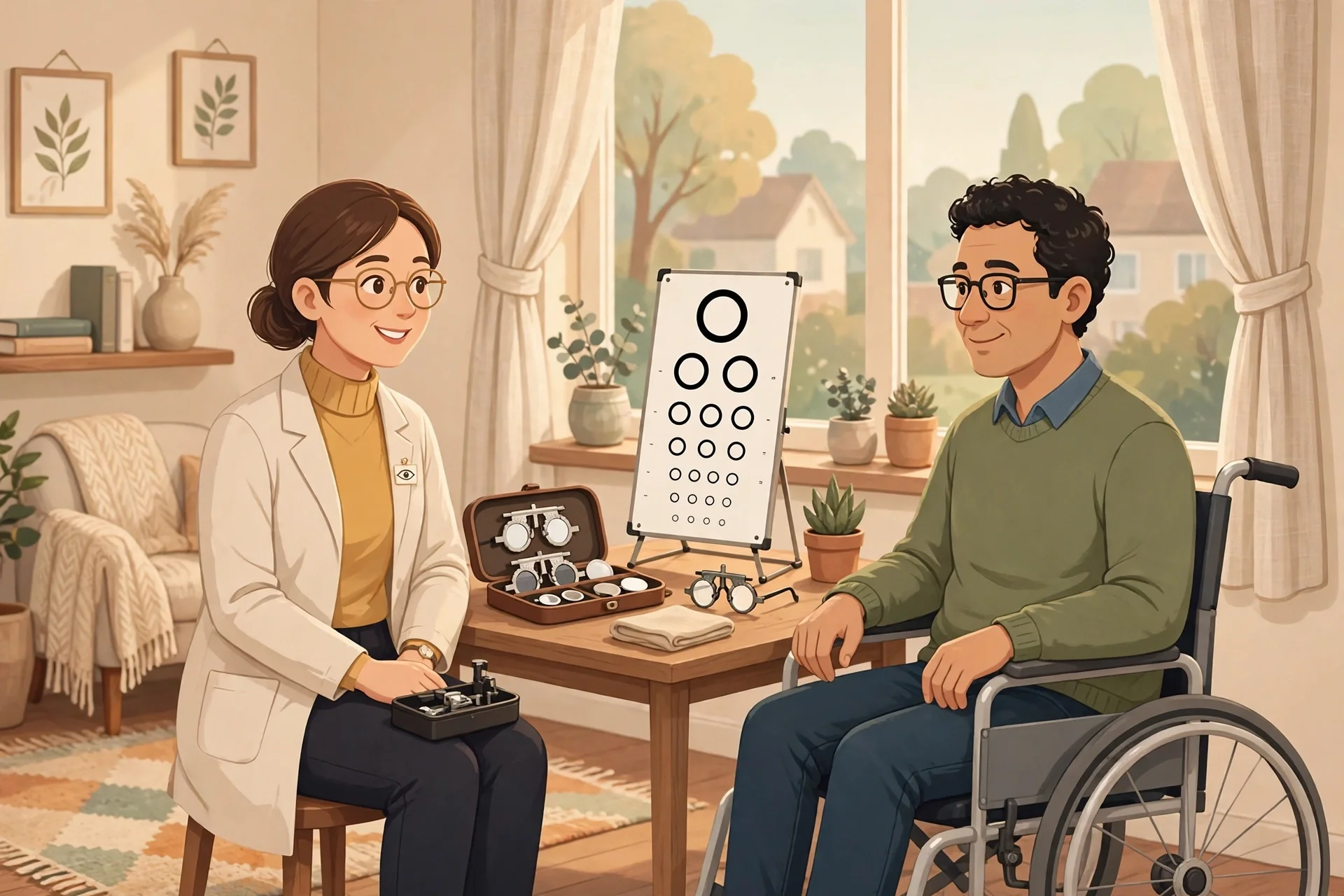
A mobile sight test is carried out by an optometrist who visits you where you live, in a residential or care home, or at a day centre if you cannot get a test at a practice or have difficulty communicating your needs unaided. The NHS notes that a sight test is only carried out when it is clinically necessary, and the optometrist's practice can only claim the NHS fee for that specific test, not for further examinations outside it. Before the visit, tell the practice about your wheelchair, your transfer needs, lighting, and where the optometrist can set up; a hallway chair or a table near a window is usually enough. Ask whether glasses can be fitted and adjusted at home too, since a prescription without a wearable frame solves only half the problem.
Vouchers, complex lenses and next steps
If you qualify, you may also get an optical voucher towards glasses or contact lenses, and the NHS publishes the complex lens voucher values: currently £15.81 for single vision lenses and £40.57 for bifocal lenses, for lenses of -10/+10 dioptres or more or prism-controlled bifocals. These vouchers are a contribution, not full payment, and they are only available to people who meet the clinical criteria and are not eligible for a main optical voucher. Start by contacting your usual optometrist and asking whether they offer home visits; if they do not, ask them to point you to a domiciliary provider in your area. Keep your prescription, note the date of the test, and ask what happens if your glasses need adjusting after delivery.