General planning information only — no plan guarantees safety. UK residential rules cited (Fire Safety (Residential Evacuation Plans) (England) Regulations 2025, in force 6 April 2026) apply to England; US tips come from FEMA’s Ready.gov campaign. Lift, carrying or rescue arrangements must be confirmed with your building management and local fire service. Not legal advice.
Build Your Home Evacuation Plan
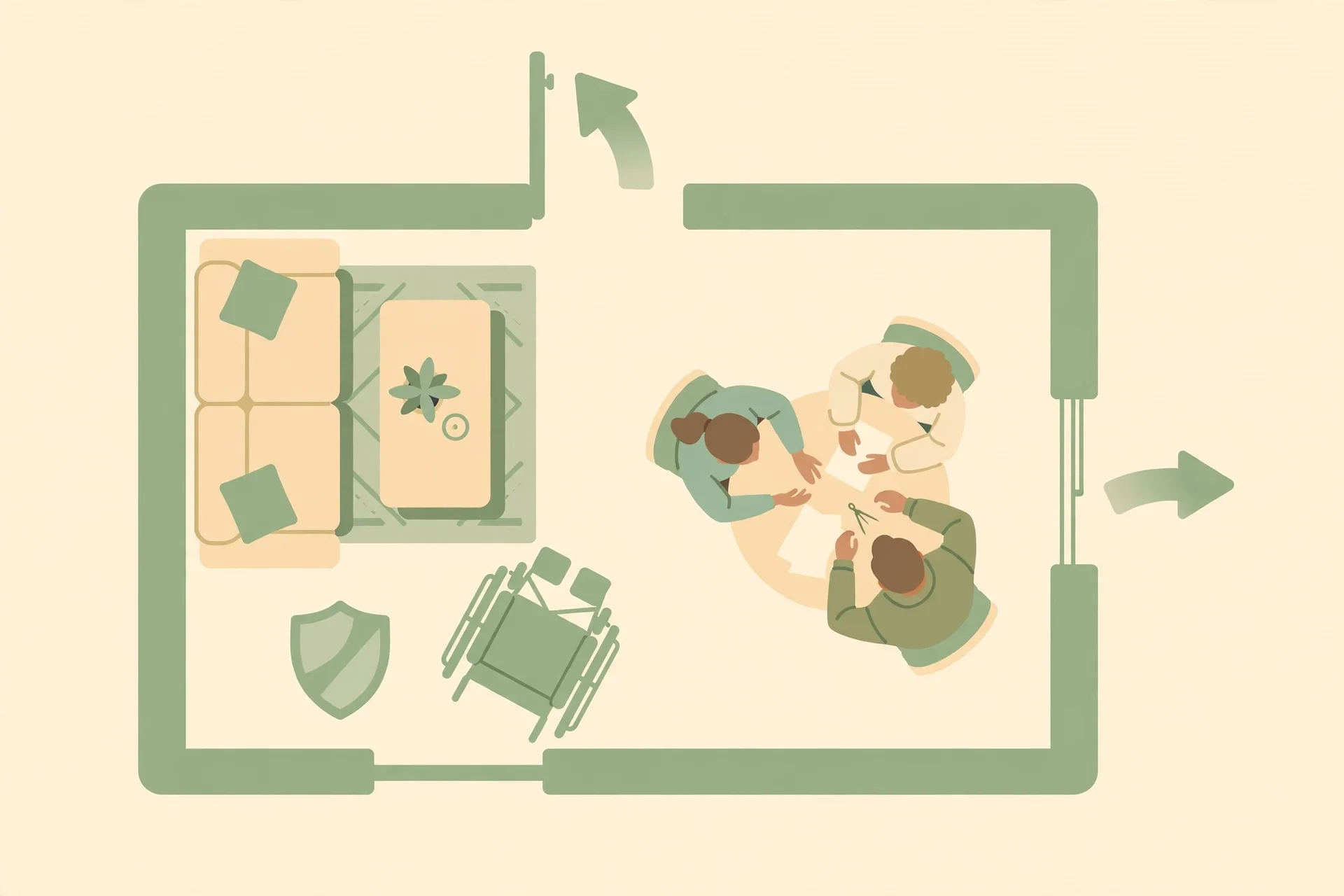
Walk through your home with evacuation in mind and sketch two routes out of every room you use regularly — the front door and a back door or ground-floor window are the classic pair, and for each route ask whether a wheelchair can pass comfortably, including door widths, thresholds, loose rugs and furniture that narrows the path at night. Choose a refuge point: a spot where you can wait for firefighters or a helper if your usual route is blocked, ideally near a window where you can be seen and heard, and tell your household and at least one neighbour or friend where it is. Set up redundant ways to call for help — a mobile phone kept charged at bedside height, plus something low-tech like a whistle or a pre-agreed signal with household members, because networks and power can fail together. Ready.gov, the US FEMA emergency campaign, recommends keeping a support network of people who can help you in a disaster, keeping your contact list in a watertight container, and even giving a trusted person a key to your home; the same logic applies to a fire at 3am. If you use a power wheelchair, keep the battery charged overnight, store an extra battery charged if you have one, and teach at least one other person how to switch the chair into freewheel or manual mode, assemble and disassemble it, and operate its brakes — Ready.gov also suggests a lightweight manual chair as a backup where possible, plus a patch kit, a portable air pump and a spare cushion. Keep a small grab kit by the door with medication, your phone charger, a torch and your medical alert information. And register with any voluntary disability registry your local emergency management office runs, where one exists, so responders can plan targeted assistance.
Workplace PEEPs and the UK’s Residential Rules
At work, the standard UK practice is a personal emergency evacuation plan — a PEEP — agreed between you and your employer or the building manager. It names the assistance you need, the people who will give it (a buddy system works well), the routes you will use, and how you will be alerted given your hearing or vision. Ask for the meeting before you need it, bring a simple written summary of your mobility needs, and get the final plan in writing so relief staff and new colleagues can follow it; review it whenever your desk, floor or team changes. For residential blocks, England now has its own framework: the Fire Safety (Residential Evacuation Plans) (England) Regulations 2025, which came into force on 6 April 2026 following the Grenfell Tower Inquiry’s recommendations. Under it, the building’s “Responsible Person” — typically the owner or manager of larger residential buildings — must make reasonable efforts to identify residents who would struggle to evacuate without help and offer them a person-centred fire risk assessment and an agreed emergency evacuation statement; sharing your details with the fire and rescue service requires your explicit consent, and you cannot be compelled to take part. If you live in a higher-risk residential building in England, asking the Responsible Person about this process is a reasonable step, and your building’s fire safety information should say who to contact. These regulations apply in England only and are about the building owner’s duties, not a personal guarantee of rescue, so treat them as one layer of the plan — your own household arrangements are still the layer you control. Outside England, ask your landlord or housing association what evacuation arrangements exist for residents with reduced mobility and get the answer in writing.
When the Lift Is Out of Service
Lifts are the most dangerous assumption in any wheelchair evacuation plan, so start from the principle that you do not use a standard passenger lift in a fire — and any alternative involving lifts, carrying, or being moved by others must be agreed in advance with your building management and your local fire and rescue service, not improvised on the day. Many workplaces designate evacuation lifts with independent power and fire-protected shafts, but these are specific certified installations; confirm with the building manager whether yours has one, how it is activated, and who is trained to operate it. Where no such lift exists, the usual fallback is a refuge area — a fire-protected lobby or stairwell landing where you wait, call for help, and let the fire service reach you — but refuge locations, wait times and rescue procedures differ by building, so the only trustworthy source is the building’s own fire evacuation plan. Ask your building management for that plan in an accessible format, check what it says about people who cannot use the stairs, and raise gaps with the Responsible Person or your employer rather than designing your own workaround. If you live in a house or ground-floor flat, the lift question is simpler but the same discipline applies: never re-enter a building for a forgotten chair or bag, and keep your refuge point and alert methods tested. Whatever the building tells you, write it down, keep it where your support network can find it, and revisit it after any renovation, lift replacement or change of managing agent, because evacuation arrangements are only as current as the last review.
A Practice Checklist to Keep the Plan Alive
A plan you never rehearse is a guess, so work through this checklist a few times a year and after any move, renovation or change in your mobility. First, walk both escape routes in your wheelchair in daylight and after dark, checking that doors open fully, thresholds are passable, and the route is clear of delivery boxes, bikes and furniture; fix what blocks you the same week. Second, test your alert methods: call your agreed contact from the refuge point, check the phone is charged and within reach at bedtime, and confirm your whistle or other signal still works. Third, rehearse the buddy arrangement — at home and at work, make sure your designated helpers know the plan, know how to operate your chair’s freewheel mode and brakes, and know who takes over if one of them is away. Fourth, refresh the kit: medicines in date, spare batteries charged (including hearing-aid and communication-device batteries), a charged power bank, torch batteries, and copies of your medication list and emergency contacts in the watertight container. Fifth, review the paperwork: your workplace PEEP, any agreed evacuation statement with your building’s Responsible Person, and your voluntary registry details if you use one. Sixth, after each rehearsal, note what was awkward — a door that is hard to open under stress, a corridor that narrows at night — and change the plan rather than accepting the friction. None of this guarantees safety in a real fire; what it does is shorten the decisions you have to make under pressure and make sure the people around you know what to do before the alarm sounds.