Scope: feature vocabulary from Marriott and Hilton official pages; actual features vary by individual property.
In brief
- 'Accessible' is a label, not a layout — the same word covers roll-in showers, transfer showers and tubs with grab bars, so verify per property.
- Learn the chains' vocabulary (Marriott's roll-in vs transfer vs tub, Hilton's accessibility filters) and book the accessible room type explicitly rather than relying on requests.
- Confirm directly with the hotel's front desk before arrival, get it in writing, and recheck the seven questions: shower, toilet, doorways, bed height, alarms, parking and step-free routes.
Why 'Accessible' Means Different Things at Different Hotels
Book two 'accessible rooms' at two different hotels and you may get two very different rooms. At one property the bathroom has a roll-in shower you can wheel straight into; at another it has a standard bathtub with grab bars and a bath seat; at a third the 'accessible' features turn out to be mostly about hearing — visual alarms and a flashing door knocker — with a bathroom that barely fits a chair. All three were sold under the same word.
The reason is simple: 'accessible' is a label, not a single standard layout. Hotel chains each maintain their own accessibility vocabulary, and what gets built into a given property depends on the brand, the building's age, and which room category you booked. A newly built flagship and a converted older property from the same chain can describe their accessible rooms with the same terms while delivering noticeably different bathrooms.
This matters because the details decide whether the room actually works for you. The difference between a roll-in shower and a transfer shower is the difference between showering independently and needing help. Toilet height plus grab-bar placement decides whether a transfer is safe. Doorway widths and turning space decide whether you can reach the bed at all. None of that is visible in the word 'accessible'.
The practical consequence: never assume, and never treat the booking-site filter as the final answer. Filters narrow the field, but the authoritative description lives on the hotel's own site and, ultimately, with the hotel's front desk. Hilton's own guidance says exactly this — its website shows a dedicated view of each hotel's accessible room options with detailed descriptions, and guests with specific needs are advised to contact the hotel directly. Treat the label as the start of the research, not the end of it.
Decoding the Official Feature Vocabulary
Hotel chains publish their accessibility features in their own jargon. Here is what the official terms actually mean, drawn from Marriott's and Hilton's own pages.
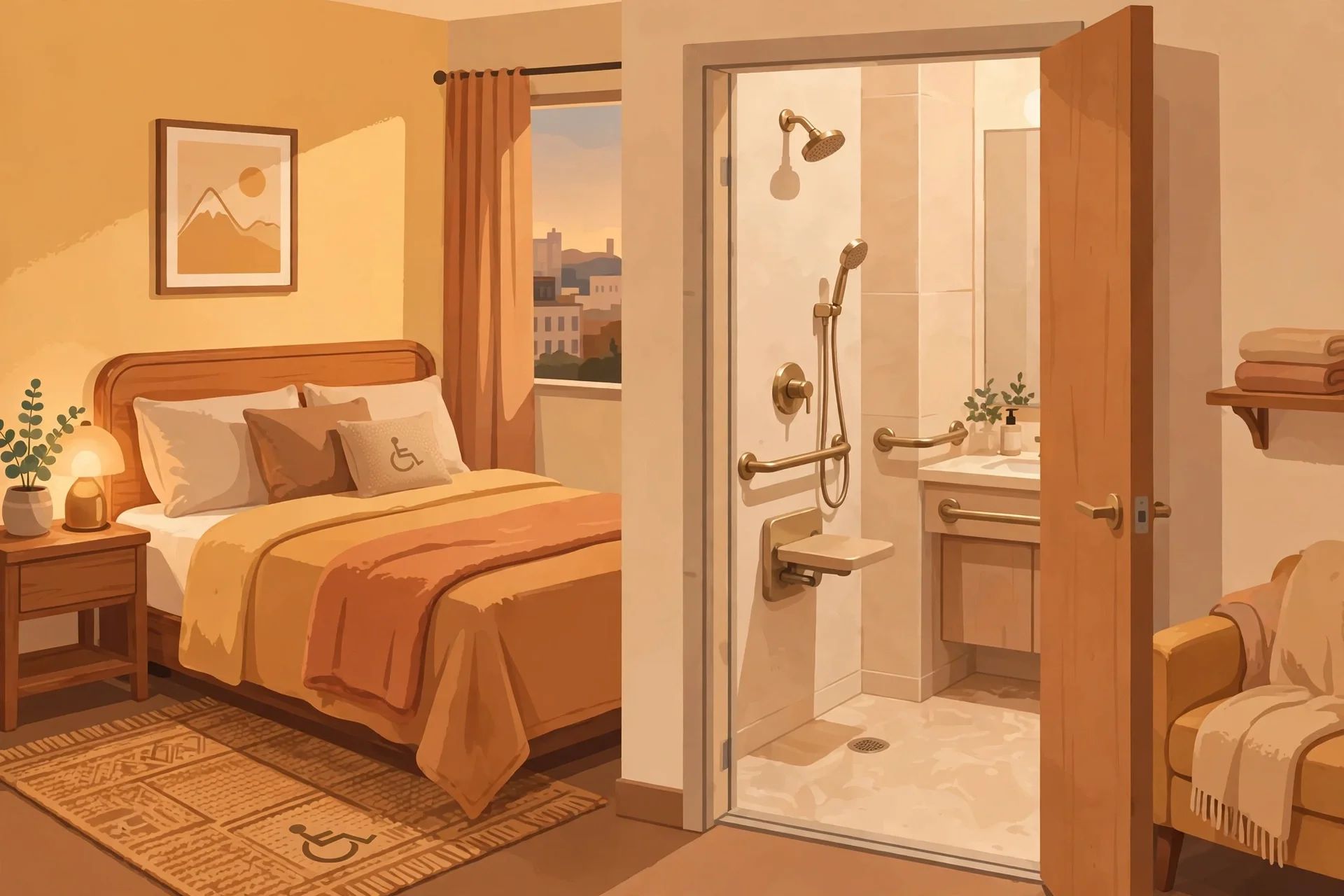
**Bathing: roll-in vs transfer vs tub.** Marriott's official vocabulary distinguishes three setups. A *roll-in shower* has no curb or lip — you wheel straight in, which suits shower chairs and independent showering. A *transfer shower* is smaller and designed for transferring from a chair onto a built-in bench or seat. A *bathtub with grab rails and a bathtub seat* keeps the standard tub but adds rails and a seat for safer entry. These are not interchangeable, and the difference determines your whole bathroom routine — so this is the single most important term to pin down.
**Mobility vs hearing.** Marriott separates *mobility accessible rooms* from *hearing accessible rooms and kits*. Mobility covers the physical layout — step-free access, bathroom fixtures, lowered features. Hearing covers alerts and communication: *visual alarms* (flashing strobes tied to the fire alarm), *flashing door knockers* (a light that signals someone is at the door), *TTY-compatible phones* and *closed-caption TV*. If you need hearing features, look for them explicitly; a mobility-accessible room does not automatically include them, and vice versa.
**Room hardware.** Marriott lists *lowered electrical outlets*, *lever door handles* (easier than knobs for limited grip) and *accessible vanities* (knee clearance underneath). These small details add up: a room can have a perfect bathroom and still be awkward if you cannot reach a socket or open the door comfortably.
**Bed height.** This one surprises people. Marriott notes that guests in mobility-accessible rooms may inquire about *lowering the bed height* — hotel beds are often higher than a wheelchair seat, which makes independent transfers hard. The key word is 'inquire': it is a request the property can often accommodate, not a guaranteed feature, so raise it before arrival rather than discovering the problem at midnight.
**Service animals.** Marriott states that service animals are welcome without a fee or documentation. If you travel with one, that is the policy in writing — useful to have on hand if a front-desk conversation goes sideways.
**Hilton's side.** Hilton's website offers a dedicated view of a hotel's accessible room options with detailed accessibility descriptions, and its room descriptions spell out features for mobility and hearing disabilities — including *accessible bathing fixtures* and *visual alarms and notification devices* — alongside search filters for accessible rooms. Use the filters to shortlist, then read the property-level descriptions before deciding.
**Shared spaces.** Marriott's feature lists also cover *accessible parking, elevators and restaurant access*. A perfect room loses its value if you cannot park, reach the lobby, or eat breakfast — check the route, not just the room.
The Pre-Booking Checklist: Questions to Ask
Once you have shortlisted a property, run through these questions — with the hotel directly, not just the booking site. Each one maps to a feature the chains themselves name.
- **What type of shower or bath does the accessible room have?** Roll-in, transfer, or bathtub with grab rails and a seat? Ask for the exact term, not 'an accessible bathroom'. - **What is the toilet height, and where are the grab bars?** A comfort-height toilet with well-placed bars makes transfers safer; a standard-height toilet without them may not work for you. - **How wide are the doorways, and is there turning space?** The bathroom door and the space beside the bed are the two pinch points that most often cause problems. - **How high is the bed, and can it be lowered?** Marriott flags this as something guests may inquire about — ask before you arrive so it is done when you get there. - **Are visual alarms and notification devices available?** If you need hearing-accessible features — visual alarms, flashing door knockers, TTY-compatible phones — confirm they are in the room, not just somewhere in the building. - **Is there accessible parking and a step-free route to the room?** Confirm the path from the car park to the lift to your door, not just the existence of a parking bay. - **Can I reach the pool, fitness room and restaurant step-free?** Shared facilities are part of the stay; check them with the same rigour as the room.
Two booking rules close the loop. First, book the accessible room type explicitly — select it as the room category rather than booking a standard room and adding 'accessible please' to the requests box, which is a wish, not a reservation. Second, write down who confirmed what: a name, a date, and an email confirmation beat a remembered phone call every time.
After Booking: Confirm Directly with the Hotel
The booking confirmation is not the finish line — it is the moment to verify. Hilton's own accessibility guidance advises guests with specific needs to contact the hotel directly, and the front desk is the team that actually assigns your room.
Call or email the property a few days before arrival. Restate the features you booked — the shower type, the bed-height request, the visual alarm — and ask for written confirmation that your assigned room has them. Properties juggle room assignments constantly, and a room can be swapped for maintenance or overbooking reasons; a direct confirmation puts your requirements back on the radar at the right moment.
Use the call to sort logistics too. Confirm accessible parking and the step-free route from the entrance to your room, especially if you arrive late when fewer staff are around. If you asked for the bed to be lowered, confirm it will be done before check-in, not after you point it out. If you travel with a service animal, a brief heads-up avoids a debate at the desk — Marriott's written policy welcomes them without fee or documentation, and having that reference ready keeps the conversation short.
On arrival, do a sixty-second room check before you unpack: roll into the bathroom, test the shower setup, check the grab bars and the bed height, and glance at the alarm devices. If something does not match what was confirmed, raise it immediately — the front desk can usually reassign you on the spot, while complaining the next morning means a night already spent in the wrong room.
Ask the front desk to add your specific requirements as a note on the reservation itself, so any staff member on any shift can see them — 'roll-in shower, lowered bed, visual alarm confirmed' written on the booking beats a verbal assurance given to one person. Request the confirmation by email so you have something to show at check-in if the assigned room does not match. If you need the room ready early in the day, say so now: lowering a bed or fetching a hearing kit takes staff time, and flagging it in advance means it is done before you arrive rather than after you point it out at the desk.