UN 3556 classification and 67th-edition requirements from IATA's dangerous goods guidance for passengers; airline-specific battery limits from Austrian Airlines' accessible travel page. Checked 29 September 2026.
In brief
- IATA's 2026 (67th edition) rules classify lithium battery-powered wheelchairs as UN 3556, Class 9, requiring airline approval.
- Key limits: 300 Wh for a single removed battery, or 160 Wh each for two batteries; removed lithium batteries fly in the cabin.
- Tell the airline your battery type, watt-hour rating and removability at least 48 hours ahead; 2027 rules tighten further.
The 2026 framework: UN 3556 and airline approval
Under the 67th edition of the IATA Dangerous Goods Regulations, in force since 1 January 2026, a battery-powered mobility aid with lithium-ion batteries is classified as UN 3556, described as a vehicle powered by lithium-ion batteries, Class 9. The practical consequence is straightforward: operator (airline) approval is required before you fly, and IATA publishes a dedicated Battery-Powered Wheelchair and Mobility Aid Guidance Document setting out what passengers should provide so their device can be accepted and loaded without delay. Approval is never automatic — even with correct paperwork, the final decision rests with the airline, so build confirmation into your booking rather than assuming it.
Watt-hour limits you must know
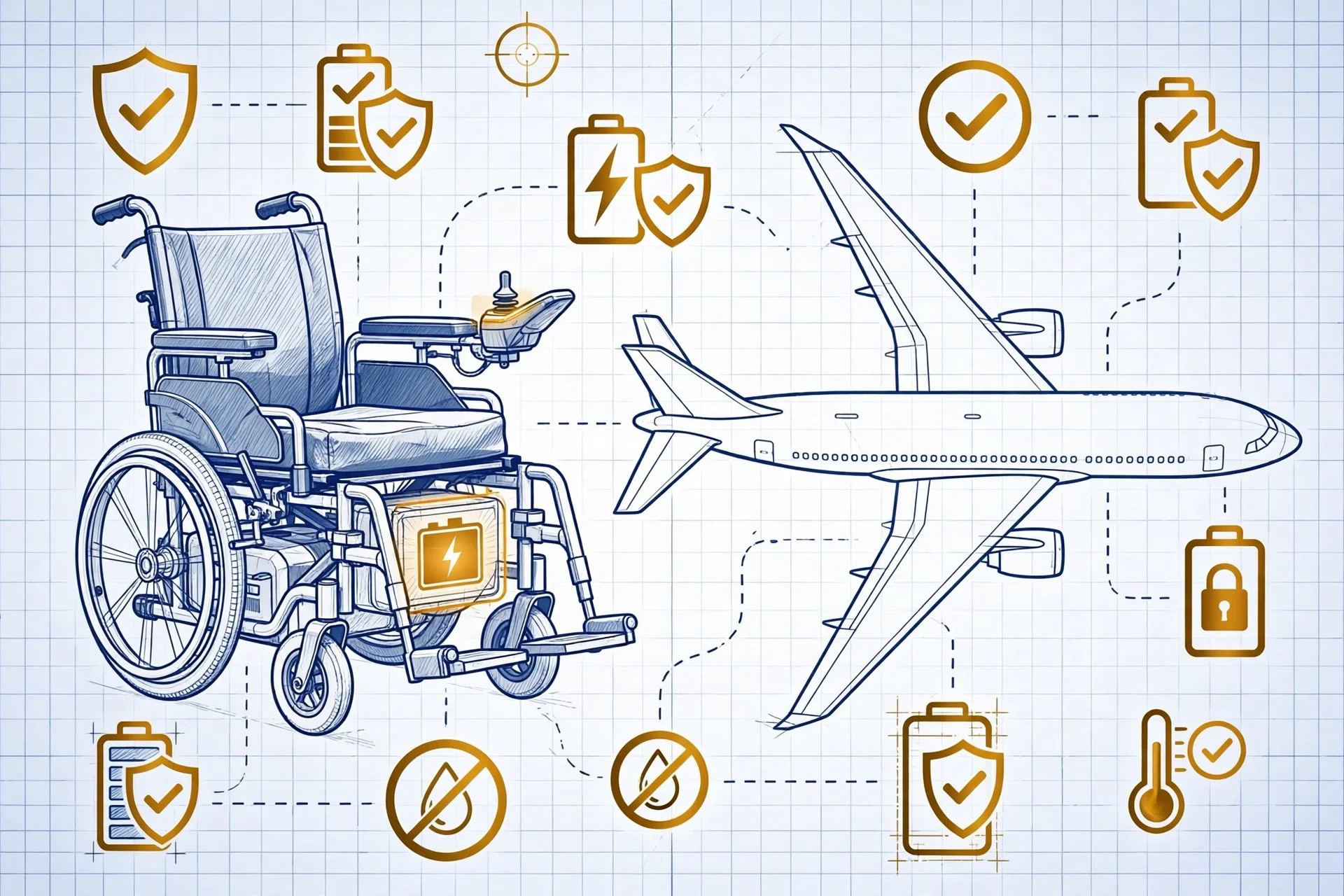
For lithium batteries, the headline numbers are: a removed battery from a mobility aid must not exceed 300 Wh, or for devices fitted with two batteries, each battery must not exceed 160 Wh. Removable lithium batteries are carried in the cabin, never in checked baggage, and exposed terminals must be insulated against short circuits. Some airlines go further on specific designs: Austrian Airlines, for example, limits wheelchairs with permanently installed, non-removable lithium batteries to a maximum of two batteries of up to 160 Wh each under rules effective from October 2025. Spillable (wet) batteries face entirely different handling — removed spillable batteries must travel in strong, rigid, leak-tight packagings marked for wheelchair batteries — so know your battery chemistry before you call the airline. Lithium batteries also need to meet UN 38.3 test requirements, and you may be asked to show proof of compliance at check-in.
What to tell the airline, and what is coming in 2027
Contact the airline well before departure — the standard is at least 48 hours — with your wheelchair's make and model, battery type (lithium-ion, spillable or non-spillable), watt-hour rating, whether batteries are removable, and its weight and dimensions. Ask explicitly whether your device needs the battery removed and carried in the cabin, and how the airline wants the chair prepared at handover. Looking ahead, the 68th edition of the DGR taking effect in 2027 adds operator obligations for lithium battery-powered mobility aids with batteries exceeding 300 Wh, alongside new state and operator variations — a sign that rules keep tightening as battery chemistries diversify. The direction of travel is clear: document your battery specs now, keep manufacturer paperwork with your travel documents, and re-check the rules before every trip rather than relying on what worked last year.