
Skip to content
Guides / Guides

Connecting Flights with Wheelchair Assistance: How Airport Transfers Work

Wheelchair assistance is booked per flight, not per trip - and the transfer between them is where things most often go wrong. Here is how airport assistance handoffs work on connecting flights, how much connection time to allow, and what to double-check before you fly.

Connecting Flights with Wheelchair Assistance: How Airport Transfers Work

Practical guidance compiled from airline assistance guides and airport accessibility resources, checked 2026-10-03. Procedures vary by airline and airport; confirm the details of your own itinerary with your carrier.

Connections need their own request

The single most important thing about connecting flights: assistance does not automatically follow you from one flight to the next. Each flight segment needs its own assistance request in your booking, including the transit portion at the connecting airport and the return journey. When you book, tell the airline explicitly that you have a connecting flight and need a chair to get between gates - at a large hub, the distance between an arrival gate and a departure gate can be enormous. If a partner airline operates one of your legs, confirm that the assistance request has been passed on to them too.

Allow generous connection time

Assistance teams hand you from one crew to the next, and at busy hubs that handoff takes time. Practical travel guides suggest treating 90 minutes as a realistic floor for connections at large airports when you need assistance - tighter than that, and one late inbound flight can strand you between gates. When you have a choice of itineraries, the longer layover is usually the calmer option. If you realise your booked transfer time is short, contact your airline immediately to discuss whether the assistance can still be arranged for that connection.

What happens during the transfer

In transit, assistance staff typically meet you at the arriving aircraft and escort you through any transit security checks to your next gate. Your own wheelchair is usually returned to you at the gate or at the baggage belt depending on the airport, so clarify with the airline which it will be before you land. If you are travelling with a powered wheelchair, the same pre-flight battery and labelling preparation applies to the connection as to the first flight - the ground team at the transit airport needs the same information.

If things go wrong mid-journey

Missed connections are the weak point of the system. If your inbound flight is delayed and your connection looks tight, tell the cabin crew before landing so they can alert the ground team. Keep your phone charged and your airline's assistance contact details handy - if you cannot find the transfer staff at the gate, calling the airline gets you directions faster than wandering the terminal. And if an overnight delay happens, ask the airline's assistance desk about hotel transfer support rather than trying to sort it alone.

Reconfirm before you fly

Assistance bookings can quietly drop off a reservation when flights are changed, rebooked, or retimed. Reconfirm every assistance request about 48 hours before departure, and check again on travel day that each leg - outbound, connections, and return - still shows the request. Written confirmation for each segment is your safety net if anything is disputed at the airport.


Sources & further reading

How to book a Singapore Airlines flight with assistance service (layover coordination)Airport Wheelchair Assistance: How to Book It (practical guide)

Our editorial approach

CONTINUE EXPLORING

A little more useful reading.

Cold Weather Battery Care: Keep Your Power Wheelchair Charged All WinterGUIDES

Cold Weather Battery Care: Keep Your Power Wheelchair Charged All Winter

Cold weather reduces a power wheelchair battery's capacity and stretches out charging time, which means noticeably shorter range on winter days. Manufacturer guidance converges on a simple routine: charge and store the chair at normal room temperature — around 20°C — plug in every night, and keep the battery topped up rather than running it flat. In practice, that means a full charge before heading out, shorter planned trips on freezing days, carrying the charger, and never leaving the chair out in the cold overnight.

Read the guide
Over 300Wh? Airline Approval Rules for Your Power Wheelchair BatteryGUIDES

Over 300Wh? Airline Approval Rules for Your Power Wheelchair Battery

If your power wheelchair's lithium-ion battery is rated over 300 watt-hours (Wh), flying takes more than just checking the chair into the hold: IATA's rules classify the wheelchair as a UN 3556 lithium-ion-powered vehicle (Class 9), require your airline's approval before the flight, and - from the 2027 edition of the Dangerous Goods Regulations - add new operator obligations specifically for mobility-aid batteries above 300Wh. Start by reading the Wh rating on your battery label: that number decides which approval lane you are in, what paperwork to prepare, and whether a spare battery can come along.

Read the guide
Folding vs. Full-Size Power Wheelchair: Which Should Frequent Flyers Choose?GUIDES

Folding vs. Full-Size Power Wheelchair: Which Should Frequent Flyers Choose?

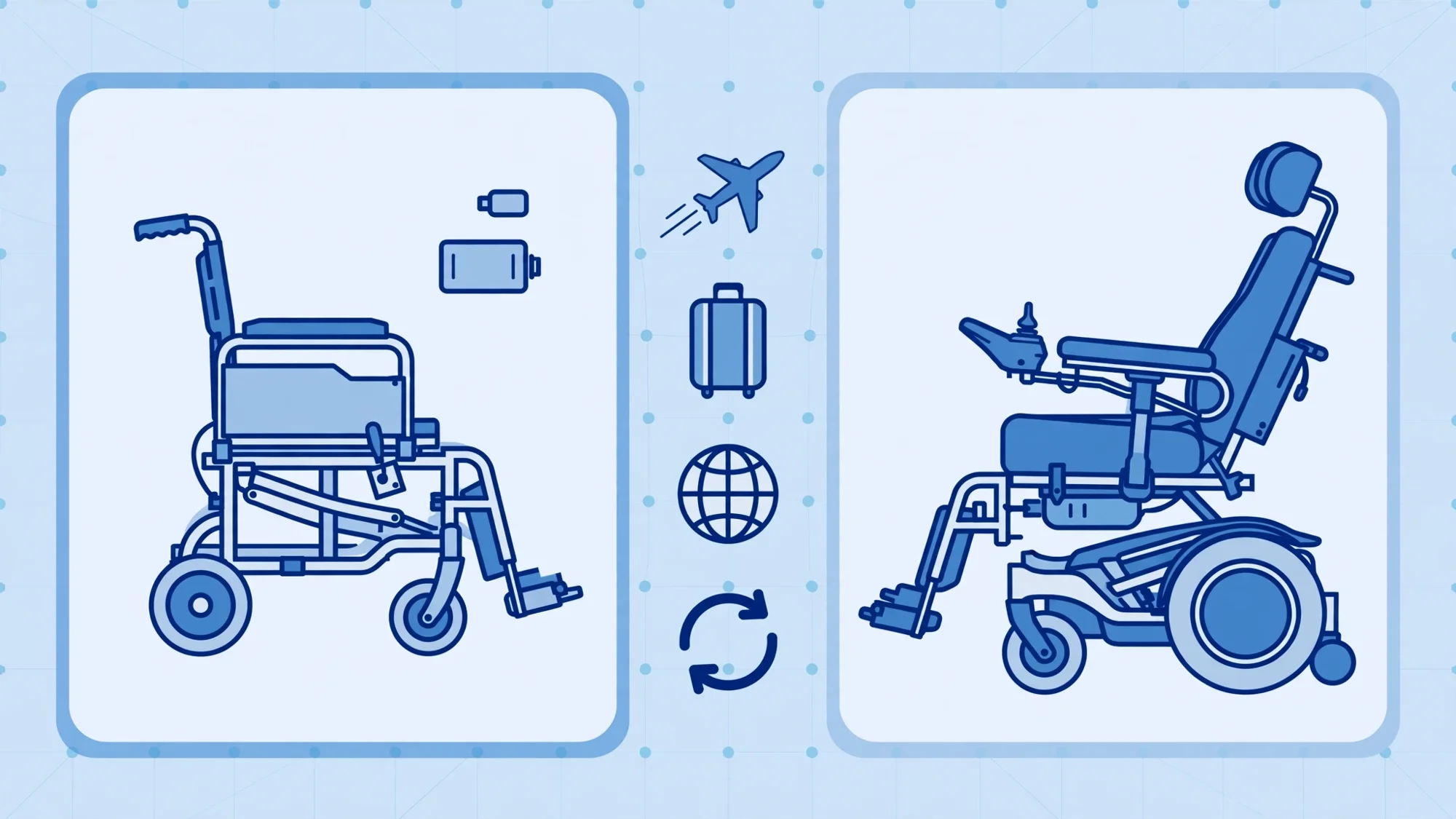
If you fly often, the choice between a folding power wheelchair and a full-size model comes down to one trade-off: portability versus comfort and seating support. Folding chairs collapse into a compact package that is easier to protect from damage, though they usually offer less range and fewer seating features — but watch the battery, because IATA's 2026 passenger guidance draws the line at 100Wh (generally no airline approval needed) and 100–160Wh (operator approval required), with at most two spare batteries. Full-size chairs give you tilt, recline and seat elevation, but they must travel in the aircraft hold, where rough handling can damage them. No rule guarantees your chair can fly — airline policies differ, so verify with your carrier before every trip.

Read the guide