Scope: US DOT rules cover flights to, within and from the United States; Delta's page shows one carrier's process — always check your own airline and destination-country entry rules.
In brief
- Airlines must carry trained service dogs on flights to, within and from the US — emotional support animals do not qualify.
- Submit the DOT attestation forms up to 48 hours ahead (plus the relief form on 8+ hour flights); finish them right after booking.
- The dog must fit at your feet, stay harnessed, and behave — aggression, disruption, or missing forms are valid denial grounds.
Which dogs qualify as service animals — and which don't?
Q: What counts as a service animal on a flight?
A: Under US Department of Transportation rules, airlines must recognize dogs as service animals and transport them on flights to, within and from the United States. Dogs are the only species the federal rules single out by name: for other species, accepting them as service animals is the airline's choice rather than a federal requirement. The dog itself must be trained to the task — trained to do work or perform tasks for a person with a disability. Training is the dividing line the framework draws between a service dog and a well-behaved pet, and it is the reason the DOT forms in the next section ask you to attest to training specifically, rather than to ownership or veterinary history alone.
Q: Do emotional support animals qualify?
A: No. The DOT framework is explicit on this point: emotional support animals are not service animals, and they have no right to travel in the cabin as service animals. This is the single most common point of confusion, so it is worth stating plainly: a clinician's letter does not convert an emotional support animal into a service animal for air-travel purposes. If your animal's role is comfort or companionship rather than trained task work, it will be handled under the airline's ordinary pet policy — fees, carriers and cargo rules included — not under the service-animal rules.
Q: Are psychiatric service animals treated differently?
A: They are treated exactly the same as other service animals. A psychiatric service dog — trained, for example, to interrupt a panic episode or to guide a handler during disorientation — goes through the same forms, the same 48-hour submission rule and the same seating and behavior standards as a guide dog or a mobility-assistance dog. There is no separate, stricter track for psychiatric service animals, and airlines may not single them out for additional requirements beyond what the DOT framework allows for every service animal.
Q: Is there a breed or size limit?
A: Neither source names breeds or publishes a weight cutoff in advance. Instead, the rules use practical tests that apply to every dog. The animal must fit within its handler's foot space in the cabin, and it must be harnessed, leashed or tethered at all times. An airline may deny transport if the animal is too large or heavy to be accommodated safely in the cabin. So a large breed is not automatically excluded — but the foot-space test is non-negotiable, and it is worth checking your dog against the seat pitch of the aircraft you will actually fly before you commit to a booking.
Q: Can an airline demand extra proof, like a training certificate, a vest, or a doctor's note?
A: No — with one narrow exception. Airlines cannot require documentation beyond the DOT forms described in the next section, except where another Federal agency, a US territory, or a foreign jurisdiction's animal-transport rule requires it. That exception matters most at your destination: countries and territories set their own animal entry rules — vaccination, health certification, sometimes quarantine — and those run on a separate track from airline paperwork. They are the traveler's responsibility, not the airline's, so check them as early as you check passport and visa requirements.
Q: Whose rules apply on my itinerary?
A: The DOT rules follow the route, not the airline's flag: they cover flights to, within and from the United States. That is the scope to plan around. Individual carriers then publish their own process inside those federal boundaries — Delta's is worked through below — and your destination country's entry rules sit on top of both. When in doubt, read the three layers in this order: the federal rule, the airline's process, and the destination's entry requirements.
The two DOT forms and the 48-hour rule
Q: What is the Service Animal Air Transportation Form?
A: This is the main DOT form that airlines may require for service-animal travel. By completing it, you attest to three things about your dog: its health, its behavior, and its training. The attestation carries weight because it is a federal form — airlines are allowed to rely on it, and the federal framework bars them from demanding other documentation in its place. Fill it in carefully and truthfully. It is the document the airline will point to if there is ever a question about your animal at the airport.
Q: What is the Relief Attestation Form, and when is it needed?
A: For flights scheduled at eight hours or more, airlines may additionally require the DOT Relief Attestation Form. It attests that the dog will not need to relieve itself during the flight — or that it can do so in a sanitary manner if it must. This is the form that makes long-haul handlers plan ahead: it forces the question you should already be asking, which is whether your dog can realistically settle for the full duration of the flight. If the honest answer is no, that is useful information to have before you book, not after.
Q: When do the forms have to be submitted?
A: It depends on when you booked. If your reservation was made more than 48 hours before the travel date, the airline may require the completed forms up to 48 hours in advance — which makes the real deadline two days before you fly, not at the airport. If you booked inside the 48-hour window, the paperwork moves with you: you present the forms at the check-in counter or the departure gate. Either way, the practical move is identical — complete the forms the moment you book, and carry a copy with you to the airport. Last-minute scrambling at the counter is how trips unravel.
Q: How does Delta run this process in practice?
A: Delta's published policy is a useful worked example of the federal rules in action. Delta accepts only trained service animals — nothing else travels under the service-animal banner on a Delta flight. If you booked 48 hours or more before departure, you submit Delta's Service Animal Air Travel form in advance so it can be validated; if you booked inside 48 hours, you present it at the check-in counter or the departure gate instead. Flights of eight hours or more need the DOT Relief Attestation as well. Delta caps carriage at two service animals per passenger, matching the DOT ceiling. And note what Delta does not ask for: no certificates, no vests, no ID cards beyond the DOT forms — the federal framework forbids exactly that kind of extra paperwork, and Delta's process reflects it.
Q: Can an airline ever ask for anything else?
A: Only to comply with an animal-transport rule set by a Federal agency, a US territory, or a foreign jurisdiction. That is the single carve-out, and it exists for destination entry requirements — a country's vaccination or health-certificate rules, for example — not so the airline can invent its own service-dog documentation. If a carrier asks you for paperwork that is neither a DOT form nor tied to a government entry rule, the request sits outside what the federal framework allows. Knowing that boundary is what lets you tell a legitimate request from an illegitimate one.
At the airport and in the cabin: seating, behavior, and denial grounds
Q: Where does the dog sit?
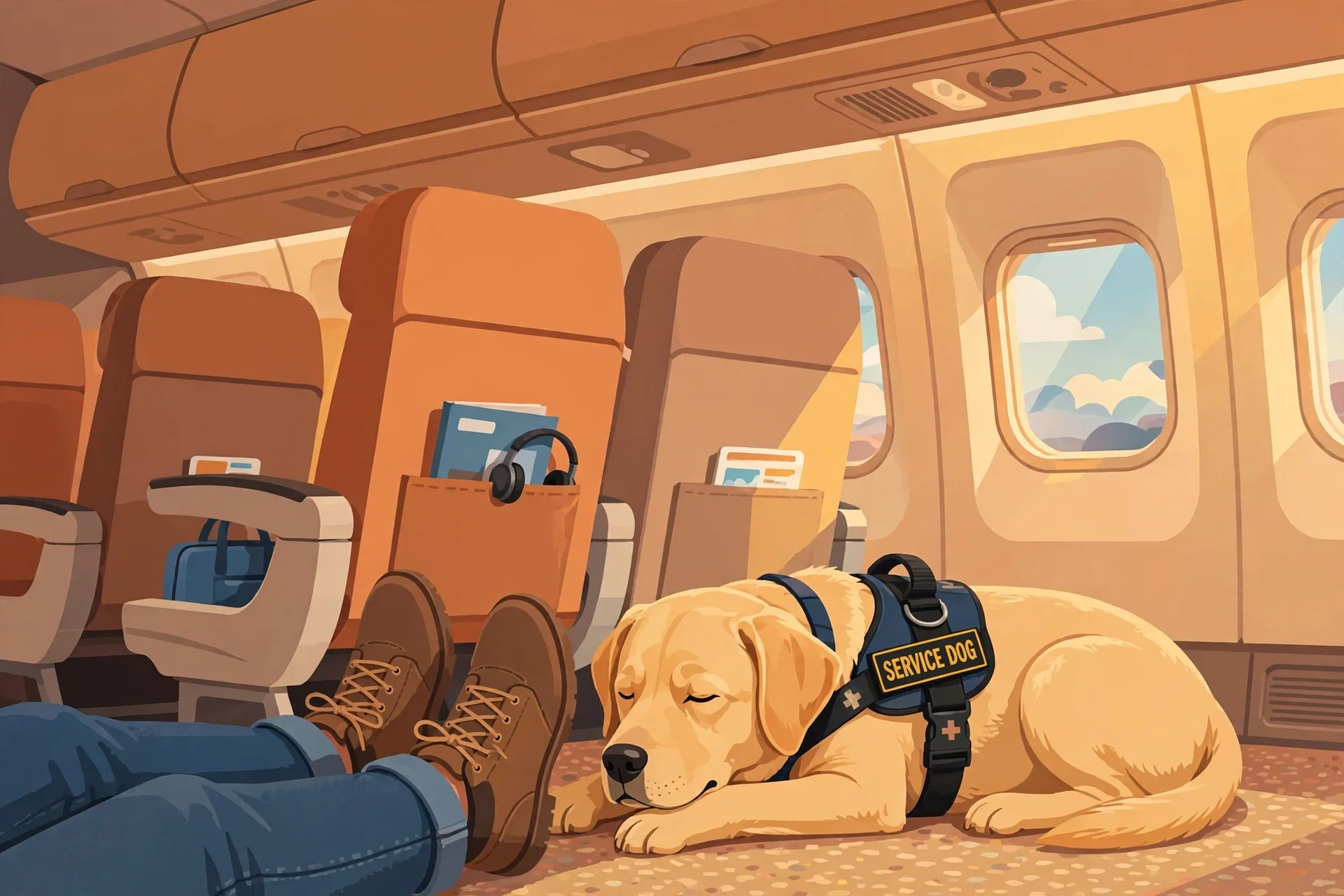
A: With you, in your foot space. The dog must fit within the handler's foot space and stay harnessed, leashed or tethered at all times — it does not get its own seat, and it may not block aisles or spread into other passengers' space. Delta's policy adds one concrete seating rule: a service animal may sit anywhere in the cabin of purchase except the exit row. In practice, bulkhead rows offer the most foot space where they exist, but they are never guaranteed, so board with a plan that works in a standard seat too.
Q: What behavior is expected of the dog?
A: A working standard, from curb to carousel. The dog must remain under the handler's control throughout the journey. Delta states the line plainly: it denies boarding to animals that are aggressive or inappropriate in public, naming barking, growling and uncontrolled bodily functions as examples. The airport is usually the harder test than the flight itself — crowds, announcements, other animals, long waits at the gate. A dog that settles calmly at your feet through all of that is doing exactly what the rules expect.
Q: When can an airline refuse to carry my dog?
A: The DOT lists five denial grounds, and they read like a pre-flight checklist. An airline may deny transport if the dog is too large or heavy to be accommodated safely in the cabin; poses a direct threat to the health or safety of others; causes significant disruption; would violate a health requirement — for example, the animal entry rules of the territory or country you are flying to; or if the required DOT forms were not provided. Every one of these is something a handler can see coming a week out, which is why the forms and the destination entry rules from the first two sections are really the whole game.
Q: What should I have ready on the travel day?
A: Three things: the completed DOT forms, finished right after booking rather than the night before; a separate, deliberate check of your destination country's animal entry rules; and a dog that has had the chance to relieve itself before boarding. The framework rewards the prepared traveler — and every denial ground on the DOT list traces back to paperwork or planning, not to luck.