General guidance for folding manual wheelchairs. Dimension examples are from the manufacturers' listed specifications for two folding chairs (Drive Medical S1 via Health and Care; Drive Medical Steel Transport Wheelchair via Mobilityshop) — always measure your own chair and car.
The measurements that matter
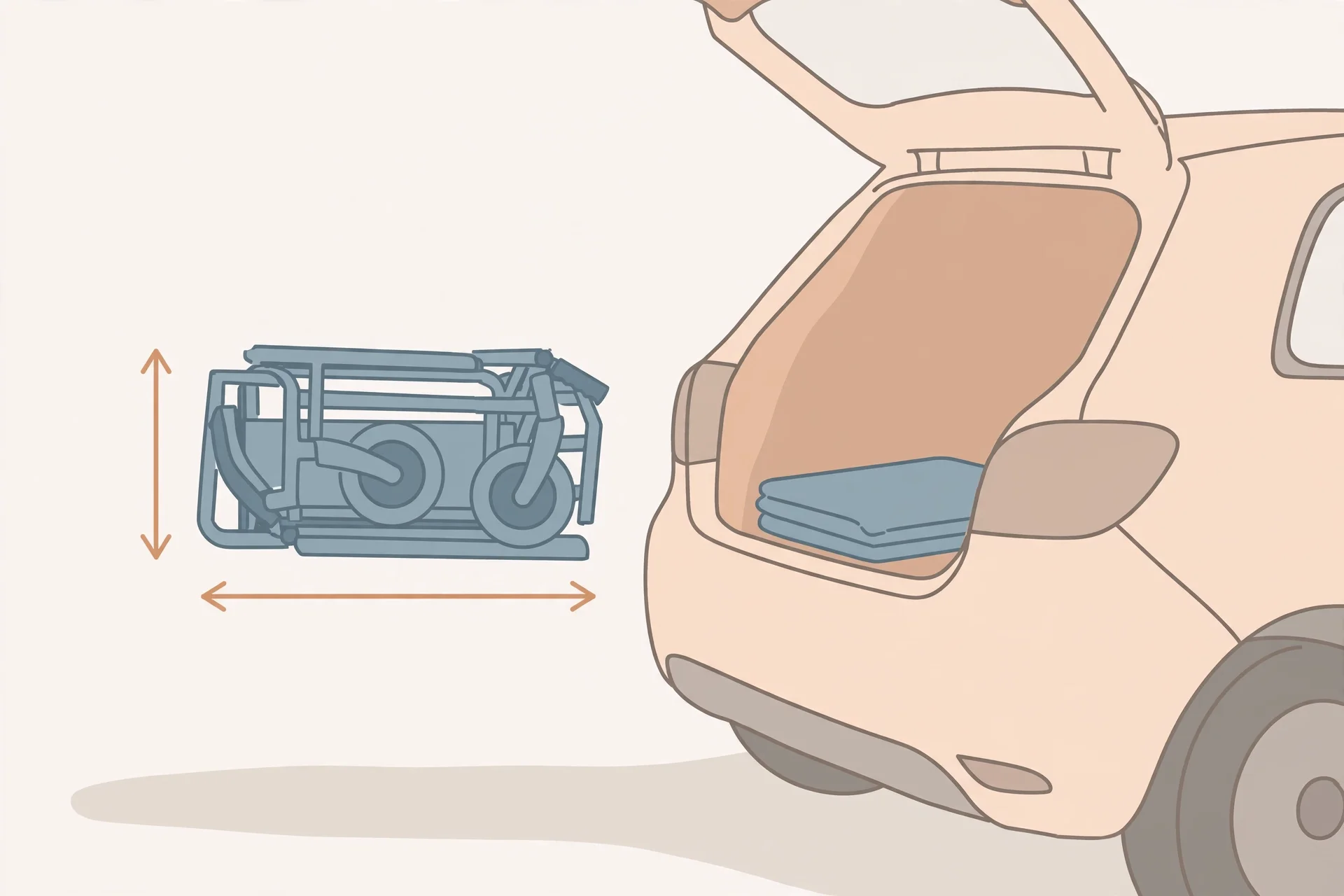
Measure the chair folded, not open — and measure the boot opening, not just the boot. Start with the four numbers that decide everything, taken from the manufacturer's specification sheet:
- Folded width: a steel transit chair like the Drive Medical S1 folds to about 26 cm wide; the Drive Medical Steel Transport Wheelchair folds to just 8 inches (20 cm). Folded width is the number that decides whether the chair slides through the boot aperture. - Folded length and height: the S1 is listed at 88 cm long and 91 cm high folded; the Steel Transport at 33 inches (about 84 cm) long and 39 inches (about 99 cm) high. Length usually decides whether the chair lies flat or has to stand. - Total weight: the S1 weighs 14.6 kg; the Steel Transport weighs 12 kg. Write this number down — it is the number the person doing the lifting has to live with, every single time. - Boot opening, not boot interior: measure the narrowest point of the aperture — the tailgate frame, not the cavernous space behind it — and the height of the boot lip you have to lift over.
Then add the human factors the spec sheet cannot show you. Who lifts the chair, and can they manage that weight in an awkward folded shape, over a boot lip, several times a week? A compact 12 kg box is one thing; a 14.6 kg folded wheelchair with wheels and footrests sticking out is another. How often will this be loaded — once a month or four times a day? And does the whole journey work, not just the boot? A chair that fits the car but cannot be managed at the entrance, or whose passenger cannot transfer at the destination, has not solved the problem.
One more measurement people forget: the route at the destination. A folding chair is only useful if doorways, lifts, and corridors at the other end suit it. Reproduce the whole journey — boot, route, destination — before you commit.
Two refinements from experienced buyers. First, measure the narrowest point of the route, not the nominal door size: the chair may be 60 cm wide open, but door handles, radiator covers, and lift entrances narrow the real clearance, and you need room for the attendant's hands and for turning just beyond the doorway. Second, test the lift before you buy, not after. If the dealer will let you, fold the actual chair and lift it into your actual car in the dealer's car park. A chair that looks manageable on a specification sheet can feel very different at arm's length over a boot lip in the rain. And check the destination the same way you checked the car: entrance steps, the surface from car park to door, and where the chair will sit while you are inside. A wheelchair that fits the boot but cannot be safely lifted or used at the entrance has not solved the complete problem.
Fold and load, step by step
Do it the same way every time, and the routine becomes safe by habit. This sequence works for a typical folding manual wheelchair with swing-away or removable footrests and a folding back:
- Clear the chair first: apply the parking brakes and move to a level, dry area with enough space to work. - Remove or swing away the footrests: most folding chairs have footrests that swing away or detach completely. Taking them off narrows the folded package and stops them snagging on the boot lip. - Fold the backrest down if the chair has a folding or half-folding back — this is what gets the folded height down. - Lift the seat centre strap or pull the seat up: the cross-brace folds the frame inward. Keep fingers clear of the folding mechanism. - Lock nothing and rush nothing: check the chair is fully folded before lifting, so it does not spring open mid-lift. - Lift with two hands, close to your body: bend the knees, keep the back straight, and get the folded chair over the boot lip in one controlled movement rather than dragging it across the bumper. - Position it so it cannot slide: wedge it against the boot sides or secure it so a sharp stop does not send it into the back seats. - Count the loose parts: footrests, cushion, and any removed accessories should go in with the chair or in a consistent spot. Removable parts are the things most often left in car parks.
At the other end, reverse the routine deliberately: unfold fully, confirm the frame is locked open, refit the footrests and check they are secure, release the brakes only when the passenger is ready. A chair that is not fully locked open is not safe to sit in.
When a hoist or ramp makes more sense
There is no prize for lifting a chair you cannot lift safely. Consider a boot hoist, a ramp, or a different transport solution when any of these are true:
- The weight is beyond the regular loader: if the person doing the lifting cannot manage the folded chair comfortably and repeatedly — including when tired, in rain, or on an uneven car park — that is the answer, not a debate. Manual-handling guidance for care settings says the same thing in formal terms: avoid hazardous manual handling where practicable, assess what cannot be avoided, and reduce the risk. - The shape defeats the strength: some carers can lift a compact 12 kg box but struggle with an awkward folded wheelchair of the same weight. The boot lip, the twisting space, and the frequency of lifting all count. - Loading is frequent: twice a day, every day, changes the calculation versus a monthly trip. Repetitive lifting is where backs and shoulders quietly fail. - The passenger travels in the chair: if the person stays seated in the wheelchair in the vehicle, you are in a different world — crash-tested chairs, tie-downs, and occupant restraints — and folding the chair into the boot is not the plan at all. For example, some transit models are certified to ISO 7176-19 for use as a vehicle seat, but only with the correct restraint systems and compatible vehicle.
A hoist lifts the chair for you; a ramp lets it roll; a lighter chair changes the whole equation. Talk to your occupational therapist or wheelchair service about which fits your car, your chair, and your body — before the lifting becomes the thing that stops you going out.
If even a lighter chair is too much, the next rung is powered loading: a boot hoist that lifts the chair for you, or a vehicle adapted so the chair rolls in up a ramp. These are bigger decisions — cost, vehicle compatibility, installation — and they belong in a conversation with your occupational therapist or a vehicle adaptation specialist rather than in a checklist. The honest version of this guide's message is simple: the right answer is the one that keeps you going out. If measuring, folding, and lifting means outings shrink to the ones worth the effort, the transport setup is failing you, not the other way round. Say so to your therapist — 'I am skipping trips because loading the chair is too much' is exactly the kind of sentence that unlocks assessments, equipment, and funding conversations.