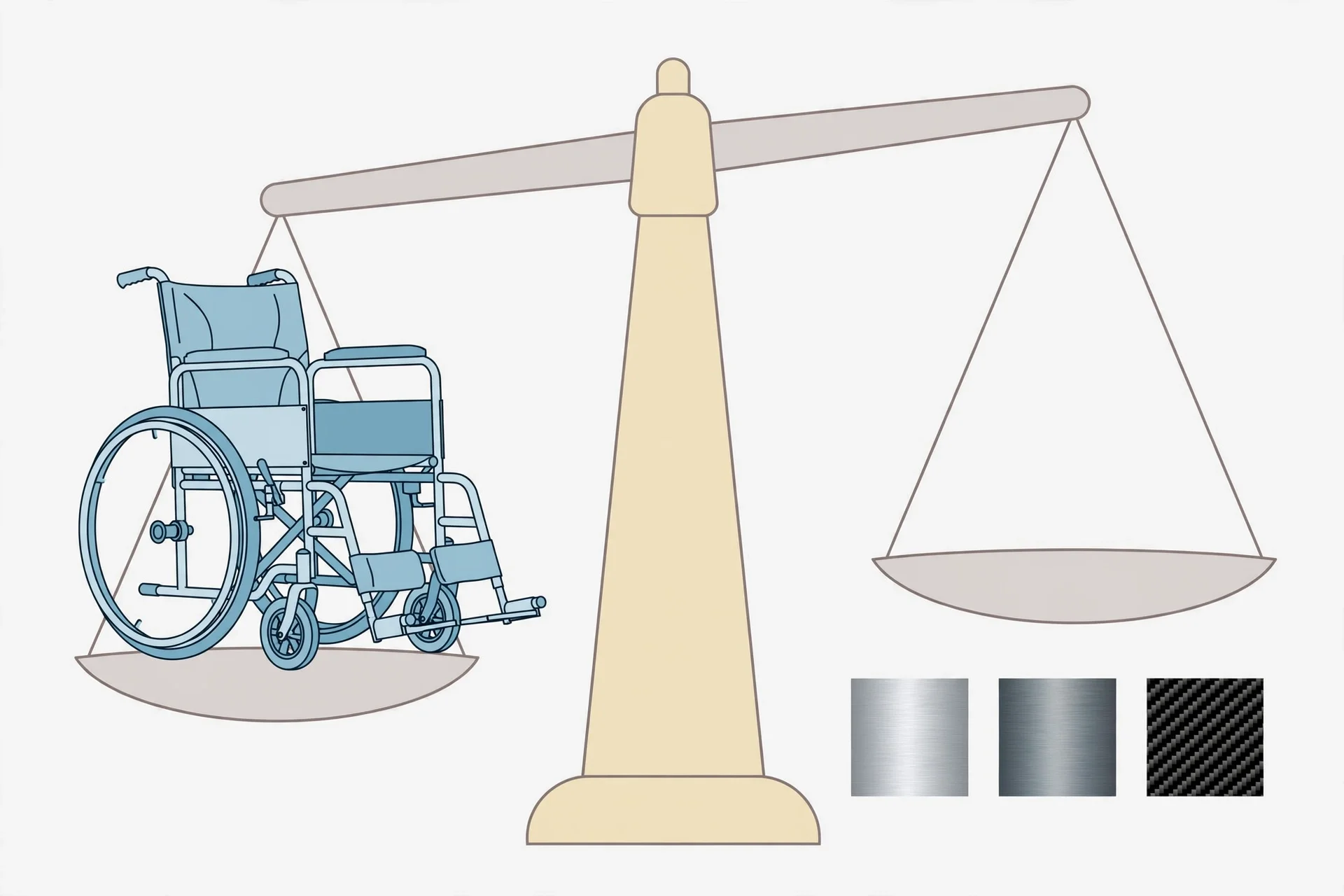
Clinical and manufacturer educational material, checked 19 October 2026. Axle setup must be done by a trained professional — this article explains the concepts; it is not fitting advice.
What moving the axle actually does
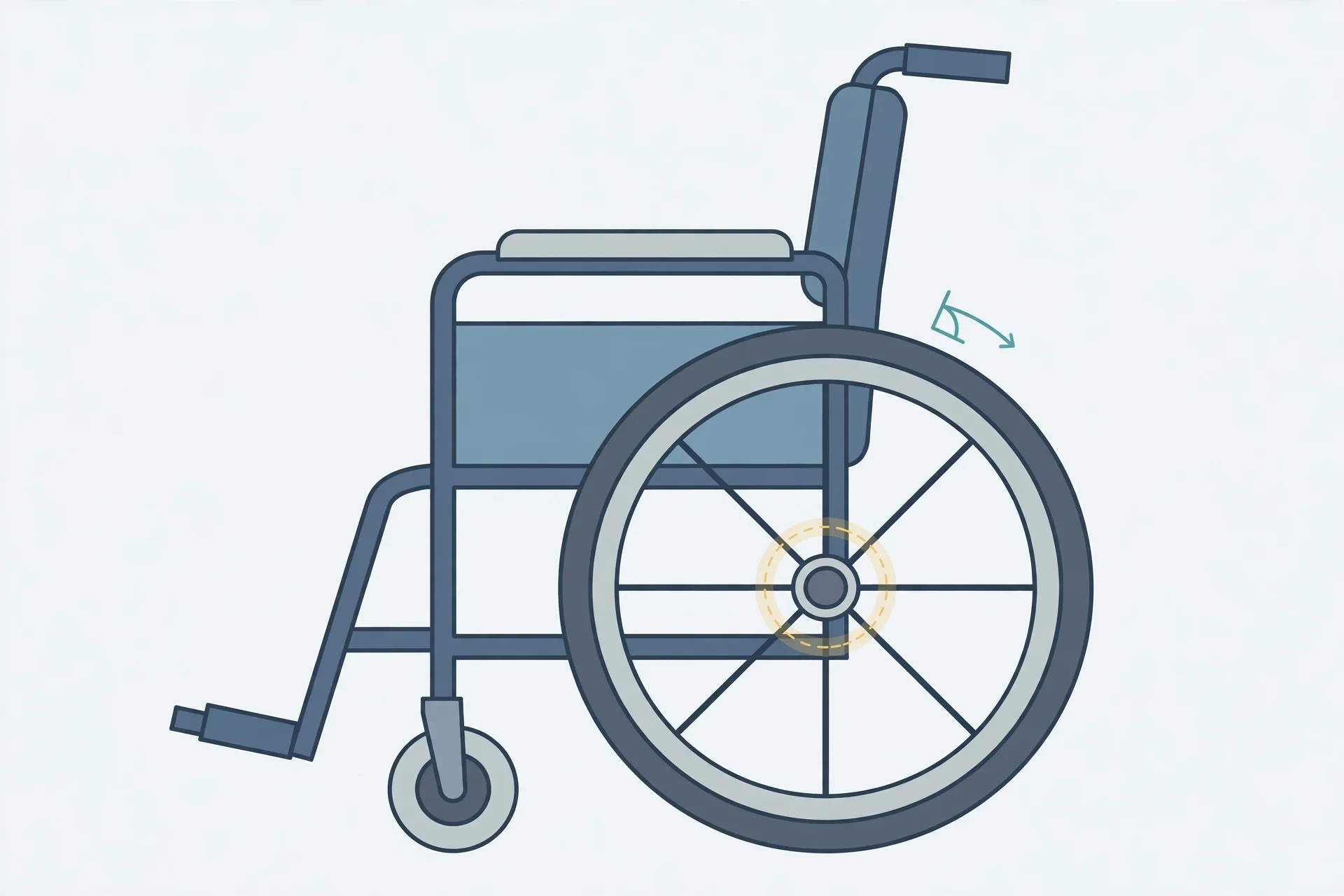
The rear axle sets the chair's centre of gravity relative to your own. Move the axle forward and more of your weight sits over the big wheels: rolling resistance drops, each push takes less effort, you can use a longer stroke — clinicians describe the ideal as a '10-to-2' push pattern, like hands on a clock face — and everyday obstacles such as thresholds get easier to clear.
Move the axle back and the chair becomes more stable rearward, but harder to propel. Sunrise Medical's clinical team notes that an axle left in its most rearward position is one of the most common setup mistakes they see in active pushers, who end up reaching behind themselves just to find the wheel. Most ultra-lightweight chairs allow this adjustment along an axle plate, and the axle can also be moved vertically to fine-tune how your hands meet the handrim.
The starting points clinicians use
Two widely cited guidelines give a practical starting point for active users:
- **The fingertip rule.** Position the axle so the tip of your middle finger rests at the wheel hub, giving roughly 100–120 degrees of elbow bend with your hand at the top of the pushrim. This is the set-up Sunrise Medical's educators use as a baseline for clients with moderate to high-level propulsion skills. - **The PVA recommendation.** The Paralyzed Veterans of America's clinical practice guideline on preserving upper-limb function recommends setting the rear axle so that the angle between the upper arm and forearm is 100–120° when the hand is at the top dead centre of the pushrim (cited by New South Wales' Agency for Clinical Innovation).
Neither is a prescription. People whose centre of mass sits further back — bilateral amputees, for example, or petite users with little trunk mass — usually start from a more conservative, rearward setting and may use anti-tip devices while building skill. Vertical position matters too: sit too high above the wheel and the stroke shortens, forcing faster, choppier pushes; sit too low and the shoulders work through awkward, elevated angles that invite pain over time.
Why this is a professional adjustment
Axle changes ripple through the whole set-up. Raising or lowering the axle alters the seat angle, the backrest angle and the caster-stem alignment — the casters should end up perpendicular to the ground — and each of those must be corrected or the chair can become unstable, uncomfortable or genuinely hard to control.
Do not reposition axles yourself without training. Ask your wheelchair service, occupational therapist or dealer to assess and adjust the chair, and tell them how and where you actually use it — a chair set up for indoor office life needs a different balance than one built for hilly streets. If you are being fitted for a new chair, ask specifically which centre-of-gravity setting was chosen and why. A good prescriber will always have an answer.