NHS trust tissue-viability patient leaflet and Paralyzed Veterans of America clinical practice guideline (2nd ed), both opened and verified 19 October 2026. Guidance summarised in own words; check with your clinical team for personal advice.
What a pressure ulcer actually is
A pressure ulcer forms when sustained pressure squeezes the skin between your body weight and the seat, reducing blood supply until the tissue is damaged. The NHS describes it as an area of damage to the skin and the tissue below, and in serious cases the muscle and bone can be affected too. A second culprit is shear — the force created when layers of skin slide over each other, for instance when you slump or slide down in the chair.
The danger zones are the parts of the body with little fat padding that press directly against the seat or backrest: the buttocks, sacrum and tailbone area, sitting bones, hips, heels and toes. This is why seated pressure is a daily concern for anyone who spends long hours in a wheelchair. Research cited in the Paralyzed Veterans of America's clinical practice guideline notes that between 27 and 40 percent of people develop a pressure ulcer during their initial rehabilitation hospitalisation after a spinal cord injury — so this is not a rare or edge-case problem, and almost everyone with a spinal cord injury faces it at some point.
The 15-minute habit: pressure relief in your chair
The single most effective prevention measure, according to NHS tissue-viability guidance, is changing position regularly — as a rule, wheelchair users should shift their weight at least once every 15 to 30 minutes. The Paralyzed Veterans of America guideline phrases it in terms of physiology: a weight shift lets the skin be replenished with oxygen. Their recommendation is a weight shift every 15 to 30 minutes; for people with a spinal injury at T1 or lower, every 15 minutes for about 15 seconds; for those who cannot shift their own weight, an assisted pressure relief every 30 minutes for about 30 seconds.
In practice, that means forward leans, side-to-side leans, or wheelchair push-ups if you have the upper-body strength. If you can stand safely, standing for a couple of minutes or going for a short walk counts too. If you cannot reposition independently, ask your care team or a carer to help you build repositioning into your day rather than leaving it to memory. And plan ahead for long journeys: the NHS advises that anyone considering a trip of an hour or more should discuss their equipment and repositioning plan with their clinical team before travelling.
Cushions: what they do and how to choose one
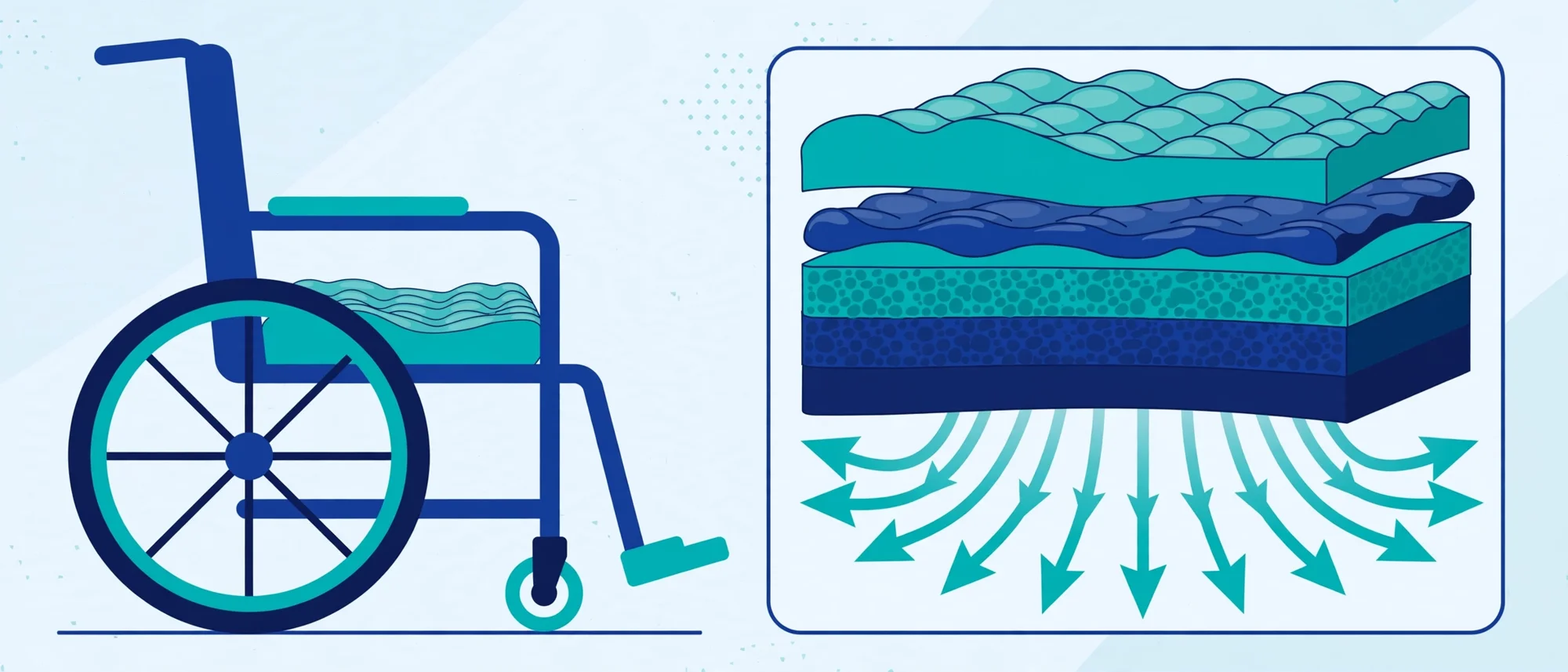
A good cushion redistributes your weight across a larger surface so that no single bony area takes the full load. The NHS leaflet on pressure-ulcer prevention describes high-specification foam and gel-filled seat cushions as working by moulding around the body to cushion bony areas and reduce pressure while sitting. Air-based cushions use adjustable cells for the same purpose, and alternating (dynamic or electric) systems go a step further by cycling inflation to relieve each area in turn.
Two caveats matter. First, the right cushion for you should be chosen after a full assessment by your care team — body shape, posture, sensation and how you transfer all feed into the decision, and equipment that suits someone else may not suit you. Second, the NHS is explicit that pressure-relieving equipment will not remove your risk: you still have to offload pressure and change position while using it. One more practical point from the PVA guideline: if your weight changes noticeably — around 10 percent up or down — have an occupational or physical therapist recheck your wheelchair and cushion fit, because a cushion that no longer matches your body can create new pressure problems.
Skin checks, warning signs and daily basics
Catching a problem early is what keeps a sore from becoming a wound. Inspect the high-risk areas daily — sitting bones, sacrum, heels and anywhere else that takes load — and ask a carer to help or use a small handheld mirror for spots you cannot see yourself. The NHS says the first sign of a forming ulcer is usually a patch of skin discolouration that does not fade after a few hours: redness on pale skin, or a purple or bluish area on darker skin, which may feel tender.
Watch for pain or discomfort in an area, skin that is hotter or cooler than the surrounding skin, hardness or swelling, blistering, and any break in the skin or wound. Report any of these promptly to your nurse, GP or spinal-injury team — early-stage changes can often be managed simply by changing the seating and offloading plan, while waiting makes everything harder.
Two everyday habits support skin resilience: keep your skin clean and dry (moisture from incontinence or sweat raises the risk), and eat a balanced diet with enough protein — the NHS recommends plenty of fruit and vegetables plus protein-rich foods such as meat, fish, eggs and dairy, and about 8 to 10 cups of fluid (roughly 2,000 ml) a day. Smoking reduces blood flow and slows healing, so stopping or cutting down helps too. None of this is a substitute for professional advice: if you have reduced sensation, poor circulation, or a history of ulcers, ask your clinical team for a personalised pressure-care plan.