Spec-based review from manufacturer-published data (UK product page, US listing). Prices and specs are UK figures unless stated; range claims vary between the manufacturer's own pages as noted.
What the MM60 Carbon is, on paper
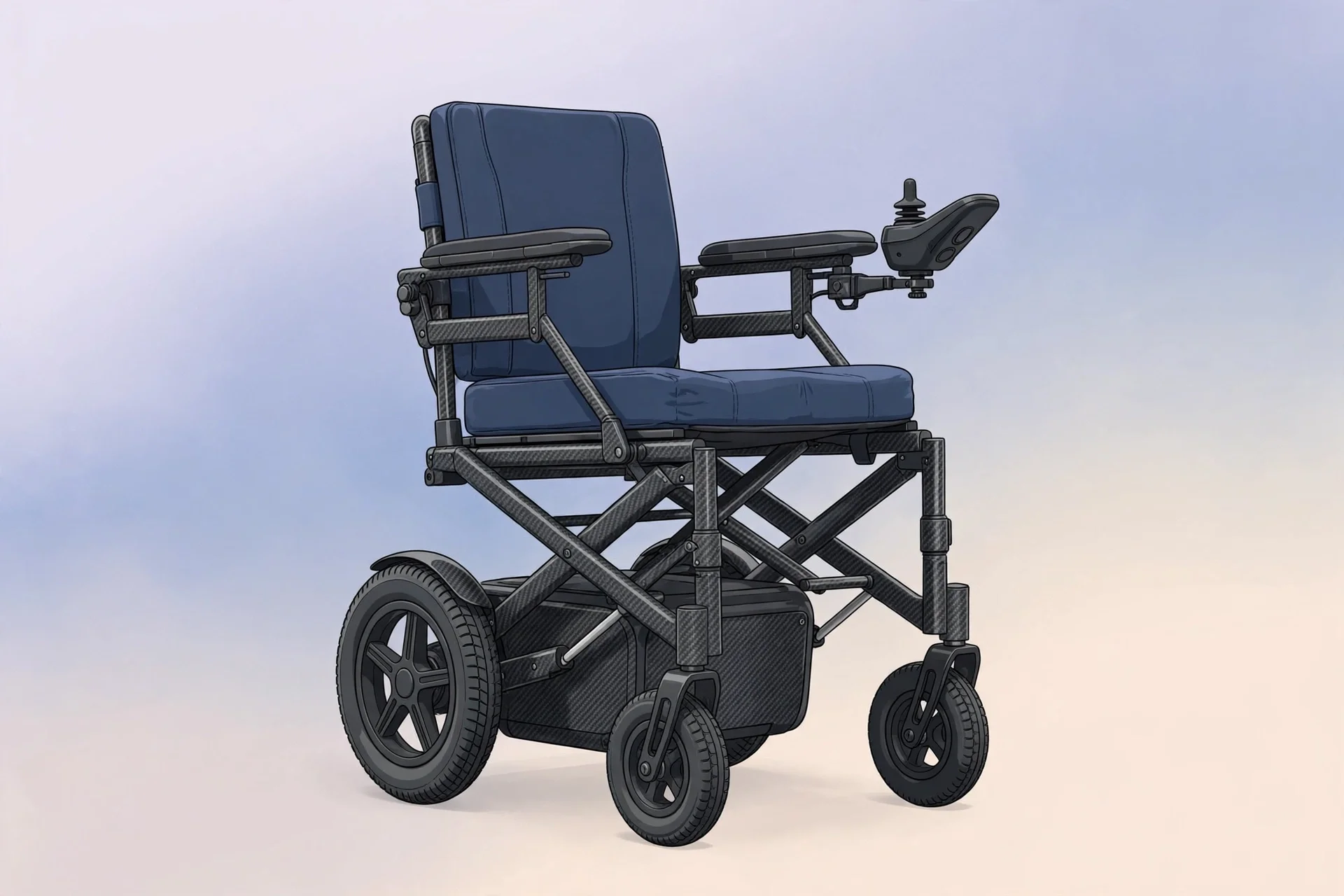
The MM60 Carbon is Monarch Mobility's ultra-lightweight folding power wheelchair, and its headline number is hard to argue with: 13 kg without the battery, which Monarch says makes it one of the lightest folding power wheelchairs in its class. For context, many folding powerchairs sit at 20 to 28 kg before the battery, so a 13 kg frame is a genuine step change for anyone who lifts the chair into a car boot daily – the difference between a one-person lift and a two-person struggle. The frame is carbon fibre, the folded dimensions are 74 × 60 × 32 cm, and unfolding gives you a chair measuring 95 × 60 × 96 cm with an 18-inch-class seat (46 cm wide, 45 cm deep, 50 cm seat-to-ground height). Drive comes from twin 200 W rear motors with a 4 mph top speed, 9-degree climbing ability, electromagnetic brakes, anti-tip wheels, puncture-proof tyres, a safety belt and a manual freewheel mode for pushing when the power is off. The battery is a removable 24 V 10 Ah lithium pack that charges on or off the chair, with a USB port for topping up a phone on the move. Seating gets a supportive padded seat, a breathable backrest and flip-up armrests that help side transfers. UK pricing is £2,695 RRP, and the chair is Motability Scheme approved, which matters if you plan to lease through the Scheme rather than buy outright – Scheme approval also signals the chair has passed the Scheme's own assessment process. Monarch lists it as air, coach and cruise friendly, which signals the removable battery is intended to meet transport rules – though as always, confirm with your airline before you fly rather than treating a marketing claim as a boarding pass. Everything in this review comes from Monarch's own product page and published FAQ, cross-checked against the US retail listing that Monarch's American dealers publish, not from time in the chair – and the review is explicit about that, because a spec sheet tells you what a chair claims, not how it rides. The 'New!' badge on the product page and the July 2026-dated product imagery suggest this is a recent addition to Monarch's line-up, arriving as the company expands – Monarch marked a major international milestone with its REHACARE 2026 presence and new distribution partnerships across more than twenty countries. That context matters for buyers: a manufacturer in growth mode is investing in its range, but also means early production runs deserve the usual caution – ask the dealer whether any running changes have been made since launch, and check the warranty terms in writing before you pay.
Where it shines, and where it doesn't
The strengths are real and specific, and they cluster around one idea: this chair is optimised for being lifted, folded and transported. Thirteen kilograms without the battery is genuinely light for a folding powerchair, and the folded 74 × 60 × 32 cm package will go into most car boots without disassembly, which is the whole point of this category – the chair disappears into the boot and reappears at the destination. The removable battery charges on or off the chair, the flip-up armrests help side transfers onto car seats and sofas, and the safety list is complete for the class: electromagnetic braking that holds on slopes, anti-tip wheels, puncture-proof tyres and a seatbelt. Motability approval is a practical plus in the UK, and the 21-stone (about 133 kg) user weight limit is generous for a carbon-frame folder, though users near that limit should remember that range and performance fall as load rises on every chair. Now the limits, stated honestly, because a review that only repeats the brochure is an advert. The 24 V 10 Ah battery is small, and Monarch's own page gives two different range figures: the spec icon block says up to 9 miles, while the FAQ says the 10 Ah pack gives up to 6.2 miles under normal driving conditions. Treat 6.2 as the realistic planning number and 9 as best case on flat ground with a light user – and plan your day around the lower figure. There is no attendant control option, which rules the chair out for users who need a carer to drive; no suspension, so rough pavements will be felt; a single black colour choice; and a 9-degree climb rating with 1.25-inch ground clearance that confines it to pavements, shopping centres and firm paths – this is a town-and-travel chair, not an all-terrain one. The 35-inch turning radius is respectable for indoor use but not class-leading. And at £2,695 it sits at the premium end of folding powerchairs, where you are paying for the carbon frame and the weight saving, not for features – a heavier aluminium folder with the same motors costs substantially less. None of this is a flaw in the chair; it is the price of the design brief. But buy it understanding the brief. Two smaller observations from the spec sheet are worth flagging. First, the seat-to-ground height of 50 cm and the 46 cm seat width put it in the standard adult range – neither notably roomy nor cramped – so users at either end of the size spectrum should trial it rather than assume. Second, the 'air, coach and cruise friendly' claim appears in the spec table without further detail; it almost certainly refers to the removable lithium battery being designed within transport limits, but the page does not publish the battery's watt-hour rating, which is the number airlines actually ask for. A 24 V 10 Ah pack is 240 Wh by calculation – above the 160 Wh threshold many airlines apply to spare batteries, though installed mobility-aid batteries are treated under the separate mobility-aid provisions. Get the watt-hour figure confirmed in writing by the dealer before you fly, and do not rely on the reviewer's arithmetic at check-in.
Who should buy it, and the checks to run before you pay
The MM60 Carbon makes sense for one clear user: someone who needs a genuinely liftable folding powerchair for car transport and travel, can work within about six miles of real range, drives mostly on pavements and indoor floors, and values low weight over heavy-duty features. It is a weaker fit if you need attendant controls, regularly face steep hills or rough ground, want the longest possible range per charge, or need a chair that doubles as an all-day outdoor workhorse. The Motability Scheme approval adds a specific buying route for eligible UK users – leasing through the Scheme rather than finding £2,695 upfront – which is worth exploring with a Motability adviser before committing to a private purchase. Before buying, run three checks that apply to any folding powerchair but matter especially here. First, measure your car boot against the folded 74 × 60 × 32 cm dimensions and physically trial the fold if you can – folding mechanisms vary in effort and in how small they really go, and Monarch describes this one as a manual fold, so make sure you or your carer can do it comfortably, repeatedly, in a rainy car park. Second, if you fly, email the airline with the battery's exact spec (24 V, 10 Ah, removable lithium) and get written confirmation before you book; never assume an 'air friendly' marketing claim replaces the airline's own dangerous-goods sign-off, and carry the manufacturer's battery documentation with you. Third, compare against at least two rivals in the lightweight folding class on the same four numbers – weight without battery, folded dimensions, battery capacity, and user weight limit – and ask the dealer about local service and spare-parts availability before you commit, because a carbon frame is only as good as the dealer who can fix it. Monarch is a UK manufacturer with a dealer network, which is worth more than a spec sheet when something needs fixing under warranty. At £2,695 with Motability approval, the MM60 Carbon earns its place on the shortlist for lightweight folding powerchairs; just buy it for what it is – a travel-optimised town chair – rather than what no 13 kg chair can be. One last piece of buying advice specific to carbon frames: ask what happens when the frame is damaged. Carbon fibre does not dent like aluminium – it can fail invisibly after an impact – so ask the dealer about the inspection procedure after a knock, whether the frame is repairable or replace-only, and what a replacement frame costs outside warranty. These are the questions that never appear on a product page and that you will be glad you asked the day the chair meets a baggage carousel. A good dealer answers them directly; a dealer who waves them away is telling you something about the after-sales experience.