Scope: armrest types and adjustment mechanisms from the Power Plus Mobility NV TILT owner's manual and the Sunrise Medical Quickie Q300 M Mini Instructions for Use, both read on 2026-10-12. Knob positions, hole counts, and available ranges vary by model — follow your own chair's manual. No safety, medical, or warranty conclusions are made here; structural problems are left to your dealer.
In brief
- Most power wheelchair armrests come in three styles — full-length, desk-length, or flip-back — and many can also be removed entirely via a latch for transfers.
- Height usually adjusts with a release knob through preset positions or an Allen-key bolt on the arm post; always set both sides to the same position and confirm the lock reseats.
- Width (±20 mm is typical), pad angle (0–15°), and pad height ranges (190–320 mm on common models) are the fine-tuning settings that decide table clearance and doorway fit — ask your dealer about them at service time.
Three Armrest Styles You'll Meet
Power wheelchair armrests generally fall into three styles. Full-length arms run from the back of the seat to the front and give the most forearm support. Desk-length arms are shorter at the front, so you can roll closer to a table or desk without the armrest bumping the edge. Single-post or flip-back arms mount on one post and swing backward, opening the side of the chair completely. Many chairs also let you remove the armrests outright by releasing a latch and lifting them straight up — manuals describe this as the standard way to clear the side of the chair.
| Style | What it's good at | The trade-off | |---|---|---| | Full-length | Maximum forearm support, steady feel | Can block you from pulling up close to tables | | Desk-length | Slides under tables and desks | Less support surface for the forearm | | Flip-back / single-post | Swings back for easy side transfers | Usually the simplest pad, fewer adjustments |
Which one you have is decided at purchase or by your dealer, but knowing the style tells you which adjustments to look for — height knobs live on adjustable posts, while flip-back arms have a release lever instead.
Height Adjustment: Knobs, Holes, and Preset Positions
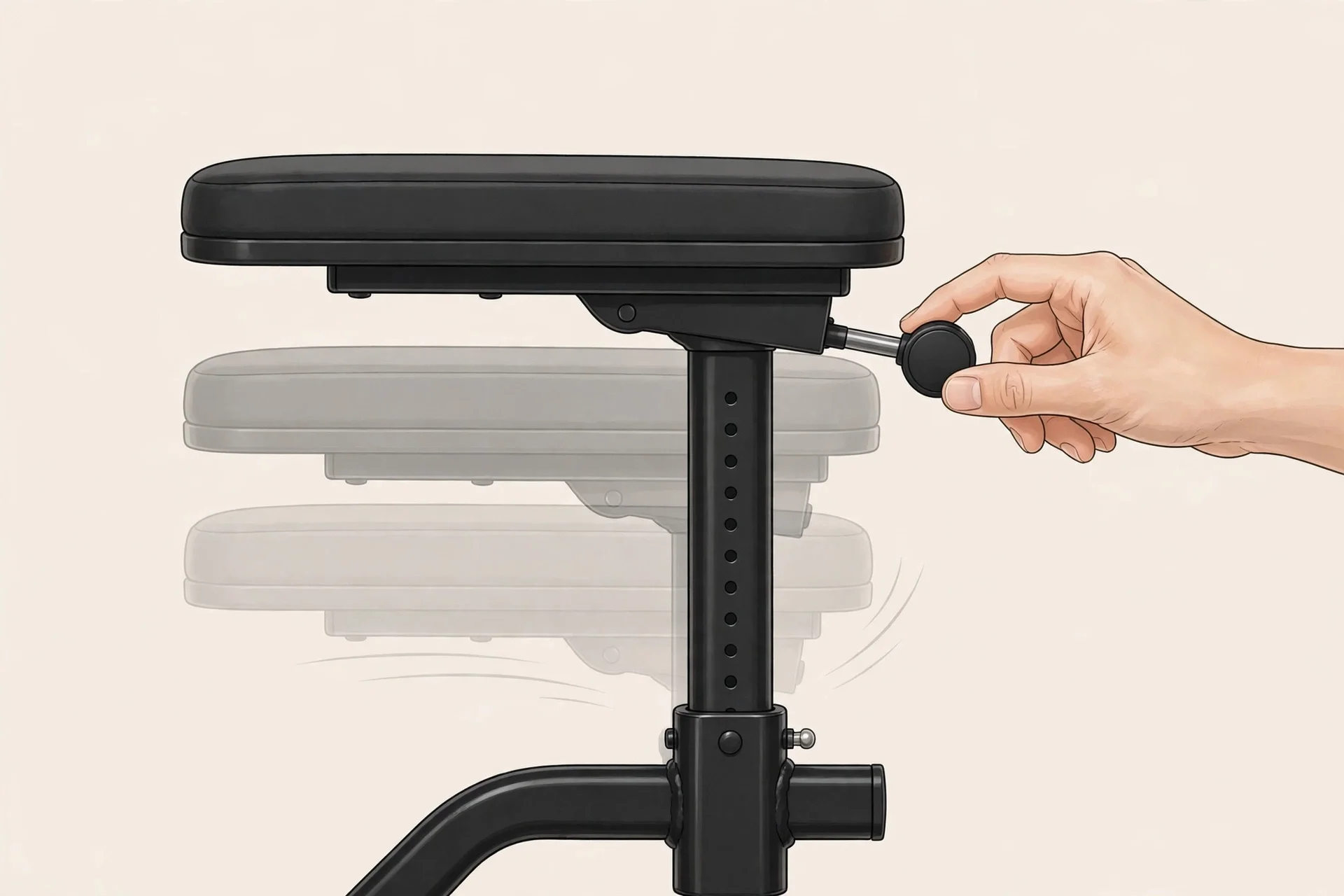
If your chair has adjustable-height arms, there are two common mechanisms. The simplest is a spring-loaded release knob: pull it out, lift or push the armrest top to the height you want, and let go so the pin drops into the next hole. Some chairs offer several preset positions this way — five is a typical count in owner's manuals. The other common design uses a bolt through the arm post that you reposition with an Allen key, moving the armrest hardware up or down along the back frame tube.
Whichever type you have, count the clicks or holes and set both armrests to the same position — uneven arms are a common cause of a chair that 'feels wrong' after cleaning. A practical check: sit in the chair with your hands resting lightly on the pads. If your shoulders ride up or your elbows dangle, the height needs changing. Small changes are fine to do yourself at home; the manuals only ask that you make sure the locking pin or bolt is fully reseated afterward.
Width, Depth, and Angle: the Settings People Skip
Beyond height, several chairs let you fine-tune the armrest footprint. Published specifications show what's typical: one popular powerchair lists its armrest pad height adjustable from about 190 mm to 320 mm above the seat plate (roughly 7.5 to 12.6 inches), with the single-post flip-back version covering about 250 to 400 mm. Width adjustment of around ±20 mm on the seat frame is also common, along with pad angle adjustment of 0 to 15 degrees from vertical.
Why do these matter? Width determines how the chair fits through your narrowest doorway with the armrests on — a few centimeters can be the difference between scraping paint and clearing it. Pad angle changes where your forearm rests relative to the joystick, which matters if you drive with a relaxed arm versus an extended one. On some chairs with T-style arms, the armrest angle is linked to the backrest angle in fixed steps (for example 5, 10, or 15 degrees), so changing one means checking the other. These are dealer-level adjustments on many models, but knowing they exist means you can ask for them at your next service visit instead of living with a setup that annoys you.
When Adjustment Pays Off — and When to Call Your Dealer
A few everyday moments are worth an armrest tweak. If you can't pull up to your dining table, check whether your arms are desk-length and whether lowering them a notch clears the table edge. For side transfers, flip-back or removable arms are what the manuals recommend: flip or lift the arm out of the way before you move, then lock it back into place and confirm the latch caught before driving. If the chair has a tilt or recline function, glance at the armrests after changing position to make sure nothing binds.
Two maintenance notes from the manuals: arm pads are wear items — they are typically excluded from the frame warranty, so a cracked pad is a replacement part, not a defect claim. Clean pads and posts with mild soap and water and rinse well. And know your limit: if a height latch won't stay engaged, a post wobbles after tightening, or a flip-back lever feels loose, stop adjusting and call your dealer. Armrests carry real load during transfers, and a bracket that fails mid-transfer is not a home-repair job.