Charging, storage and battery-care advice paraphrased from Permobil's official charging guide (maintenance-free AGM, EMEA/UK edition) and Sunrise Medical's official battery-care page and owner manuals (UK). Applies to the manufacturers' own products; always follow the charger manual supplied with your chair. Checked 2026-10-04.
Mistake 1: Only charging when the battery looks empty
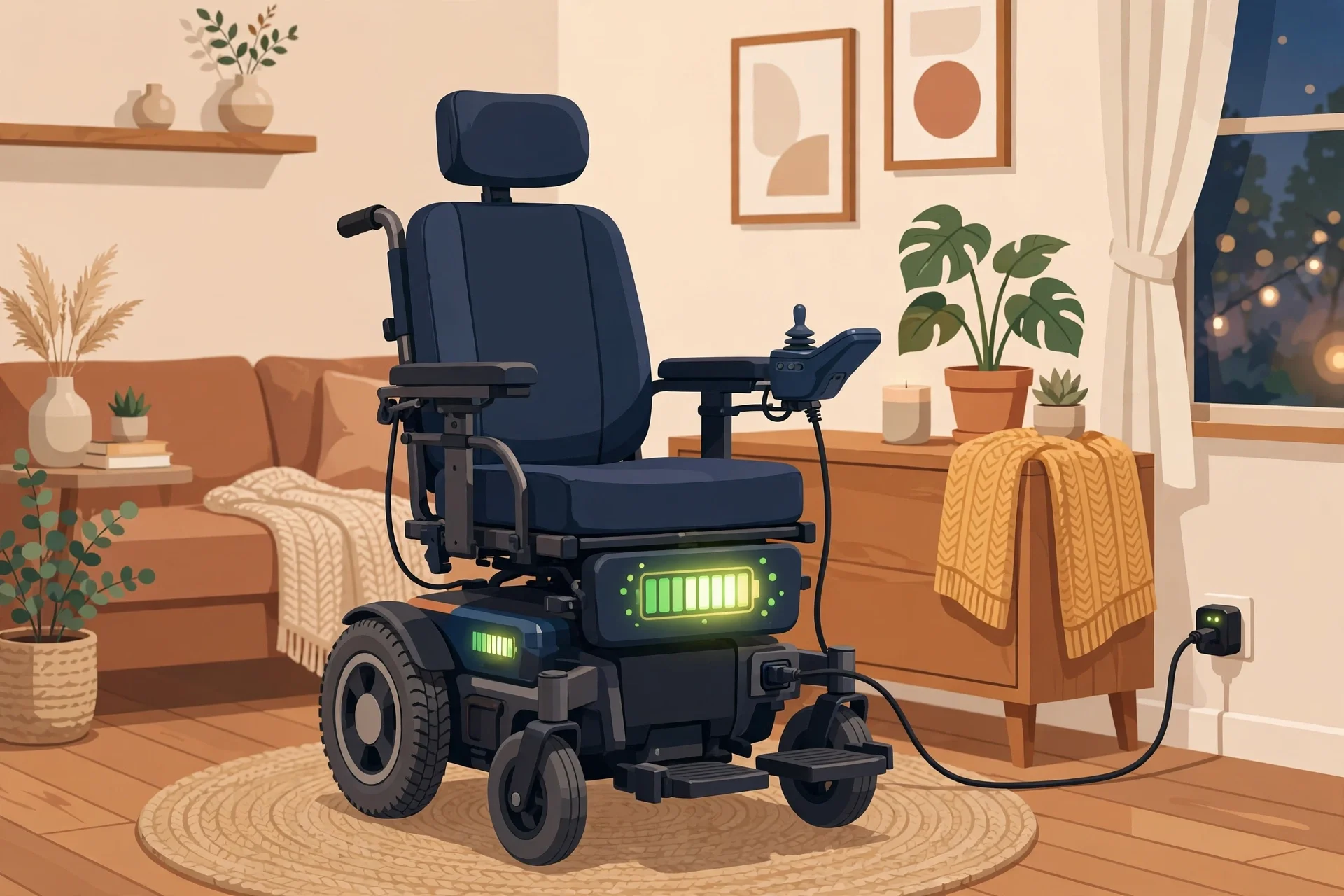
Waiting until the battery gauge looks low before plugging in is one of the most common habits Permobil and Sunrise Medical both warn against. Permobil's charging guide recommends charging the wheelchair every evening or night when you have finished driving for the day, as a routine — not as a rescue. Sunrise Medical's battery-care guidance says the same thing: recharge the batteries every night, regardless of how much you used the chair that day, and even if you did not use it at all. The reasoning is straightforward. Deep discharge is hard on batteries, and a chair left sitting at a low charge degrades faster than one that is topped back to full after each day. Permobil also flags an edge case for people who barely drive: if your chair is rarely used and the battery level rarely drops below half, you should once a week drive the chair more intensively so the level reaches the red zone, and then charge. That keeps the battery chemistry exercised rather than idling at a permanent near-full state. The habit to build is boring but effective: end of day, plug in. Do not treat the charger as an emergency tool.
Mistake 2: Interrupting the charge — or topping up by day
Unplugging the charger early because the gauge reads 'good enough' is the second classic mistake, and both manufacturers are explicit about it. Permobil states that charging should normally last at least eight hours, and that fully discharged batteries need approximately twelve hours to reach a full charge; the charge should not be interrupted until the process is complete and all four indicator lights on the charger are lit. The charger operates automatically, so there is nothing to gain by babysitting it — and Permobil warns against connecting it to a socket with a timer. Sunrise Medical adds two related points. First, do not interrupt the charging cycle. Second, do not top up the charge of your batteries during the day; wait until the evening for a full overnight charge. Short daytime top-ups never complete the full cycle the battery needs. There is also a subtler version of this mistake: switching the wall socket off while leaving the charger cable plugged into the chair. Sunrise Medical warns that turning the mains off while the cable stays connected will eventually deplete the battery charge. If the chair is not required for use, it should stay connected to the charger with the mains left switched on — that, they say, will not damage the batteries.
Mistake 3: Storing the chair with no battery plan
Batteries keep degrading even when nobody is driving the chair, and both manufacturers describe what happens when a chair is left alone. Sunrise Medical warns that if your mobility device is not needed for a while, failure to plan for recharging will damage the batteries and can lead to shorter travel distances and premature failure. Their rule: if you leave the chair for more than fifteen days, charge the batteries fully, then disconnect the main battery lead, and make sure you fully charge them at least once a week. Their blunt bottom line is that deep discharge can render batteries useless. Permobil's guidance covers the temperature side of storage. They recommend charging and storing the wheelchair at a normal indoor temperature of approximately 20°C. In colder conditions, charging takes longer and battery capacity is reduced, which can shrink the travel distance per charge. Sunrise Medical adds a cold-weather warning from their instruction manuals: never charge a frozen battery. A fully charged battery rarely freezes, but the electrolyte of a discharged battery can freeze at minus nine degrees Celsius, and any battery suspected of being frozen should be thawed completely before charging. So the storage checklist from the manufacturers is: full charge first, disconnect if it will sit for weeks, recharge weekly, and keep the chair at indoor temperatures rather than in an unheated shed or garage.
Mistake 4: The wrong charger, the wrong spot, and neglected terminals
The fourth mistake is really three small ones that belong together: using a charger the manufacturer did not approve, charging in a bad spot, and never looking at the battery terminals. On chargers, the advice is unanimous. Permobil says only to use a Permobil charger intended for use with your wheelchair, warning that incorrect chargers can damage the batteries, the wheelchair, the control system or the charger itself. Sunrise Medical likewise says only to use an approved Sunrise Medical charger compatible with the vehicle being charged. The charger and the chair are a matched pair — do not substitute. On charging location, Permobil says to charge in a well-ventilated, dry room, and their manuals add specifics: not in a wardrobe or closet, not in a bathroom or wet room. Sunrise Medical's manuals say to always place the chair on a hard surface in a room with good ventilation when charging, and not to charge outdoors. On terminals, Sunrise Medical recommends checking them regularly for signs of corrosion. If corrosion is apparent, clean the terminals completely — a wire brush is ideal — and re-grease them using petroleum jelly, not ordinary grease, making sure the terminal nuts, cable clips and exposed cable are fully covered. One more difference the manufacturers spell out concerns battery types. Sunrise Medical fits maintenance-free batteries as standard and notes a practical distinction: maintenance-free batteries generally take longer to fully charge than wet lead-acid batteries, so the charge cycle needs its full time. Permobil's chairs use maintenance-free AGM batteries, and their line on them is simple: charge regularly, and no other maintenance is required. Whatever type your chair uses, the routine that covers everything above is the same: charge every night after use, give the cycle its full time — at least eight hours — and do not interrupt it or substitute daytime top-ups. Use only the charger supplied or approved for your chair, charge in a dry, ventilated room at normal indoor temperature, and leave the chair connected with the mains switched on when it is not in use. For long idle periods, charge fully, disconnect the main lead if it will sit beyond about two weeks, and recharge weekly. Check the terminals now and then for corrosion and clean and re-grease them with petroleum jelly if you see any. If your chair behaves oddly during charging — for example the charger plug or the chair's charging socket getting hot — Permobil says the contacts should be checked and replaced by qualified personnel, so contact an authorized service centre rather than improvising.