UK details verified 2026-10-07 against Driving Mobility's Going by Train guide and Amtrak's official Accessible Travel Services page. Scooter size limits vary by UK train company; Amtrak device limits are published on its Wheeled Mobility Device Services page.
United Kingdom: how Passenger Assist works
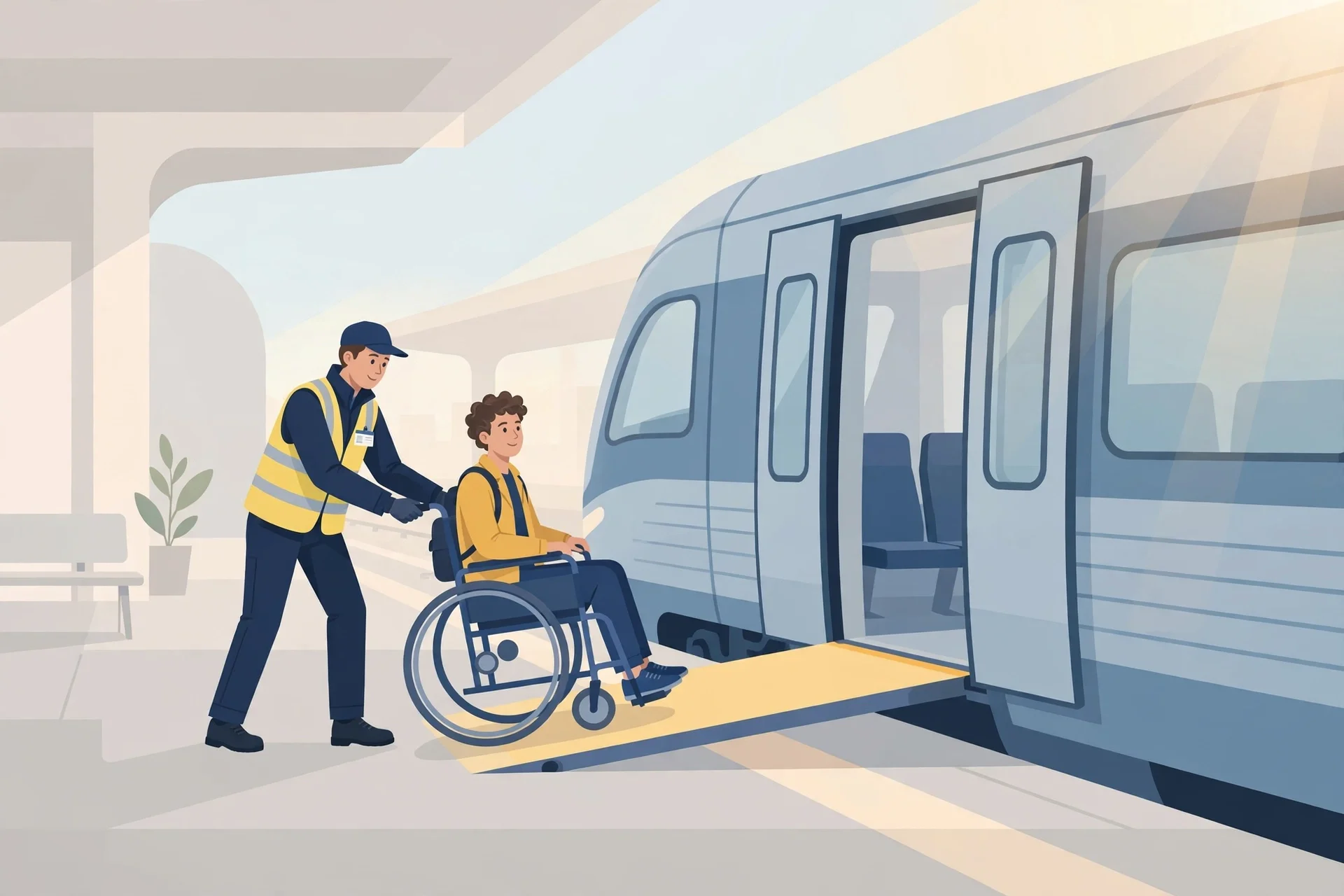
Passenger Assist is the free, rail-industry-wide service that arranges help for any train journey in Britain. You can book it 24 hours before you travel by calling 0800 0223720, and it is available to anyone who needs assistance because of a disability, a temporary impairment, or older age — no railcard or membership is required. When you book, staff will arrange to meet you at the station entrance or an agreed meeting point, help you navigate the station and accompany you to your train, provide a ramp to get you on and off, meet you from the train and take you to your next train or the exit, and carry up to three items of luggage. On board, you can stay in your wheelchair or transfer to a seat if you prefer; wheelchair spaces sit close to the accessible toilets fitted on modern trains. Two things to check before you commit. First, station staffing: some smaller stations are not staffed at all hours, so confirm that staff will be present when you arrive and depart — National Rail Enquiries can confirm this. Second, if you travel with a mobility scooter, each train company sets its own size and weight limits, so check the operator's policy rather than assuming your scooter will be accepted. Mainline and London stations are all accessible and staffed, which makes them the safest bet for a first assisted journey.
United States: how Amtrak accessible travel works
Amtrak runs its own accessibility programme under the banner of Accessible Travel Services. The core of it is the accessible-space reservation: on many services you need to reserve the wheelchair space or accessible seat in advance, and Amtrak publishes separate guidance on who may reserve accessible space and how to book it — online, by phone, or in person at a staffed station. Before you book, read Amtrak's Wheeled Mobility Device Services page, which sets out the types of manual and powered devices the trains can accommodate along with boarding and detraining procedures; checking your chair against those guidelines is the single most useful preparation step. Amtrak also publishes station accessibility information so you can confirm whether your origin and destination stations are step-free and staffed, and notes that some routes include Amtrak Connection bus services, which use lift-equipped coaches. If you travel with a companion or attendant, there are dedicated provisions for them, and accessible bedrooms are available on overnight trains for longer journeys — these are limited in number, so book early. As with the UK, the rule of thumb is simple: book the assistance at the same time as the ticket, and reconfirm the station's staffing hours.
Booking timeline: a checklist that works in both countries
Two weeks before: decide whether you will stay in your wheelchair or transfer, and measure your chair's width, length and weight. One week before: book your ticket and your assistance together — in the UK call 0800 0223720 at least 24 hours ahead; with Amtrak, reserve accessible space when you book, especially for accessible bedrooms on overnight routes. Three days before: check your stations. Confirm step-free access between the entrance and the platform, and confirm that staff will be on duty at the times you travel. The day before: charge powerchair batteries fully, pack any tools or chargers you might need, and save the assistance phone number in your phone. On the day: arrive early — at least 30 to 45 minutes before departure in the UK, more at large US stations — and make yourself known to staff as the passenger who booked assistance; the reservation alone does not identify you in a crowd. If your plans change, tell the assistance team as soon as you know, because ramps and staff are scheduled around your booking.
Preparing your chair for the journey
Whatever the country, a little preparation prevents most problems. If you use pneumatic tyres, check the pressure before you leave; an under-inflated tyre makes ramps harder and increases the risk of a puncture mid-journey. Remove or secure loose accessories — bags, cup holders, joystick guards — so nothing snags on the ramp or the train door. Know your chair's folded dimensions if you plan to transfer to a seat, because the crew may need to stow it. Bring the charger for a powerchair on longer journeys, and keep the manufacturer's emergency contact in your phone. Finally, keep your booking reference and the assistance team's number where you can reach them without digging through luggage. Trains are among the most wheelchair-friendly ways to travel long distances, and the assistance systems on both sides of the Atlantic are genuinely good — they just need advance notice to work.