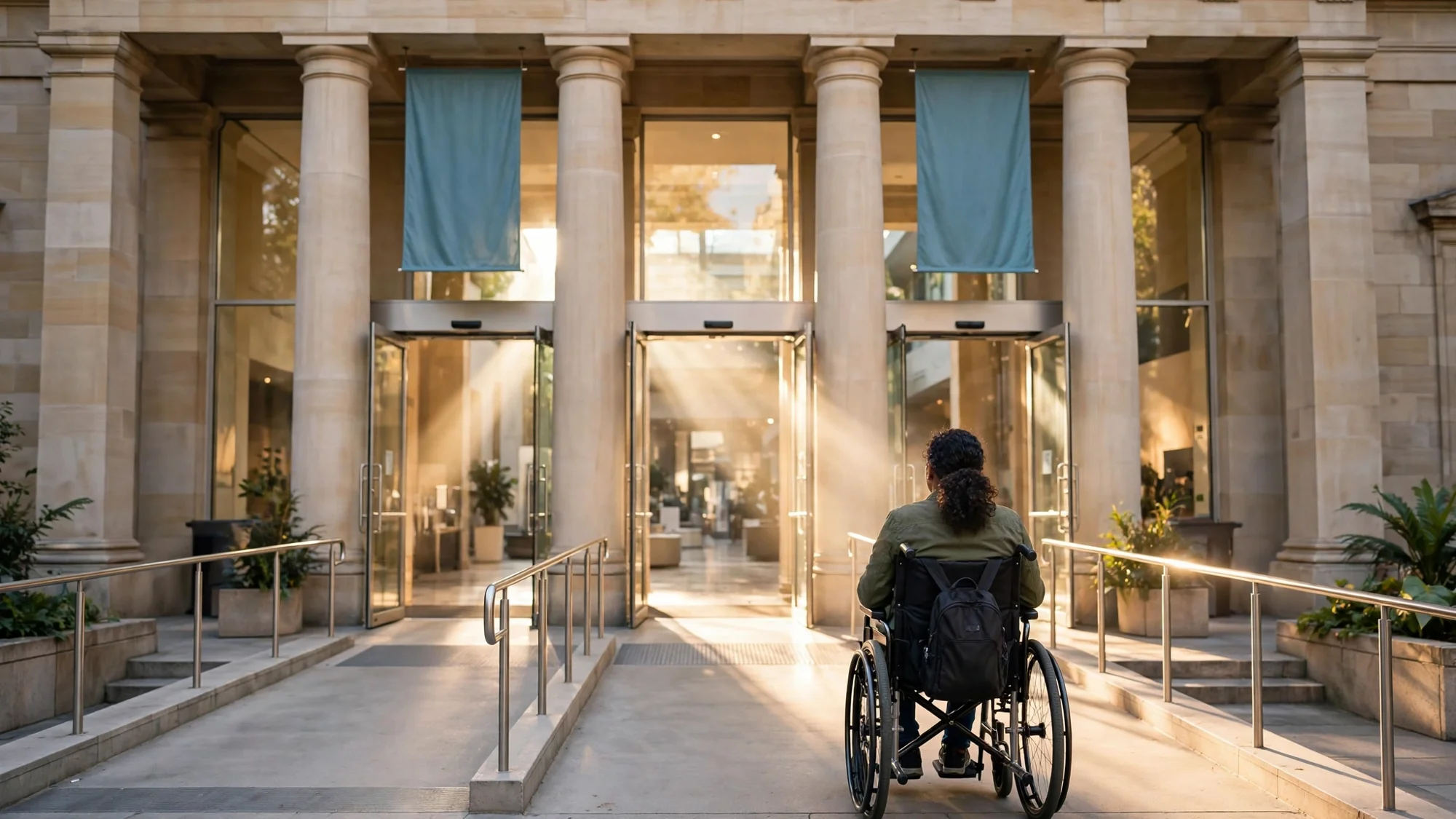
Trail details are for the New Forest; check the facilities and access tab for other Forestry England forests.
In brief
- Check the car park map first: 22 accessible bays across nine named New Forest car parks
- Tall Trees' narrowest point is 1.1 metres at the chicane barriers - measure your chair against it
- No all-terrain scooter hire in the New Forest itself; Moors Valley is the named alternative
Start with the car park, not the trail
Forestry England lists 129 car parks across the New Forest, with gravel surfaces and unmarked spaces except for accessible bays. There are 22 dedicated accessible parking bays across nine car parks: Anderwood, Bolderwood, Burley, Hatchet Pond, Knightwood Oak, Linford Bottom, The Old Reptiliary, Whitefield Moor and Wilverley Plain, and the parking page maps them. Parking charges apply in the New Forest to all vehicles, including Blue Badge holders, while Blue Badge parking lets a visitor, driver or passenger, park close to their destination in the designated spaces. The visitor information unit at Bolderwood is open seasonally during bank and school holidays, and the pages also point visitors to the New Forest Heritage Centre in Lyndhurst. Rail options are listed too, with stations at Ashurst, Brockenhurst, Lymington, New Milton and Sway, and the A35 and A337 roads cross the forest.
Tall Trees, measured
The Tall Trees Accessible Trail leaflet is the model of what an access page should give. It is a 1.4-mile (2.3 km) woodland walk starting and finishing at Blackwater car park, grid reference SU 268 047, on Ordnance Survey map Explorer OL 22, taking under one hour. Blackwater car park has two disabled bays, plus disabled access toilets, picnic tables, bike racks and an information point. The path is a fairly smooth gravelled surface, level, with frequent resting places and no gates. The narrowest width along the route is 1.1 metres at the chicane barriers where the trail crosses the road, and there is one bridge 1.5 metres wide with handrails and a 1-metre wide anti-slip covering. The route winds past giant redwoods, following pinecone waymarker posts parallel to the road. If your chair is wider than 1.1 metres, or you need a turning space at a chicane, this is the number that decides the visit.
Two more trails, and one honest gap
Forestry England recommends the Knightwood Oak trail and the Blackwater Arboretum trail for a short stroll suitable for mobility scooters, manual wheelchairs and pushchairs. The honest gap is hire: Forestry England says it does not have all-terrain scooter hire at its car parks across the New Forest, but scooters are available at Moors Valley Country Park and Forest. There is an accessible picnic area at Bolderwood, located at the rear of the car park. So the practical plan is to pair a named trail with a named hire point rather than assuming the forest provides both.
What the pages do not promise
There are no shelters located in the New Forest, though tearooms and cafes can be found in and around Burley, Brockenhurst, Lyndhurst and Lymington. That matters on a wet or cold day, because a trail without shelter is a trail with a hard time limit. Before you go, check the facilities and access tab for the specific forest you plan to visit, confirm which car parks hold the accessible bays, and re-check after heavy rain, since gravel surfaces and slopes change with the weather. The access pages are good here precisely because they say what is missing, not just what is provided.