England forest trails, with Mallards Pike and Beechenhurst as examples checked 2026-10-25. Conditions vary by site and season; always check the site access page before travelling.
In brief
- Read the site access page for surface, parking, seating and toilets
- A surfaced lakeside loop with benches beats a longer unsurfaced route
- All-terrain scooter hire can open rougher trails if booked ahead
Start with the access information page, not the photo gallery
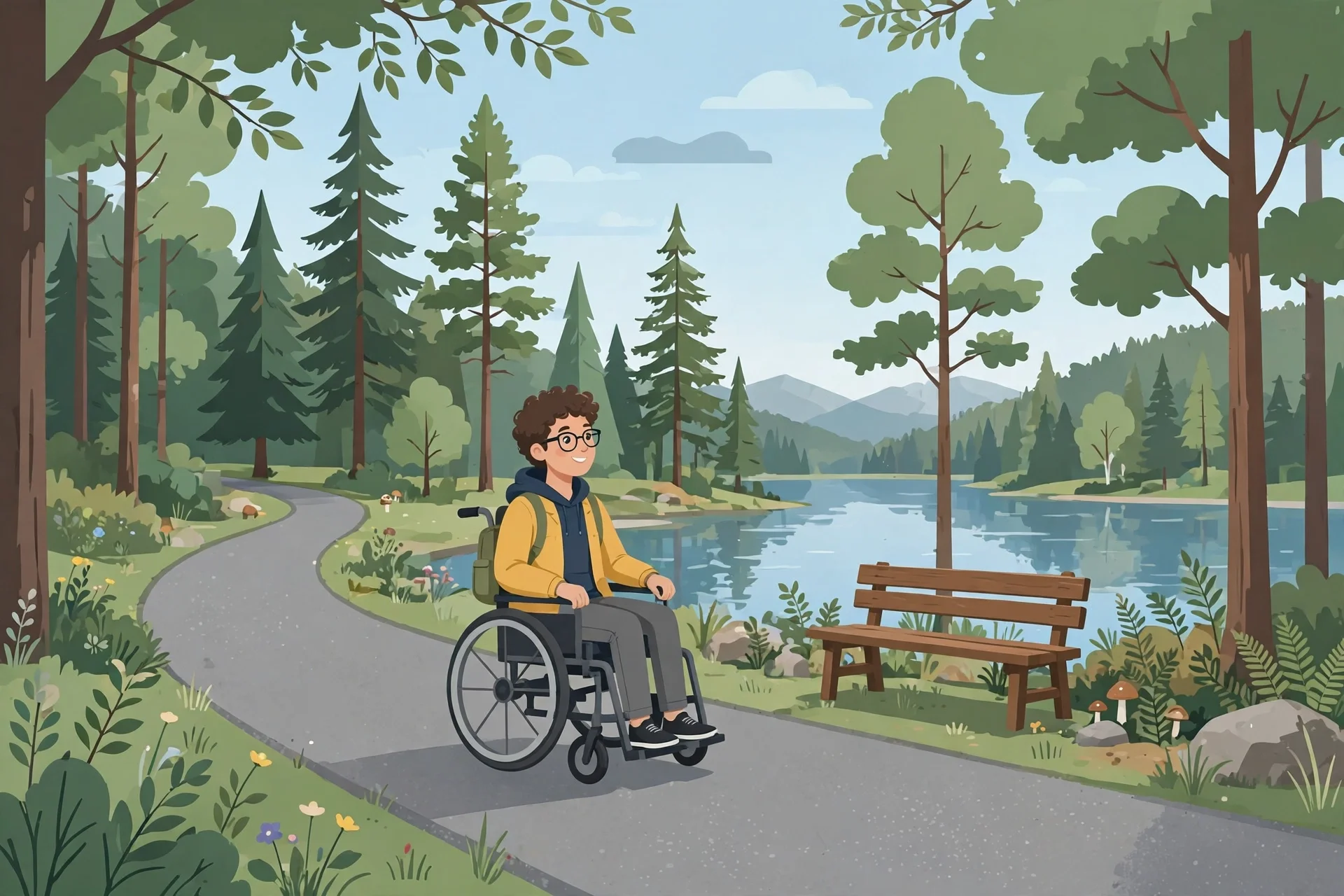
Forestry England publishes access information for individual forests, and it is worth reading before the main visitor page. For Mallards Pike in the Forest of Dean, the access page records six accessible parking bays, a surfaced path from the car park to the cafe and trails, and a lakeside path that is fully surfaced and suitable for wheelchairs and pushchairs, with benches to rest and enjoy the view. It also notes there is no public transport to the site and no sheltered seats along the trails, which matters on a wet or hot day. The same habit applies everywhere: look for parking, surface, gradient, seating, shelter and toilets, and treat a page that gives none of these details as unconfirmed.
What makes a trail genuinely wheelchair-friendly
Surface comes first. A firm, surfaced path that stays usable after rain is very different from a grass or gravel track that is fine in summer and heavy going in winter. Next comes gradient and width: a short steep section can end an otherwise easy route, and a narrow gate or bridge can block a wider chair. Then distance and rest points: a 2 kilometre surfaced loop with benches is more useful than a 5 kilometre route with nowhere to stop. Finally, check the start and finish: accessible parking near the trailhead, an accessible toilet, and a cafe or shelter nearby turn a route from possible into enjoyable. If any of these are missing, decide whether the gap matters for you, and plan around it.
Hiring wheels for rougher ground
Some forest sites offer all-terrain mobility scooter hire, which opens up trails that a manual or standard power chair would struggle with. At Beechenhurst in the Forest of Dean, for example, visitors with limited mobility can hire an all-terrain mobility scooter, and the site also has a Changing Places toilet and blue badge parking. Hire usually needs advance booking, and you may need to show that you can control the vehicle safely. Ask about the hire terms, the range of the vehicle, and which trails it is allowed on. If you bring your own chair, ask whether the site has a charging point for a power chair, and carry a basic repair kit for punctures on forest tracks.
A pre-visit checklist you can reuse
Before any forest visit, confirm five things: how you will get there, where you will park, what the surface is like, where you can rest and shelter, and where the nearest accessible toilet is. Check the weather the day before, because a surfaced path can still be slippery with wet leaves. Tell someone your route and expected return time if you are heading into a larger forest. Pack water, a phone charger, and a layer for wind, since woodland shade and open viewpoints can feel very different. And if you find a trail that works well, leave a review or tell the site team, because good access information depends on visitors sharing what they actually found.