Skip to content
HomeGuidesdays out
Guides / DAYS OUT

Wheelchair-Accessible Playgrounds: What Inclusive Play Equipment Really Means

An inclusive playground is not one with a wheelchair symbol at the gate. It is one where a wheelchair user can actually play alongside other children: flush roundabouts you can roll onto, swings with harness seats, low-level play panels, and surfacing firm enough to cross. Councils publish the details unevenly, so this guide shows how to read their equipment lists, and which five checks matter before a family trip.

Wheelchair-Accessible Playgrounds: What Inclusive Play Equipment Really Means

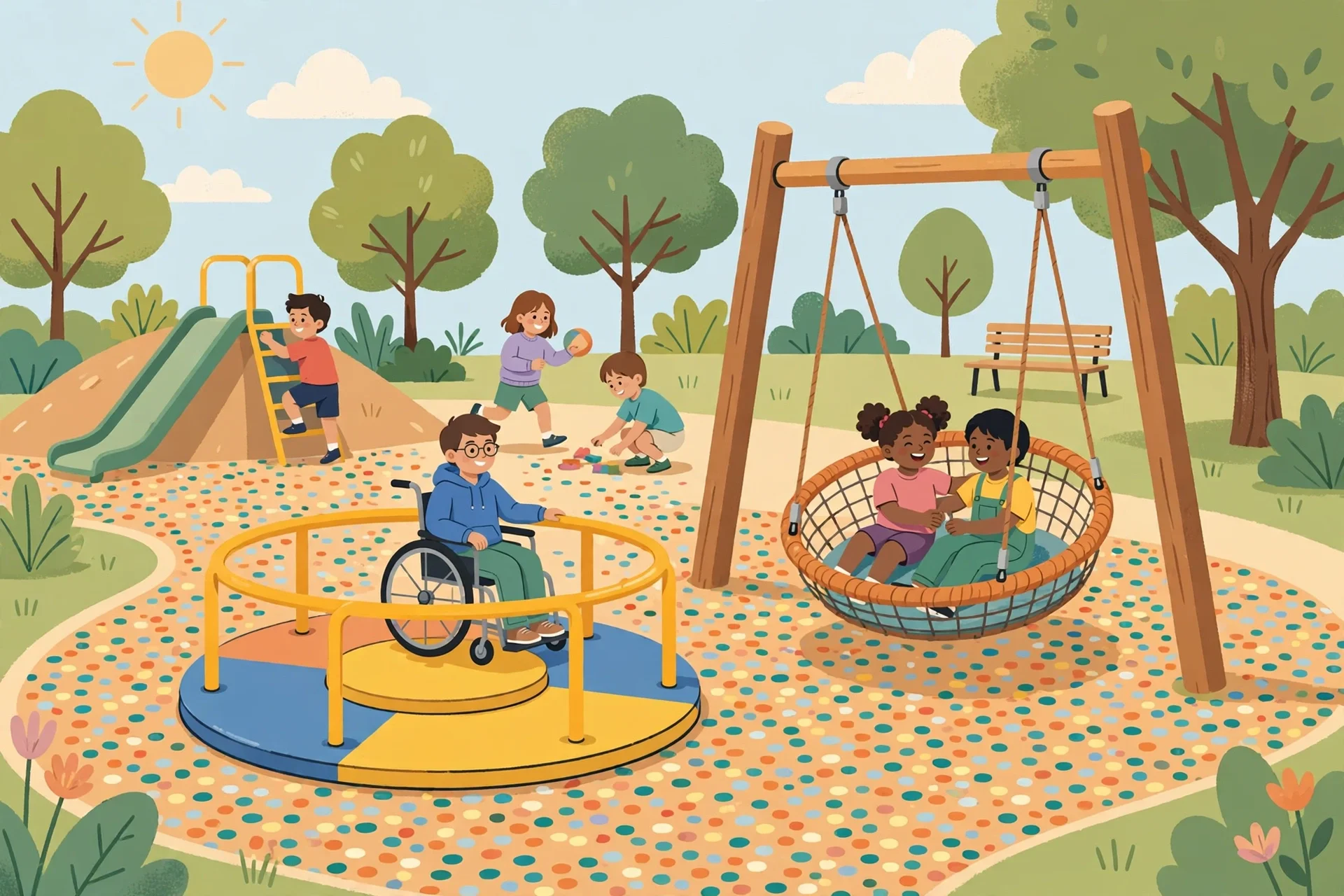
Illustration of an inclusive playground with a wheelchair-accessible roundabout flush with the ground, a basket swing and wet-pour rubber surfacing.

Council equipment lists change as playgrounds are refurbished; treat any list as a starting point and confirm surfacing and equipment with the council before travelling.

Accessible is not the same as inclusive

Telford & Wrekin Council's own equipment table makes the distinction visible. Some of its play areas are marked wheelchair accessible but have no accessible equipment at all, while others are fully accessible with wetpour surfacing plus a dish roundabout, basket swing or wide slide. Adur & Worthing Councils explain the design logic: roundabouts flush with the ground with a speed restrictor, swings with harness-type seats, see-saws wide enough for a carer and child at both ends with back support, low-level social play at the heart of the equipment rather than up a climb, and wet-pour rubber or Matta tile surfacing that wheelchairs and pushchairs can cross. A playground can pass the gate test and still fail the play test, so read the equipment column, not just the access label.

Five checks before you travel

First, surfacing: wetpour rubber, macadam or rubber mulch roll well, while bark, grass and grass matting stop most chairs, and Telford's table repeatedly marks areas not wheelchair accessible for exactly that reason. Second, gate width: Telford records a 1.2 metre accessible gate at its Marlebrook Way, Roden play area, which is a useful benchmark to ask other councils about. Third, equipment you can use without transferring: flush roundabouts, basket swings and ground-level panels. Fourth, toilets and parking near the play area, not just somewhere in the park. Fifth, whether the council's page was updated recently: Adur & Worthing's accessible play page was last updated on 9 October 2026, while other councils' lists go years without review. If a page looks stale, phone the council's parks team and ask what changed since it was written.

Ask the council before you complain about the gate

When a playground disappoints, the fix usually sits with the council's parks team, not the equipment maker. Ask which surfacing standard the area was built to, when it was last resurfaced, and whether the accessible equipment list on the website matches what is actually installed, since Telford's table itself shows areas where an accessible gate leads to bark surfacing that a wheelchair cannot cross. If a roundabout or swing is out of order, report the exact equipment and location, and ask for a repair date rather than a general assurance. Councils plan refurbishments in cycles, and a specific, dated report from a family that uses the playground carries more weight than a general complaint. If the council is planning a refurbishment, ask whether inclusive equipment is in the brief, and point to the Adur & Worthing approach: flush roundabouts, harness swings, wide see-saws and firm surfacing chosen together, not one token item added at the end.


Sources & further reading

Accessible play (Adur & Worthing Councils)Inclusive playgrounds for all ages and abilities (Telford & Wrekin Council)

Our editorial approach

CONTINUE EXPLORING

A little more useful reading.

Wheelchair-Accessible Pantomimes: Booking the Seats That Actually WorkGUIDES

Wheelchair-Accessible Pantomimes: Booking the Seats That Actually Work

Pantomime season runs from late November into January, and the best wheelchair spaces go early - in one small theatre, fire regulations allow a maximum of two wheelchair users per performance. Booking the right seat is therefore a different task from booking any seat: you need to know how many wheelchair spaces exist, whether they must be booked by phone, and whether a relaxed performance would suit your party better. This guide uses two theatres' published arrangements to show what to check before you pay.

Read the guide
Lake District Miles Without Stiles: Wheelchair-Friendly Routes and How to ChooseGUIDES

Lake District Miles Without Stiles: Wheelchair-Friendly Routes and How to Choose

The Lake District has more than 50 Miles without Stiles routes: graded, stile-free walks along lakeshores, riversides, tarns and through woods that are designed for wheelchair users, mobility scooter users, families with pushchairs, and anyone who wants an easier walk with no scrambling, climbing or steep hills. Five new routes have just joined the network after a £167,300 grant from Defra's Access for All scheme. This guide explains the new routes, how the grading works, and which walks to start with.

Read the guide
Remembrance Sunday in a Wheelchair: The Cenotaph and Local ServicesGUIDES

Remembrance Sunday in a Wheelchair: The Cenotaph and Local Services

On Sunday 8 November 2026 the National Service of Remembrance takes place at the Cenotaph on Whitehall, London, starting at 11am. You do not need a ticket: the public watches from the pavements, and a dedicated enclosure on Parliament Street is set aside for wheelchair users and others who find the general viewing areas difficult, on a first-come, first-served basis with one carer or guest each. This guide covers the London arrangements and what local services do differently, so you can choose the option that works for you.

Read the guide